模型风险

Search documents
如何加强证券公司融资类业务风险管理
Guo Ji Jin Rong Bao· 2026-01-12 14:41
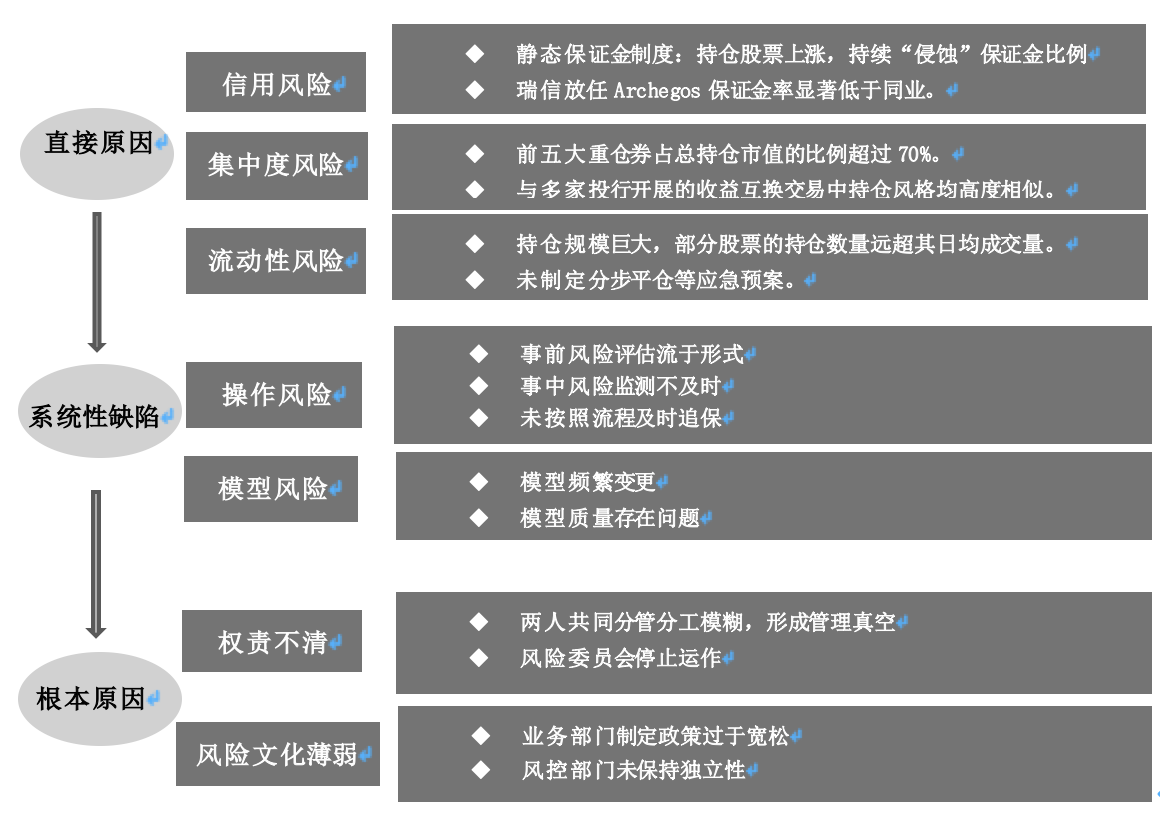
Core Viewpoint - The financing business is a crucial revenue source for securities firms, with the recent surge in A-share margin trading exceeding historical peaks, highlighting the importance of risk management in this area [1][10]. Group 1: Archegos Incident Overview - Archegos Capital Management, previously known as Tiger Asia, transformed into a family office after facing regulatory penalties and engaged in high-leverage transactions with Credit Suisse [3]. - The firm significantly reduced its initial margin requirements from 20% to 7.5%, leading to a dramatic increase in its exposure, with nominal principal rising to over $20 billion by the end of 2020 [3][4]. - The collapse of Archegos was triggered by a stock price drop of its major holdings, leading to a $5.5 billion loss for Credit Suisse due to inadequate risk management practices [4]. Group 2: Risk Factors Identified - Credit risk was exacerbated by a static margin system, with Archegos's average margin dropping to 5.9% compared to industry standards of 15% [5]. - Concentration risk was evident as over 70% of Archegos's holdings were in five stocks, leading to significant volatility and risk transmission across multiple institutions [5]. - Liquidity risk arose from Archegos holding positions exceeding daily trading volumes, complicating the liquidation process and increasing losses [6]. - Operational risk was highlighted by inadequate monitoring and assessment of Archegos's creditworthiness and risk exposure [6]. - Model risk was identified due to frequent changes in risk calculation models, leading to unreliable outputs and delayed responses to emerging risks [6]. - Ambiguity in responsibilities within Credit Suisse's management structure contributed to the lack of oversight and accountability [7]. - A weak risk culture prioritized short-term gains over risk management, leading to poor decision-making and risk mitigation strategies [7]. Group 3: Current Challenges in Financing Business - The margin trading balance in the A-share market has reached 2.34 trillion yuan, surpassing previous highs, indicating a shift in client structure towards institutional investors, particularly quantitative hedge funds [10][14]. - Increased market volatility due to geopolitical tensions and unexpected events has raised the risk of client defaults and forced liquidations [15]. - The expansion of financing targets to include a wider range of assets has introduced additional complexities and risks in collateral valuation [16]. - Risk transmission has intensified, with potential cascading effects from individual client liquidations impacting broader market stability [17]. Group 4: Recommendations for Risk Management - Securities firms should enhance risk governance by fostering a strong risk culture and integrating risk considerations into strategic decision-making [21]. - Establishing a dedicated financing business committee can help balance business growth with risk management, ensuring timely adjustments to risk policies [21]. - Improving collaboration between business and risk management teams is essential for effective risk monitoring and response [22]. - Developing a comprehensive risk view that consolidates client data across different business lines can help identify and mitigate risks more effectively [23]. - Implementing dynamic monitoring of concentration risks and adjusting control measures based on market conditions is crucial [24]. - Firms should adopt counter-cyclical adjustments to manage risks associated with market fluctuations [25]. - Enhancing risk measurement and testing through robust models and stress scenarios can improve preparedness for extreme market conditions [26][27]. - Establishing clear risk response plans and differentiated strategies for asset liquidation can enhance efficiency in crisis situations [29][30].

喝点VC|红杉美国对话千亿市值网安CEO:AI有机会彻底改变安全行业;数据泄露的问题不在于阻止了什么,而在于放进来了什么
Z Potentials· 2025-03-03 02:22
AI Development Discussion: Model Risks and Application Prospects - The past 12 months have been phenomenal in AI development, with attempts to build effective models that can remember, process, and recognize patterns [3][4] - Concerns arise regarding the costs of building these models and how to effectively utilize them, especially when they are given too much autonomy [4][5] - The emergence of low-cost models has created opportunities for startups, indicating a significant shift in the industry where building impressive models may not require substantial investment [5][6] Security Responsibilities and Threat Analysis - AI can enhance daily work for employees, but there are concerns about proprietary data being input into models, leading to potential copyright infringements and data theft [9][10] - Companies are interested in using AI in a controlled manner to prevent employees from using AI models or applications without oversight [10][11] - The risk of models being hijacked or manipulated is a significant concern for customers, necessitating the development of effective AI firewalls to monitor and protect model interactions [11][12] AI's Role in Security Transformation - AI has the potential to revolutionize the security industry by enabling real-time data analysis and anomaly detection, moving beyond traditional preventive measures [24][25] - The need for extensive data ingestion and pattern recognition is crucial for identifying security threats, as traditional methods may not suffice against novel attacks [25][26] - Security teams will need to adapt to allow AI to operate with more autonomy while ensuring adequate protective measures are in place [30][31] Company Innovation and Agility - The company rates its agility at 7 to 7.5 out of 10, acknowledging the complexity and responsibility of ensuring that innovations do not disrupt existing customer infrastructures [31][32] - The company embraces innovation by collaborating with successful external teams and integrating their solutions, while also focusing on internal development [33][34] - Continuous evaluation of market capabilities and customer needs is essential for maintaining agility and responsiveness in a rapidly evolving industry [34][35]