民营经济促进法立法

Search documents
★2025年度立法工作计划敲定 金融稳定法在列
Zheng Quan Shi Bao· 2025-07-03 01:56
Legislative Developments - The National People's Congress (NPC) Standing Committee has scheduled 14 legal proposals for continued review and 23 for initial review in 2025, including the Private Economy Promotion Law and Financial Law [1] - The Private Economy Promotion Law is expected to advance with a third draft review scheduled for April 27-30, aiming to enhance the legal environment for the healthy and high-quality development of the private economy [1] - The Financial Law and Financial Stability Law are also under scrutiny, with the People's Bank of China advocating for their expedited introduction to strengthen financial risk management [2] Financial Regulatory Framework - The current financial legal framework in China is characterized by fragmentation and lacks a comprehensive foundational law to unify and coordinate various financial regulations [2] - International experience suggests that many developed economies have achieved regulatory unity through foundational financial legislation, which China is encouraged to consider [2] - The People's Bank of China Law, established in 1995, has not undergone significant revision since 2003, indicating a need for updates to address existing gaps in monetary policy and financial stability [3]
代表委员建言加强民企司法保护: 从源头治理涉企执法乱象 让企业轻装上阵安心经营
Zheng Quan Shi Bao Wang· 2025-03-07 23:43
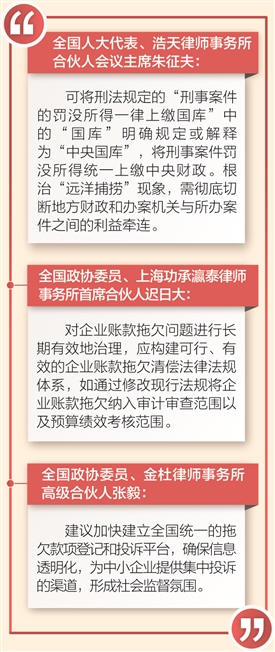
Core Viewpoint - The Chinese government is focusing on improving the legal environment for private enterprises, emphasizing the need to address issues related to overdue payments and the phenomenon of profit-driven law enforcement during the National People's Congress this year [1][2]. Group 1: Legal Framework and Enforcement - The introduction of the "Fair Competition Review Regulations" and the acceleration of the legislation process for the Private Economy Promotion Law are key developments in enhancing legal protections for private enterprises [1]. - The Supreme People's Procuratorate has identified profit-driven law enforcement as a significant issue that undermines the business environment and judicial credibility, with ongoing efforts to establish institutional safeguards against such practices [2][3]. - Recommendations include refining criminal procedural regulations, improving oversight mechanisms, and establishing accountability and compensation systems to address profit-driven law enforcement [2][3]. Group 2: Addressing Overdue Payments - The government aims to stimulate the vitality of various business entities by effectively addressing overdue payments owed to enterprises, which is seen as a critical factor for economic growth [4]. - A long-term regulatory mechanism is necessary to tackle the issue of overdue payments, with suggestions for a legal framework that includes auditing and performance evaluation [4][5]. - The establishment of a national platform for overdue payment registration and complaints is recommended to enhance transparency and provide a channel for small and medium-sized enterprises [5]. Group 3: Supporting Private Enterprises - Private enterprises are recognized as vital players in technological innovation, but they often face legal ambiguities that hinder their business operations [6]. - The judicial reforms outlined in the "Sixth Five-Year Reform Outline (2024-2028)" aim to clarify the legal boundaries for business activities and enhance the protection of entrepreneurs' rights [6][7]. - Emphasis is placed on the principle of "law without prohibition is permissible," encouraging private enterprises to innovate without fear of legal repercussions [6][7].