
水下机器人技术

Search documents
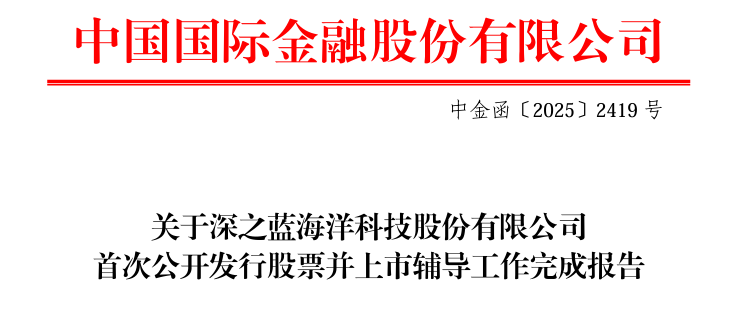
历时两年 水下机器人厂商深之蓝完成IPO辅导 拟冲击科创板
Xin Lang Cai Jing· 2025-12-15 09:17
Group 1: Company Overview - Deep Blue Ocean Technology Co., Ltd. (referred to as "Deep Blue") is known as the "Underwater DJI" and has recently changed its IPO guidance status to acceptance, with China International Capital Corporation (CICC) as the advisory institution [1] - Founded in 2013, Deep Blue specializes in the research, production, and sales of underwater intelligent equipment, focusing on both industrial and consumer markets [2] - The company has developed a range of underwater robots, including remotely operated vehicles (ROVs), autonomous underwater vehicles (AUVs), and underwater gliders (AUGs), serving various sectors such as marine scientific research, marine engineering, and emergency rescue [2][3] Group 2: Market Position and Technology - Deep Blue's consumer brand, Sublue, was established in 2016 and has captured nearly 65% of the global market share in underwater propulsion devices, delivering over 200,000 underwater technology products across more than 80 countries [2] - The company has approximately 200 R&D personnel and has made significant advancements in underwater robotics technology, holding over 400 patents, including more than 120 invention patents [3] - The global underwater robotics market is projected to grow from $9.4 billion in 2024 to over $60 billion by 2030, with China's market expected to increase from $1.4 billion to $14 billion during the same period [3] Group 3: Financial and Investment Background - Deep Blue has completed 10 rounds of financing since its inception, raising over 1.3 billion yuan, with the latest round in May 2023 amounting to 550 million yuan, backed by China Agricultural Bank [4] - The company's investors include various state-owned capital and private equity firms, with the largest shareholder being the founder, Wei Jiancang, who holds 23.64% of the shares [4][5] - The company has a diverse shareholder structure with 43 shareholders and no controlling shareholder, indicating a broad base of investment support [4]


中科院沈阳自动化研究所水下机器人研究室党总支:向海洋最深处进发
Ren Min Ri Bao· 2025-08-28 01:47
Core Insights - The "Haidou-1" submersible has embarked on a scientific mission in the South China Sea, showcasing advancements in underwater robotics technology [1] - The underwater robotics research team has a history of overcoming challenges and achieving significant milestones in deep-sea exploration [2] - The team emphasizes the importance of party organization and leadership in driving the success of underwater robotics projects [3] Group 1: Technological Advancements - "Haidou-1" has made significant progress from experimental applications to widespread use, enhancing compatibility and autonomous operation capabilities [1] - The submersible has achieved record-breaking depths, including a successful dive to over 10,000 meters, marking a milestone for China's unmanned submersibles [2] Group 2: Team Dynamics and Commitment - The underwater robotics research team consists of 127 members, with 71 being party members, highlighting the role of party organization in the team's achievements [3] - Team members have demonstrated exceptional dedication, often sacrificing personal time and enduring harsh conditions to complete missions [2][3]
向海洋最深处进发
Ren Min Ri Bao· 2025-08-26 00:39
Core Viewpoint - The article highlights the advancements and achievements of China's underwater robotics, particularly focusing on the "Haidou" series of submersibles, emphasizing their contributions to scientific exploration and data collection in deep-sea environments [1][2][3]. Group 1: Technological Advancements - The "Haidou 1" submersible has made significant progress from experimental applications to widespread use, overcoming key technical challenges such as multi-vessel compatibility and autonomous operations, greatly enhancing its versatility [1]. - The underwater robotics research team has successfully achieved record-breaking depths with the "Haidou" submersible series, including the first successful descent beyond 10,000 meters, which provided valuable temperature, salinity, and depth data from the ocean's depths [2]. Group 2: Team and Organizational Structure - The underwater robotics research team consists of 127 members, with 71 being party members, showcasing the strong organizational structure and commitment to the mission of advancing underwater robotics in China [3]. - The article emphasizes the dedication of team members, many of whom have sacrificed personal opportunities and time with family to contribute to the success of underwater missions, reflecting a strong sense of duty and teamwork [2][3]. Group 3: Future Aspirations - The team aims to continue pushing the boundaries of underwater exploration, with a commitment to placing the party flag in the deepest parts of the ocean, symbolizing their dedication to national and scientific goals [3].
向海洋最深处进发(党旗在基层一线高高飘扬)
Ren Min Ri Bao· 2025-08-25 22:27
Core Viewpoint - The "Haidou-1" submersible is embarking on a scientific mission in the South China Sea, showcasing advancements in underwater robotics technology and the commitment of the research team to contribute valuable scientific data [1]. Group 1: Technological Advancements - The "Haidou-1" has achieved significant breakthroughs in key technologies such as multi-vessel compatibility and autonomous operations, greatly enhancing its versatility [1]. - The research team has successfully transitioned from experimental applications to broader operational capabilities, with the "Haidou" series setting records for maximum diving depths [2]. Group 2: Team Commitment and Achievements - The underwater robotics research team, consisting of 127 members with 71 party members, has demonstrated unwavering dedication, often sacrificing personal opportunities for the advancement of underwater robotics [3]. - The team has successfully completed multiple deep-sea missions, including the first successful dive beyond 10,000 meters, which provided critical temperature, salinity, and depth data from the ocean's depths [2]. Group 3: Organizational Support - The establishment of temporary party groups on research vessels has been a tradition, emphasizing the importance of organizational support in overcoming challenges during missions [1]. - The leadership within the team has played a crucial role in decision-making during critical moments, ensuring that the team can take bold actions backed by organizational trust [1].
中国科学院沈阳自动化研究所水下机器人研究室党总支—— 向海洋最深处进发(党旗在基层一线高高飘扬)
Ren Min Ri Bao· 2025-08-25 21:54
Core Viewpoint - The "Haidou No. 1" submersible is embarking on a scientific mission in the South China Sea, showcasing advancements in underwater robotics technology and the commitment of the research team to contribute valuable scientific data [1][2]. Group 1: Technological Advancements - "Haidou No. 1" has achieved significant breakthroughs in key technologies such as multi-vessel compatibility and autonomous operations, greatly enhancing its versatility [1]. - The underwater robotics research team has successfully transitioned from experimental applications to broader operational capabilities, with "Haidou" and "Haidou No. 1" being pivotal in this evolution [1][2]. Group 2: Team Commitment and Achievements - The team has a strong tradition of establishing temporary party groups on research vessels, emphasizing the importance of organizational support in overcoming challenges [1]. - The successful deep-sea missions have set new records for China's unmanned submersibles, with "Haidou" achieving depths of over 10,000 meters and collecting critical temperature, salinity, and depth data [2]. - The dedication of team members is highlighted, with many sacrificing personal opportunities and spending significant time at sea to ensure mission success [2][3]. Group 3: Organizational Structure and Impact - The underwater robotics research team consists of 127 members, with 71 being party members, showcasing the influence of party organization in driving technological advancements [3]. - The leadership emphasizes the role of party members in critical positions, ensuring that the team remains resilient and effective in challenging environments [2][3].