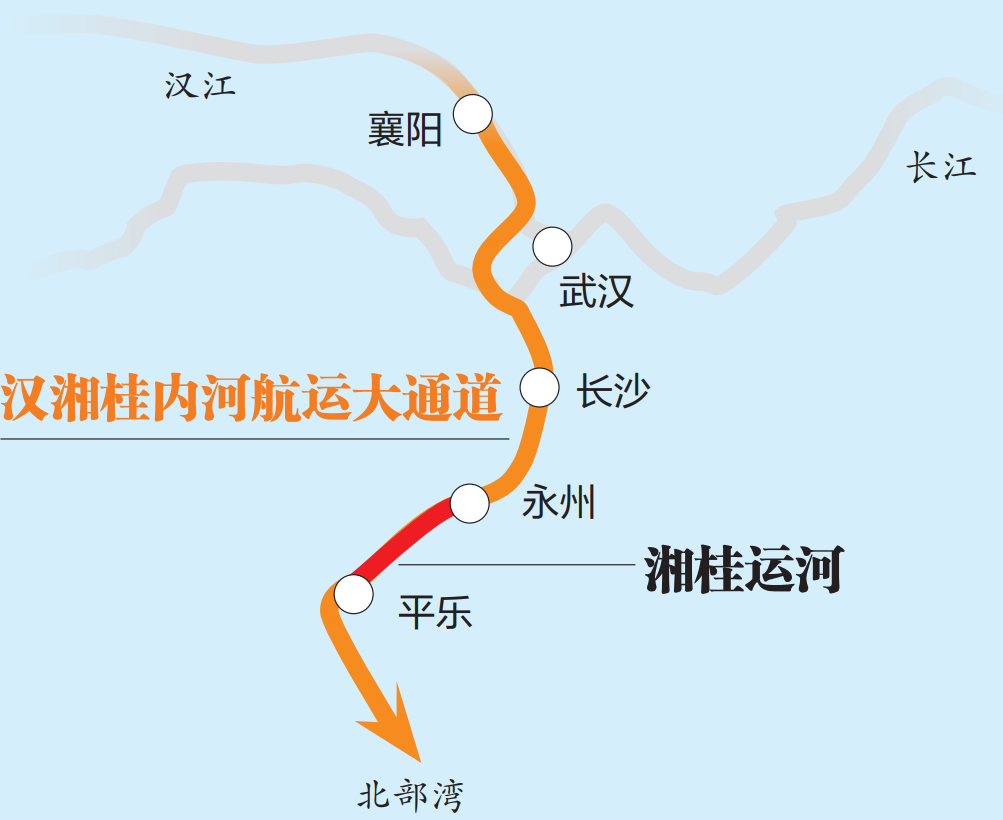
水运双出海格局

Search documents
武汉将形成水运双出海格局
Chang Jiang Ri Bao· 2026-02-24 00:38
Core Viewpoint - The completion of the TJ-01 contract section of the Hanjiang Xinglong to Caidian 2000-ton navigation channel project marks a significant enhancement in the navigation capacity of the Hanjiang River, facilitating a new era of dual maritime access for Wuhan and Hubei, breaking the long-standing reliance on the Yangtze River for shipping [1][3]. Group 1: Importance of the Navigation Channel - The Hanxianggui inland waterway transport corridor is a national-level channel that runs north-south, connecting various regions and significantly improving logistics efficiency [3]. - Wuhan is positioned as a critical node in this corridor, which has historically faced challenges due to insufficient water depth and numerous shoals, limiting the passage of large vessels [3][4]. - The TJ-01 section, located in Wuhan and Hanchuan, has undergone significant improvements, enhancing navigation capacity and allowing for larger vessels to pass without grounding [3][4]. Group 2: Economic Benefits - The new channel is expected to reduce transportation costs by 15% to 20% for bulk commodities, allowing goods from inland areas to reach the sea more efficiently [5]. - Water transport is inherently more cost-effective, with average freight costs per ton-kilometer being approximately one-fourth of rail and one-fifteenth of road transport [4][5]. - The completion of the channel will enable direct shipping routes to the Beibu Gulf, significantly cutting down on logistics costs and time for goods from southern Shaanxi and Xiangyang [5]. Group 3: Strategic Implications for Wuhan - The new corridor will elevate Wuhan's status from a single maritime outlet to a dual outlet, enhancing its role as a logistics hub connecting inland regions to both the Yangtze River and the Beibu Gulf [6]. - The city is implementing supportive policies to boost the modern shipping service industry, including financial incentives and new shipping routes [6]. - Projections indicate that by 2025, Wuhan's port container throughput will reach 1.95 million TEUs, solidifying its position as a leading logistics center in the upper and middle reaches of the Yangtze River [6].