汇率透明度

Search documents
亚洲官方储备逼近8万亿美元! 强美元或遭遇一场弹药充足的货币保卫战
智通财经网· 2025-11-20 02:46
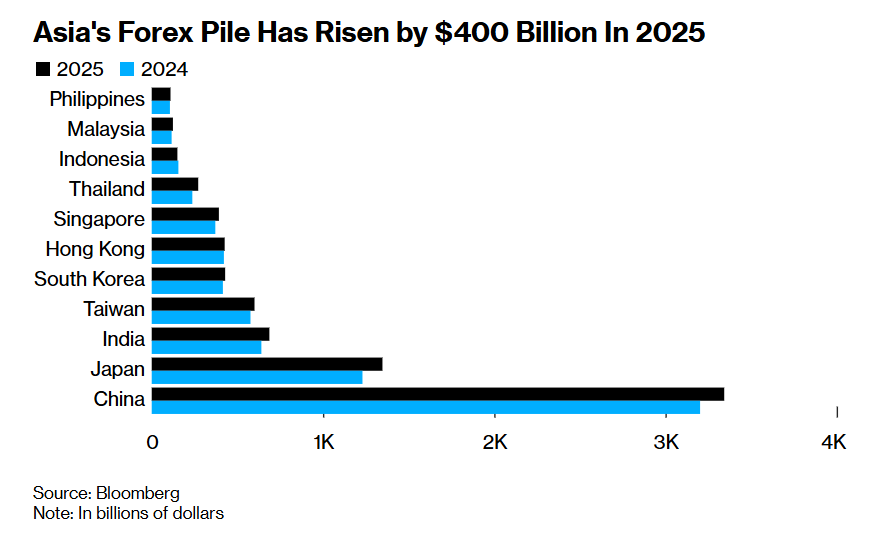
Core Viewpoint - The overall official reserves of Asian countries have surged to nearly $8 trillion, providing substantial "ammunition" for currency and fiscal authorities to defend their currencies against potential depreciation [1][4]. Group 1: Reserve Accumulation - Asian central banks have added over $400 billion to their official reserve assets this year, with the largest contributors being China and Japan, which increased their reserves by approximately $141 billion and $116 billion, respectively [4][5]. - The increase in reserves is attributed to the depreciation of the dollar and rising gold prices, which have boosted the valuation of non-dollar assets [4][5]. Group 2: Currency Interventions - The Indian rupee and Philippine peso have reached historical lows, while the South Korean won is near its weakest level in 16 years, prompting expectations of currency interventions by Asian central banks [4][6]. - The Indian central bank has actively intervened in both onshore and offshore markets to prevent the rupee from falling below its historical low of 88.80 against the dollar [5][6]. Group 3: Market Dynamics and Risks - The recent rebound of the dollar since September has led to increased volatility in global stock markets, raising concerns among Asian central banks about the weakening of their currencies [4][10]. - There are potential risks of conflict with the U.S. government regarding currency interventions, as such actions could be viewed as unfair competitive advantages [7][10]. Group 4: Regulatory Environment - The U.S. Treasury has not labeled any country as a "currency manipulator" but has criticized some Asian nations for lacking transparency in their currency practices [10]. - Asian countries, including Japan, South Korea, Singapore, and Vietnam, are under close scrutiny regarding their currency behaviors, which could impact future trade agreements with the U.S. [10].