
沉睡账户

Search documents
你的钱包里,是否也藏着一张“沉睡”的银行卡?
Jing Ji Guan Cha Bao· 2025-10-20 09:41
Core Viewpoint - The article discusses the ongoing cleanup of "sleeping accounts" by commercial banks in China, highlighting the challenges faced by account holders and the implications for the banking system [1][2][3]. Group 1: Definition and Scope of "Sleeping Accounts" - "Sleeping accounts" are defined as personal bank accounts that have not had any active transactions for five years or more and still have a balance [2]. - The criteria for identifying these accounts are becoming stricter, focusing on accounts with a balance below 10 RMB and no transactions for over three years [2][3]. Group 2: Impact on Account Holders - Many account holders are unaware of the restrictions on their accounts until they attempt to use them, leading to frustration and inconvenience [1][3]. - Current banking practices require account holders to visit physical bank branches for account activation or deactivation, which contrasts with the public's expectations for digital services [3][6]. Group 3: Financial Crime and Operational Efficiency - The cleanup initiative is partly driven by the rising risk of financial crimes, with approximately 30% of fraud cases linked to long-dormant accounts [3][4]. - Maintaining inactive accounts incurs hidden operational costs for banks, prompting a need to streamline resources and focus on active customers [4]. Group 4: Recommendations for Account Holders - Banks advise account holders to manage their accounts proactively, including closing redundant accounts and making small deposits to keep accounts active [5]. - The introduction of tools like the "One-Click Card Check" feature in the UnionPay app allows users to monitor their accounts conveniently [5]. Group 5: Future of Banking Services - The article emphasizes the need for banks to enhance their digital services, particularly in account management, to improve customer experience and trust [6]. - The balance between financial security and customer convenience remains a critical challenge for the banking sector moving forward [6].

银行将清理“沉睡账户”,银行卡里的钱会被没收吗?一文解惑
Yang Shi Xin Wen Ke Hu Duan· 2025-10-20 00:55
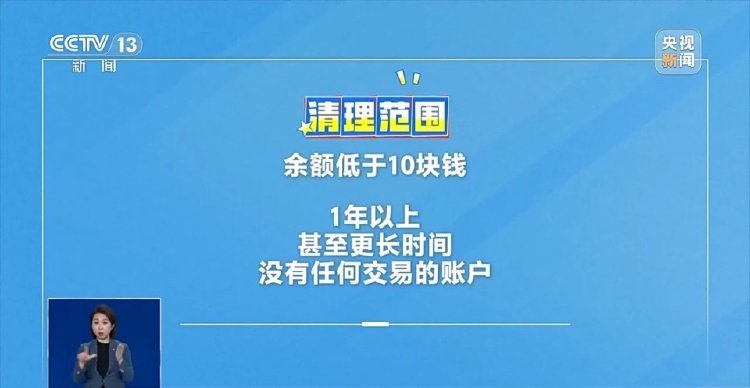
Core Viewpoint - Banks are initiating a cleanup of "sleeping accounts," which are defined as long-term inactive accounts, raising concerns among account holders about the status of their funds and the implications of this action [2][19]. Summary by Sections Definition of "Sleeping Accounts" - "Sleeping accounts" refer to personal or corporate accounts that have been inactive for an extended period, typically characterized by "long-term no active transactions" and "low balance" [5][6]. - Most banks define these accounts as having a balance below 10 RMB and being inactive for over a year, although some may only clear accounts with zero balance [5][8]. Differentiation Among Banks - Different banks have varying criteria for identifying "sleeping accounts." For instance, one bank may require a balance below 10 RMB and three years of inactivity, while another may set the threshold at 50 RMB and two years [8][10][14]. - Corporate accounts also have stricter criteria, with a six-month inactivity leading to restrictions and a year resulting in classification as a long-term inactive account [14]. Process of Account Cleanup - During the cleanup, banks will notify account holders via SMS or mobile banking alerts. To retain their accounts, customers must conduct at least one active transaction before the cleanup process begins [18]. - If an account is closed due to inactivity, the funds remain the property of the account holder and can be reclaimed from the bank [18][19]. Rationale Behind the Cleanup - The cleanup initiative is part of a broader effort by the National Financial Regulatory Administration to manage "sleeping accounts," with many banks participating in this action over the past two years [19]. - The cleanup serves three main purposes: to awaken idle funds for better utilization, to reduce unnecessary resource occupation by inactive accounts, and to mitigate potential risks associated with long-term inactive accounts, such as fraud [21]. Recommendations for Account Holders - Experts suggest that account holders should regularly check their accounts, close unnecessary ones, and ensure that active accounts have minimal transactions to avoid being classified as "sleeping accounts" [23].

银行将清理“沉睡账户”,卡里的钱怎么办?一文解惑
Yang Shi Xin Wen Ke Hu Duan· 2025-10-19 23:15
Core Viewpoint - Banks are initiating the cleanup of "sleeping accounts," which are defined as long-term inactive accounts, raising concerns among account holders about their rights and the status of their funds [1][6]. Group 1: Definition and Criteria of "Sleeping Accounts" - "Sleeping accounts" refer to personal or corporate accounts that have been inactive for an extended period, typically characterized by "long-term inactivity" and "low balance" [2][3]. - Most banks define long-term inactive accounts as those with a balance below 10 RMB and no transactions for over a year, although some banks may only clear accounts with zero balance [2][3]. Group 2: Variations in Bank Standards - Different banks have varying criteria for identifying long-term inactive accounts. For example, one bank may require a balance below 10 RMB and no transactions for three years, while another may have a threshold of 50 RMB and two years of inactivity [3][4]. - Certain accounts, such as social security and retirement accounts, are exempt from this cleanup process [3][4]. Group 3: Account Holder Rights and Notifications - During the cleanup process, banks will notify account holders via SMS or mobile banking alerts. To retain their accounts, holders must conduct at least one transaction before the cleanup [5][6]. - Even if an account is closed due to inactivity, account holders can reclaim any remaining funds [5][6]. Group 4: Reasons for Cleanup - The cleanup of long-term inactive accounts is part of a broader initiative by the National Financial Regulatory Administration to enhance financial consumer awareness and improve fund utilization efficiency [6]. - The cleanup aims to reduce the ineffective use of banking resources and mitigate potential risks associated with dormant accounts, such as fraud [6]. Group 5: Recommendations for Account Holders - Experts recommend that account holders regularly check their accounts, close unnecessary ones, and maintain minimal activity to avoid their accounts becoming inactive [7]. - It is advised to avoid using personal accounts for business purposes to prevent complications [7].