油机协同

Search documents
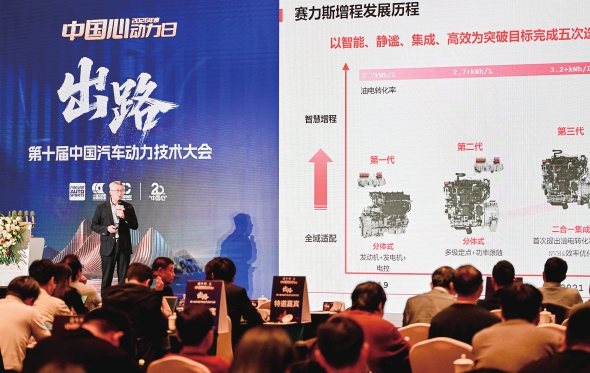
问道汽车动力技术创新 ——第十届中国汽车动力技术大会掠影
Zhong Guo Qi Che Bao Wang· 2026-02-02 09:09
Group 1 - The core viewpoint of the article highlights that the Chinese automotive market is entering a new normal of micro-growth, with total vehicle production and sales expected to reach 34.75 million units by 2026, reflecting only a 1% year-on-year increase, while the growth rate for passenger vehicles is projected to narrow to 0.5% [2] - The new energy vehicle (NEV) sector is anticipated to achieve sales of 19 million units, representing a 15.2% year-on-year growth, although this marks a slowdown compared to the previous year's growth rates of 29% and 28.2% [2] - The industry faces a crossroads between breaking through growth bottlenecks and transitioning to a new growth rate, with a pressing need to address core technological challenges and competition in the power sector [2] Group 2 - The 10th China Automotive Power Technology Conference was held in Wuxi, Jiangsu, focusing on the theme of "outlet" and exploring paths for the automotive power industry amidst market changes and technological evolution [3] - The rise of large-displacement hybrid power systems is identified as a key feature of the power sector in 2025, with various automakers developing unique technical paths based on vehicle positioning and user scenarios [4] - Companies like Wuhu Aiketech and BYD are innovating in powertrain systems tailored for specific market segments, such as luxury off-road vehicles and high-end sports cars, showcasing the industry's shift towards scenario-defined power solutions [4][5] Group 3 - The automotive power technology in China has entered its fourth phase, shifting focus from scale expansion to technological innovation and product enhancement [6] - The integration of advanced power systems is crucial for Chinese brands to break into high-end international markets, with a focus on large-displacement powertrains [7] - New energy vehicle penetration is creating new technical challenges for the automotive parts industry, emphasizing the need for specialized fuels that meet the performance and efficiency demands of hybrid and extended-range power systems [9] Group 4 - The collaboration between vehicle manufacturers and parts suppliers is essential for building a self-controlled industrial chain and promoting low-carbon, efficient development [9] - The integration of intelligent manufacturing and software technology is seen as a core support for the automotive industry's transformation, with a focus on domestic alternatives for key materials [10] - The article concludes that the path forward for the Chinese automotive power industry involves precise technological choices, iterative core capabilities, and deep restructuring of the industrial ecosystem, aiming for high-quality development [10]