法律与秩序

Search documents
特朗普威胁派兵芝加哥,州长:既不欢迎也不需要你!
Jin Shi Shu Ju· 2025-08-26 02:37
Core Points - President Trump has indicated the possibility of deploying federal troops to Chicago to combat crime, framing many major cities as lawless and attributing the issues to Democratic leadership [2][5] - The Illinois Governor J.B. Pritzker has publicly rejected Trump's potential intervention, stating that Chicago does not welcome or need federal troops [2][5] - Trump has signed an executive order to establish a "rapid response force" within the National Guard, aimed at addressing public order issues [3][4] Group 1 - Trump's rhetoric positions Chicago as a "killing field," emphasizing the city's crime issues while claiming that federal intervention could eliminate crime within a week [2][5] - The Governor's response highlights a political standoff, with Pritzker standing alongside local officials to oppose Trump's plans [2][5] - The deployment of troops in Chicago raises questions about the legality and political implications, as the Posse Comitatus Act restricts federal military involvement in domestic law enforcement [5][7] Group 2 - Crime statistics indicate a decrease in murders (down 32%) and shootings (down 37%) in Chicago this year, challenging the narrative of an urgent crisis [5][6] - Trump has focused on cities governed by Democrats for troop deployment, despite higher murder rates in cities located in Republican states, suggesting a selective approach to addressing crime [6][7] - The role of the National Guard in Chicago remains unclear, with previous deployments primarily serving a visible presence rather than engaging in law enforcement [7][8]
北美观察丨华盛顿之后点名芝加哥和纽约 美政府盯上民主党主政的大城市
Yang Shi Xin Wen· 2025-08-24 07:05
Core Viewpoint - President Trump has indicated the possibility of declaring a national emergency and extending federal control in Washington D.C. for 30 days, while criticizing Chicago and New York as "chaotic" cities, which has sparked significant controversy in the U.S. [1][4] Political Considerations - Trump's rationale for federal intervention is framed as a response to crime and maintaining order, but analysts suggest it is primarily a political maneuver aimed at highlighting perceived failures of Democratic governance in major cities [5] - The President's potential declaration of a national emergency would allow him to bypass the 30-day limit imposed by the D.C. Home Rule Act, enabling broader federal authority without congressional approval [5] - By targeting cities governed by Democrats, Trump aims to amplify the narrative of "Democratic governance failure" and position himself as the candidate capable of restoring order [5] Public Reaction - A recent poll indicates that 79% of Washington D.C. residents oppose federal takeover of local police and deployment of the National Guard, viewing it as an infringement on local autonomy [9][16] - Chicago officials have criticized Trump's threats as uncoordinated and ineffective, with local leaders asserting that federal intervention is unnecessary and unwelcome [9][12] - Legal experts express concern that Trump's actions could violate the Posse Comitatus Act, potentially leading to a constitutional crisis if military forces are deployed for local law enforcement [12] Potential Outcomes - Analysts foresee three possible scenarios: escalating judicial confrontations as local governments challenge Trump's authority, increased local resistance leading to protests, and the continued use of the "law and order" narrative to galvanize support in upcoming elections [17] - Trump's threats may deepen political and social divisions in the U.S., with supporters framing it as a restoration of order while opponents label it as an abuse of power [19]

调兵“夺回”首都 特朗普为何这样做
Xin Hua Wang· 2025-08-12 14:17
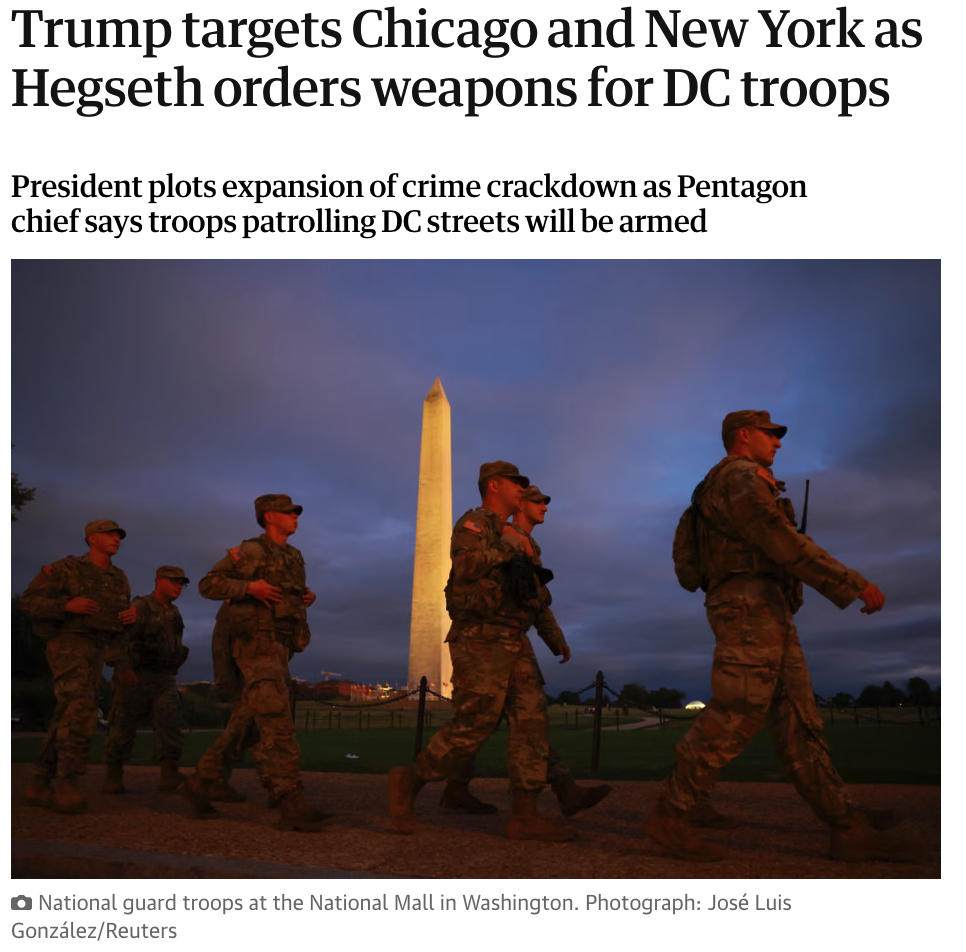
Core Points - President Trump ordered the deployment of the National Guard to Washington D.C. to address rising violent crime and homelessness issues, claiming it as a historic action to "liberate" the capital [1][3] - The measures include federal government takeover of the D.C. police department and clearing homeless encampments [1][3] - The immediate trigger for these actions was a violent incident involving a 19-year-old man in D.C. [3][4] Government Response - The deployment of the National Guard and federal control of the police faced strong opposition from D.C. Mayor Bowser and local citizens, who argued that the crime situation was exaggerated and that the measures would not effectively address crime [2][5] - Mayor Bowser described the federal takeover as "unprecedented" and an infringement on D.C.'s autonomy [5][7] - Local officials suggested that strengthening the judicial system would be a more effective solution to crime [7] Legal and Political Context - The National Guard in D.C. is directly controlled by the President, unlike state National Guards [6] - Trump's actions are legally permissible under the D.C. Home Rule Act, which allows federal intervention in emergencies [9] - However, further federal control over D.C. may face significant challenges, particularly in Congress, where Democrats could block such efforts [9] Future Developments - The duration of the National Guard's deployment and federal control of the police has not been specified, but it could last weeks or months [8] - Approximately 500 federal law enforcement personnel will also be deployed to assist in crime reduction efforts [8] - There are ongoing discussions among Democrats to push for D.C. statehood to enhance local governance and control over law enforcement [9]
抗议升级!美媒:特朗普表示不排除将现役海军陆战队派往加州
Huan Qiu Wang· 2025-06-09 01:47
Core Viewpoint - President Trump's decision to deploy the National Guard to Los Angeles in response to unrest related to illegal immigration has sparked significant backlash across the United States [1][3]. Group 1: Government Actions - Trump ordered the deployment of 2,000 California National Guard personnel to Los Angeles without a request from Governor Newsom [3][4]. - On August 8, 300 National Guard members were reported to have entered the Los Angeles area as per Trump's directive [3]. - Defense Secretary Esper warned of "unacceptable" violence against federal agencies and indicated that active-duty Marines could be mobilized if violence persists [1][3]. Group 2: Local Government Response - California Governor Newsom has publicly opposed Trump's decision, marking the first time since 1965 that a president has mobilized state National Guard without a governor's request [4]. - Los Angeles Mayor Garcetti criticized the federal government's actions, stating that deploying the National Guard would only exacerbate the chaos [4]. Group 3: Public Sentiment and Protests - Trump accused protesters of spitting on police and military personnel, asserting that such actions would be met with a strong response [3]. - The protests were triggered by large-scale enforcement actions by federal agencies against illegal immigrants, leading to serious clashes with local communities [3].