流感概念股

Search documents
流感高发季催生用药需求,抗病毒药物供应链及投资机会梳理
Di Yi Cai Jing· 2025-11-27 01:04
Core Viewpoint - The flu season in China has begun, leading to an increase in demand for antiviral medications, which has positively impacted the stock prices of flu-related companies [1] Group 1: Market Overview - The flu activity level has significantly risen, with historical data indicating that the flu season typically starts in October to November, peaking around late December to early January [1] - E-commerce platforms report an increase in sales of antiviral medications for flu, reflecting heightened consumer demand [1] Group 2: Key Players and Supply Chain - Dongyang Sunshine Pharmaceutical holds a significant market share in the supply of Oseltamivir, a neuraminidase inhibitor, and has established a robust supply chain to ensure stable drug availability during peak flu seasons [2] - The company has comprehensive coverage across hospitals, chain pharmacies, and online platforms, maintaining sufficient inventory to meet market demands [2] Group 3: Antiviral Drug Developments - In the RNA polymerase inhibitor category, Marbofloxacin has gained traction due to its convenience as a single oral dose, marketed as "Xufuda" by Roche [3] - Roche has initiated local production of Xufuda in Shanghai to shorten supply chain times and enhance responsiveness to market needs [4] Group 4: Supply Assurance and New Entries - Roche has increased the supply of Xufuda to over three times that of the previous year, with contingency plans in place to respond quickly to sudden surges in flu cases [5] - Three new RNA polymerase inhibitors have been launched by domestic companies, including Qingfeng Pharmaceutical's Mabulosavir, which is similar to Roche's Xufuda, and is currently approved for adult treatment [5][6] - Zhongsheng Pharmaceutical's Angladiwe has been recognized as the world's first PB2 protein inhibitor for treating influenza A in adults, with a stable supply chain established for its distribution [6]


流感高峰期或在下个月!三款流感新药上市
Di Yi Cai Jing· 2025-11-26 06:00
Core Viewpoint - The flu season in China has begun, leading to increased demand for antiviral medications, which has positively impacted the stock prices of related companies in the A-share market [2][3]. Group 1: Market Overview - The flu activity level in China has significantly risen, with the flu season typically starting in October to November, peaking around late December to early January [2]. - E-commerce platforms have reported an increase in sales of antiviral medications for flu, indicating a surge in demand [2]. Group 2: Key Players and Supply Chain - Dongyang Sunshine Pharmaceutical holds a significant market share in the supply of Oseltamivir, a neuraminidase inhibitor, and has established a robust supply chain to ensure stable drug availability during peak flu seasons [3]. - Roche, the original manufacturer of the antiviral drug Baloxavir Marboxil (brand name "Xofluza"), has initiated local production in Shanghai to shorten supply chain times and enhance responsiveness to market demand [5][6]. - Roche has reported that the supply volume of Xofluza this year is over three times that of the previous year, with plans for flexible supply adjustments based on regional demand [6]. Group 3: New Market Entrants - Three new RNA polymerase inhibitors have been launched in China, produced by local companies, including Qingfeng Pharmaceutical's Marzaviroc, Zhongsheng Pharmaceutical's Anladiwei, and Jichuan Pharmaceutical's Maxiloviroc [5][7]. - Zhongsheng Pharmaceutical has established a stable distribution mechanism for its Anladiwei product, ensuring availability across various channels, including public medical institutions and online platforms [7].


流感高峰期或在下个月!三款流感新药上市
第一财经· 2025-11-26 05:44
Core Viewpoint - The article discusses the rising demand for influenza antiviral medications as the flu season begins in China, highlighting the market dynamics and supply chain responses from key pharmaceutical companies [3][4]. Group 1: Influenza Season and Market Dynamics - The flu season in China typically starts in October to November, with peaks in late December and early January [3]. - Increased sales of antiviral medications have been observed on e-commerce platforms, leading to a rise in stock prices of related companies in the A-share market [3]. Group 2: Key Pharmaceutical Companies and Their Responses - Dongyang Sunshine Pharmaceutical holds a significant market share in the supply of Oseltamivir, stating that they have a robust supply chain and emergency plans to ensure stable drug supply during peak demand [4]. - Roche, the manufacturer of the antiviral drug Baloxavir marboxil (brand name "Xofluza"), has initiated local production in Shanghai to shorten supply chain times and enhance responsiveness to market demands [6]. - Roche has reported that the supply of Xofluza this year is over three times that of the previous year, with plans for flexible supply adjustments based on regional demand [7]. Group 3: New Drug Developments - Three new RNA polymerase inhibitors have been launched in China, produced by local companies, which include Qingfeng Pharmaceutical's Marbofloxacin, Zhongsheng Pharmaceutical's Anladiwei, and Jichuan Pharmaceutical's Maxilovirin [8][9]. - Zhongsheng Pharmaceutical's Anladiwei is noted as the world's first PB2 protein inhibitor for influenza treatment, specifically for adult patients [8].
A股异动丨流感概念股走强,今年流感季或提前到来,人数可能更多
Ge Long Hui A P P· 2025-10-21 06:11
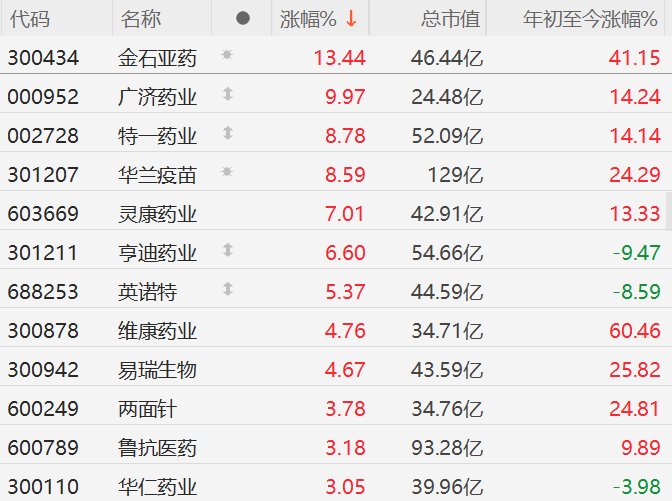
Core Viewpoint - The A-share market is experiencing a surge in flu-related stocks, driven by rising flu activity in southern provinces and the emergence of the H3N2 strain, which has led to increased investor interest in pharmaceutical companies [1][2] Company Performance - **Jinshi Yiyao**: Increased by 13.44%, with a total market value of 4.644 billion [2] - **Guangji Pharmaceutical**: Rose by 9.97%, total market value of 2.448 billion [2] - **Te Yi Pharmaceutical**: Gained 8.78%, market value of 5.209 billion [2] - **Hualan Biological Engineering**: Up by 8.59%, with a market value of 12.9 billion [2] - **Lingkang Pharmaceutical**: Increased by 7.01%, market value of 4.291 billion [2] - **Hengdi Pharmaceutical**: Rose by 6.60%, market value of 5.466 billion [2] - **Innotec**: Increased by 5.37%, market value of 4.459 billion [2] - **Weikang Pharmaceutical**: Up by 4.76%, market value of 3.471 billion [2] - **Yirui Biological**: Increased by 4.67%, market value of 4.359 billion [2] Market Trends - The China CDC reported a slow increase in respiratory disease cases nationwide, with flu activity rising in southern provinces and remaining low in northern regions [1] - Experts suggest that the flu season may arrive earlier this year, with a potential increase in infection rates due to lower immunity against the H3N2 strain [1]