流程银行

Search documents
科创金融亟需 银行经营范式转型
Jin Rong Shi Bao· 2026-01-22 01:29
Core Viewpoint - China's economy is transitioning to a high-quality development phase, with a shift in demand from traditional infrastructure and real estate to emerging high-tech industries, necessitating a transformation in the banking sector to better support this evolution [1] Group 1: Demand Changes - Since the second half of the 20th century, global economic growth has led to industrial transfer phenomena, with China becoming a "world factory" post-WTO accession in 2001, marking a golden period for banking due to high alignment between economic demand and credit supply [2] - The "three-phase overlap" period saw a decline in manufacturing loan ratios and an increase in financing for infrastructure and real estate as a response to economic slowdowns and asset quality issues [3] - In the high-quality development phase, financing growth in infrastructure and real estate is slowing, while high-tech sectors are rapidly expanding, indicating a significant shift in banking loan structures [3] Group 2: Paradigm Shift - The traditional financial paradigm focused on resolving information asymmetry between financing parties, with clear financial service demands during the industrialization phase [4] - In the new financial paradigm, banks must engage in the development process of enterprises, providing integrated financing and services to address the high uncertainty faced by high-tech industries [5] Group 3: Business Model Reconstruction - The new financial paradigm requires banks to shift from traditional lending to a "investment banking-asset management-wealth management" collaborative model, enhancing service offerings and meeting diverse financing needs [7] - This shift will lead to a restructuring of profit and balance sheets, increasing banks' profitability through diversified income sources beyond traditional interest income [8] Group 4: Structural Adjustment - Banks need to transition from a departmental structure to a process-oriented structure centered on customer needs, breaking down silos and optimizing workflows to better serve high-tech enterprises [9] - This transformation involves adjusting organizational structures, enhancing risk control mechanisms, and expanding service offerings to include non-financial support for high-tech companies [9]
黄广明:AI正推动银行向“流程银行”演进 须管控模型风险与算力成本
Xin Lang Cai Jing· 2026-01-05 09:30
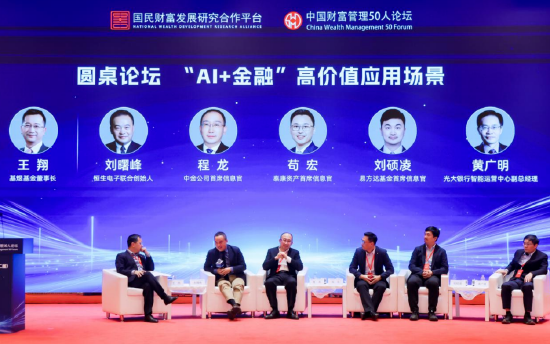
专题:中国财富管理50人论坛2025年会 1月5日金融一线消息,中国财富管理50人论坛2025年会近日在京召开,本届年会的主题是"迈向'十五 五'建设金融强国"。在"'AI+金融'高价值应用场景"圆桌论坛上,光大银行智能运营中心副总经理黄广明 介绍了光大银行在人工智能领域的探索路径,光大银行较早以模型为核心设置组织架构,长期深耕决策 式小模型,在信贷等业务中取得实际成效。随着大模型兴起,正加速从小模型向大模型转型,目前应用 规模呈现快速增长态势。 总体来看,现阶段人工智能仍以"岗位助手"为主要形态,通过构建覆盖全流程的助手矩阵,提升员工能 力和运营效率。黄广明认为,人工智能对银行的影响主要体现在三方面:客户需求显著升级、银行能力 同步增强,以及由此推动业务模式和组织模式向"流程银行"演进。同时,他强调必须高度重视模型风 险、算力成本和合规问题,当前仍处于"人+模型"的协同阶段。AI的影响不同于以往技术升级,其在决 策层面的潜力更具革命性,银行应在风险可控前提下积极行动、稳慎推进。 专题:中国财富管理50人论坛2025年会 1月5日金融一线消息,中国财富管理50人论坛2025年会近日在京召开,本届年会的主题是" ...