消费统计指标

Search documents
【统统告诉你】消费统计指标怎么用
Sou Hu Cai Jing· 2026-01-21 10:11
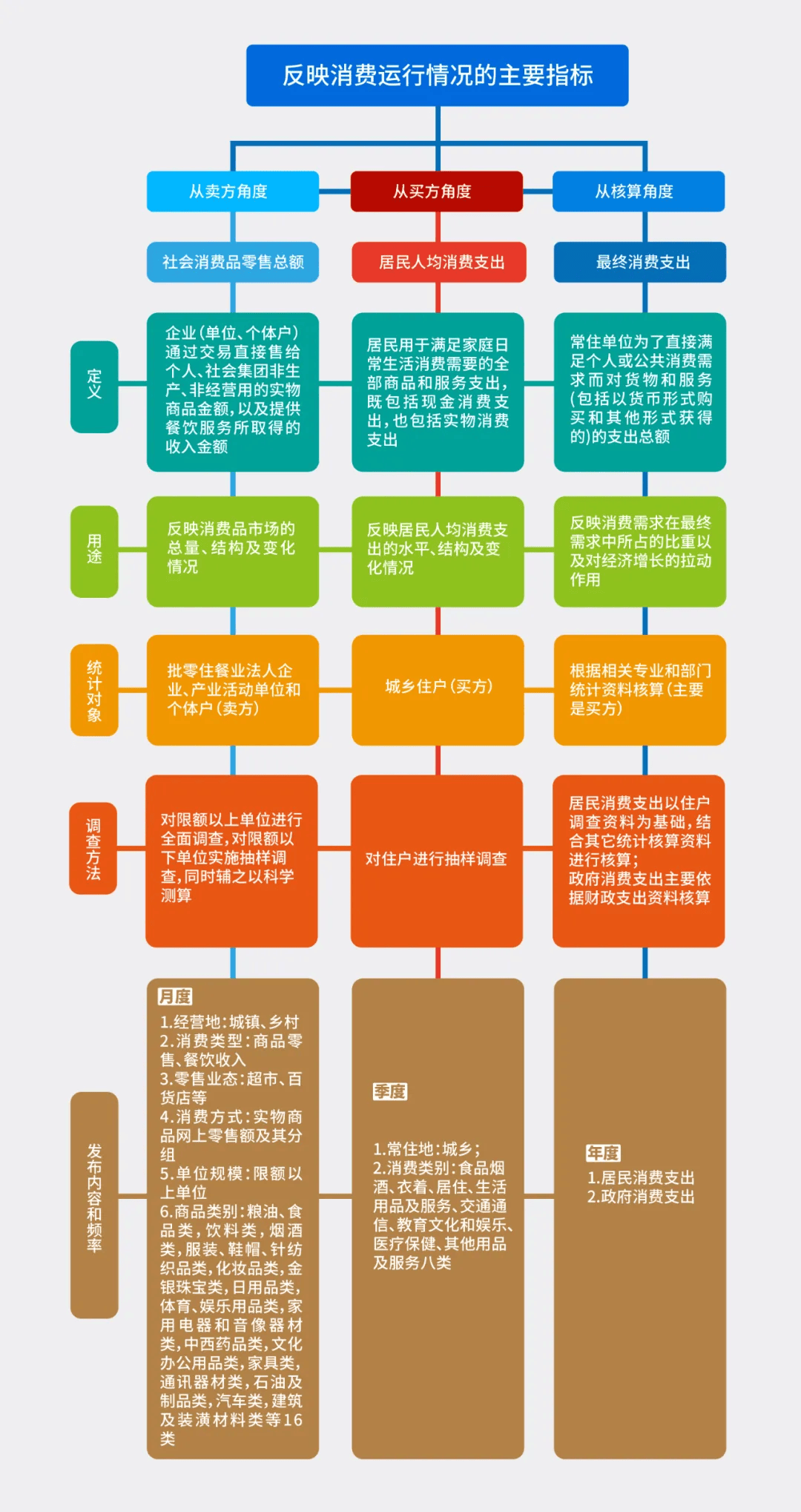
Core Viewpoint - The National Bureau of Statistics of China emphasizes the importance of various consumption statistics to analyze consumer behavior and economic conditions, highlighting the need for a multi-faceted approach to understanding consumption trends [1]. Group 1: Supply-side Indicators - Key supply-side indicators include total retail sales of consumer goods and service retail sales, which reflect the scale and distribution of domestic consumption and the status of trade circulation [2]. - The total retail sales of consumer goods focus on physical goods consumption, while service retail sales capture the performance of the service sector, indicating a shift towards balanced consumption of goods and services as living standards improve [2]. Group 2: Demand-side Indicators - The demand-side indicator is the per capita consumption expenditure of residents, which encompasses all household spending on daily needs across eight categories, providing insights into living costs and consumption quality [3]. - This indicator serves as a crucial basis for analyzing improvements in living standards and changes in consumption structure [3]. Group 3: Accounting Perspective - Final consumption expenditure is a key component of GDP calculation, reflecting the total consumption demand and its role in economic growth, including spending by residents and government [4]. - This macro-level indicator is essential for analyzing domestic demand structure and formulating macroeconomic policies [4]. Group 4: Summary of Consumption Indicators - Important consumption indicators include total retail sales of consumer goods, service retail sales, per capita consumption expenditure, and final consumption expenditure, each providing unique insights into economic activities [8]. - Total retail sales serve as a "barometer" for the goods market, while service retail sales act as an "indicator" for the service market, and per capita consumption expenditure reflects individual consumption structure and living standards [9].