消费贷凭证核查

Search documents
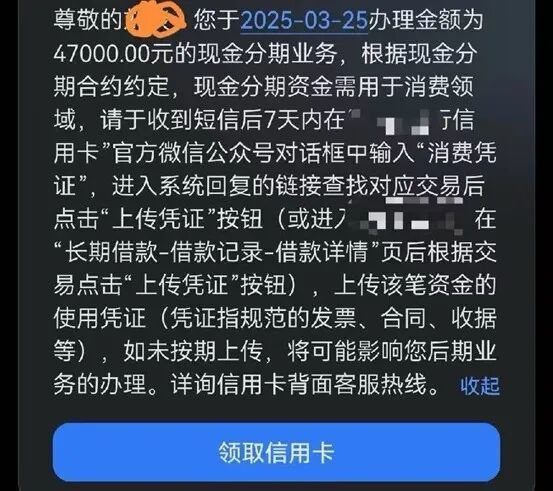
前脚消费贷,后脚被银行追讨发票,7天内上传,否则后果严重!
Mei Ri Jing Ji Xin Wen· 2025-09-30 09:41
Core Insights - The article discusses the emerging issue of "voucher anxiety" among consumers who have taken out personal loans but are required to provide proof of expenditure within a short timeframe, leading to confusion and potential financial risks [1][2][4] - A gray market for "voucher services" has developed, where intermediaries offer to create fake vouchers for a fee, highlighting the challenges banks face in verifying the actual use of loan funds [3][5][7] Consumer Concerns - Many consumers are confused about the requirement to submit vouchers for small purchases, leading to widespread discussions on social media about the necessity and difficulty of obtaining these vouchers [2][4] - Users express anxiety over the potential consequences of not submitting vouchers, including the risk of loan recall or penalties [4][8] Gray Market Development - A gray market has emerged where intermediaries offer services to create fake vouchers for a fee of 0.5% of the loan amount, indicating a significant demand for such services [5][7] - These intermediaries can tailor vouchers to match the bank's requirements, exploiting loopholes in the verification process [7][8] Banking Challenges - Banks are tightening their post-loan management practices to ensure that loan funds are used for legitimate purposes, as past misuse has led to regulatory scrutiny [8][13] - The inconsistency in voucher requirements across different banks adds to consumer confusion and complicates the verification process [12][13] Technological Solutions - The article mentions the potential of blockchain technology to enhance the traceability of vouchers, although widespread implementation is still pending due to various challenges [16][17] - Blockchain electronic invoices could provide a solution to the issues of voucher authenticity and tracking, but the adoption is limited by costs and user habits [16][17] Regulatory Recommendations - Experts suggest that regulatory bodies should consider tiered verification processes based on loan amounts and user credit ratings to alleviate the burden on consumers [18][19] - There is a call for banks to optimize voucher submission rules and improve user education on the importance of retaining vouchers for significant expenditures [19][20] Conclusion - The interplay between consumer voucher anxiety, the rise of a gray market, and banks' stringent verification processes reflects a broader challenge in financial regulation, emphasizing the need for a balance between risk management and consumer convenience [21]