
消费金融监管

Search documents
风控端强化主体责任、获客端强调自营渠道,消金行业正逐步卸掉外部依赖
券商中国· 2026-03-18 15:04
Core Viewpoint - The consumer finance industry is undergoing significant regulatory changes, emphasizing the need for companies to strengthen their own risk management and customer acquisition capabilities while reducing reliance on external channels like loan guarantee platforms and lending assistance platforms [1][2]. Group 1: Regulatory Changes - Regulatory authorities are pushing for a reduction in the balance and proportion of guarantee and credit enhancement businesses, with a new regulation effective from April 18, 2024, stating that the balance of guarantee loans must not exceed 50% of total loans, and by October 2025, this limit may be further reduced to 25% in many regions [2]. - Some companies are proactively responding to these regulatory changes, with one major consumer finance company in East China planning to eliminate its guarantee loan balance entirely within the year due to its relatively small existing balance [2]. Group 2: Customer Acquisition Strategies - Major internet platforms and fintech companies remain crucial channels for consumer finance companies to acquire customers, with a report indicating that leading platforms like Ant Group, ByteDance, JD.com, Du Xiaoman, and Meituan account for over 70% of the loan assistance balance [3]. - New regulations introduced in April 2025 aim to encourage consumer finance companies to reduce their dependence on these loan assistance platforms, leading to a trend of companies enhancing their self-operated capabilities and gradually decreasing their loan assistance business [3]. Group 3: Market Dynamics and Future Outlook - Analysts suggest that consumer finance companies overly reliant on loan assistance platforms, especially those with high guarantee loan ratios, may need to significantly adjust their business models, potentially facing pressures on business scale and profitability [4]. - Companies with strong self-operated capabilities are expected to gain more market space as regulatory changes drive industry consolidation, while those focusing on real transaction scenarios, such as automotive and 3C products, are likely to be less affected by regulatory tightening [4][5]. - Long-term, leading companies and those with clear consumption scenarios are anticipated to benefit the most, fostering a market environment where "good money drives out bad" [5].


短期消费贷减少折射居民消费意愿仍有待激发
Xin Lang Cai Jing· 2026-01-23 12:34
Core Insights - The data from the central bank indicates a significant decline in short-term consumer loans for residents, with a drop of 8,351 billion yuan in 2025 compared to 2024, while medium to long-term loans increased by 1,280 billion yuan [1][3][6] - The total consumer loan balance decreased from 92,050 billion yuan at the end of 2024 to 84,300 billion yuan at the end of 2025, reflecting a reduction of 7,750 billion yuan [1][6] - The willingness of residents to take out consumer loans remains weak, with a trend of deleveraging and a high increase in deposits, indicating a shift in financial asset allocation [3][8] Deposit Trends - In 2025, total RMB deposits increased by 26.41 trillion yuan, with household deposits rising by 14.64 trillion yuan, while non-financial enterprise deposits increased by 2.31 trillion yuan [2][7] - The increase in deposits in 2025 was largely driven by government leverage and fiscal policy, stabilizing economic growth and manufacturing investment [2][7] - Despite a significant increase in non-bank financial institution deposits, household deposits remained relatively stable, indicating a portion of household savings flowed into non-bank financial sectors due to favorable capital market conditions [2][7] Regulatory Environment - Regulatory measures aimed at reducing financing costs in the consumer finance sector have been implemented, including a cap on new loan rates and a requirement for small loan companies to lower their financing costs [3][9] - The recent policy changes extend the personal consumer loan interest subsidy program and broaden its scope, allowing for a more inclusive and incentivized consumer credit support system [5][10][11] - The shift towards a more refined and professional operational model in consumer finance is expected, with an emphasis on risk control through big data and artificial intelligence [4][9]
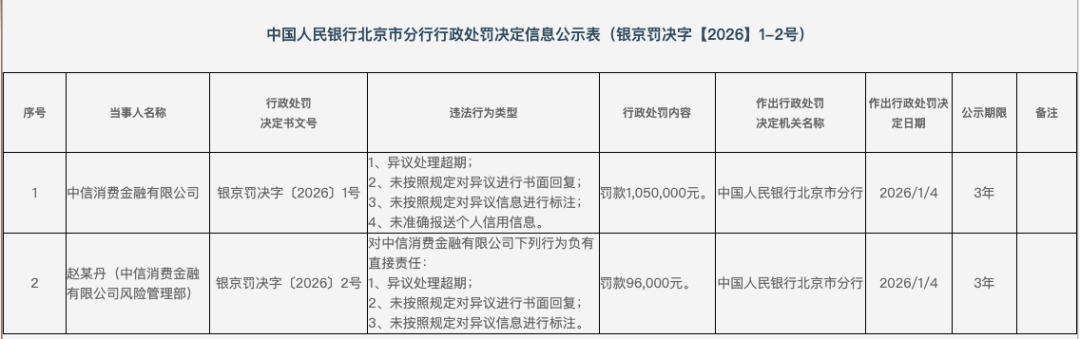
被曝四项违法行为,中信消金再吃百万罚单!
Shen Zhen Shang Bao· 2026-01-12 01:28
Core Viewpoint - Citic Consumer Finance Co., Ltd. has been fined for multiple regulatory violations, indicating ongoing compliance issues within the company [1][2][3] Group 1: Regulatory Penalties - Citic Consumer Finance was fined 1.05 million yuan for failing to respond to disputes in writing, not accurately reporting personal credit information, and other violations [1][2] - Zhao, a member of the risk management department, was fined 96,000 yuan for direct responsibility in three of the violations [1][2] - This penalty follows a previous fine of 1.2 million yuan in June 2024 for issues related to cooperation mechanisms, product information disclosure, credit approval, and post-loan management [3] Group 2: Company Background and Financial Performance - Citic Consumer Finance was established as the 24th licensed consumer finance institution in China, officially commencing operations in June 2019 [3] - The company increased its registered capital from 700 million yuan to 1 billion yuan in February 2025 [3] - In 2024, Citic Consumer Finance reported revenue of 921 million yuan, a 30.07% increase from the previous year, with total assets of 11.414 billion yuan and total liabilities of 10.48 billion yuan [3] - The company issued a total of 4.605 million loans, amounting to 124.5 billion yuan, with a loan balance of 10.688 billion yuan by the end of 2024 [3] - Citic Consumer Finance has served approximately 13.5165 million customers through its "Youqi Loan" product [3]
多家持牌消金接窗口指导 20%或将成贷款综合利率“新红线”
Di Yi Cai Jing· 2025-10-30 05:26
Core Insights - The consumer finance industry is undergoing a new round of regulatory tightening, with a focus on reducing the comprehensive cost of personal loans to 20% and potentially lowering the guarantee and credit enhancement business ratio [1][2]. Regulatory Changes - Regulatory authorities have mandated that the comprehensive cost of new loans must not exceed 20%, with local regulators beginning to communicate this to institutions [2]. - The specific implementation details and timeline for these regulations are still pending [2]. - The cap on guarantee and credit enhancement business is expected to be reduced from a maximum of 50% of the total loan amount to 25% [2]. Market Impact - The ongoing push to lower loan interest rates is expected to have a profound impact on the consumer finance market [3]. - The previous "24% + credit enhancement service fee" model is being phased out, with new regulations capping annualized interest rates at 24% [3]. - Major platforms have already begun to cut off access to smaller platforms with annualized rates exceeding 24% [3]. Cost Structure and Risk Levels - The industry is experiencing positive changes in cost structure and risk levels, with funding costs decreasing and overall risk levels remaining stable [4]. - A report from Ping An Securities estimates that the average financing cost for consumer finance companies will decrease by 54 basis points year-on-year in 2024 [4]. Profitability and Risk Indicators - Among nine consumer finance companies that disclosed risk indicators for 2024, three reported a slight increase in non-performing loan ratios, while the others showed varying degrees of decline [5]. - The most significant decrease in non-performing loans was reported by Zhongyou Consumer Finance, with a drop of 51 basis points year-on-year [5]. Future Industry Dynamics - The industry is expected to face challenges in fully reducing the comprehensive financing cost to below 20% in the short term [5]. - There is a concern that risks may begin to spread from weaker institutions to medium-sized institutions and even upstream banks, potentially leading to asset quality pressures and a tightening credit environment [5]. - The future competition in the consumer finance industry will likely shift from scale and interest rates to risk pricing capabilities, refined operations, and customer experience [5].