渐冻症研究

Search documents
渐冻人蔡磊回应身体近况,已准备好尝试脑机接口
Xin Lang Cai Jing· 2025-12-03 15:27
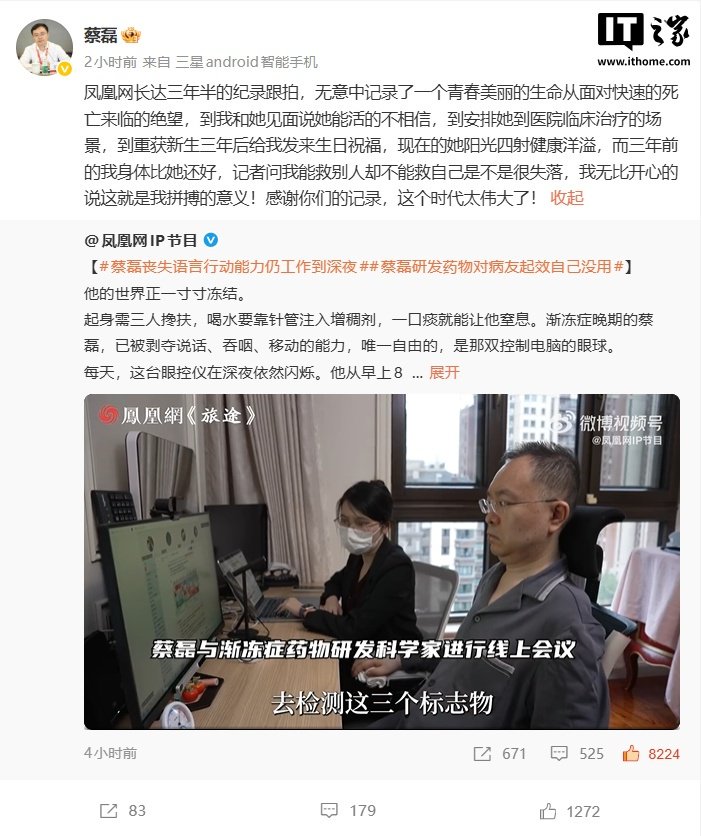
Core Insights - The article highlights the advancements in assistive technology for individuals with disabilities, particularly focusing on eye-tracking technology and the potential future of brain-computer interfaces [1][4]. Group 1: Current Technology and Usage - The eye-tracking system is currently utilized by individuals with severe disabilities, allowing them to perform basic office functions such as typing, browsing the web, and document processing [1]. - The system's parameters, including cursor speed and click sensitivity, can be adjusted to enhance user experience, leading to improved accuracy in communication and work tasks [1]. Group 2: Personal Experience and Challenges - The individual featured in the article, a former executive at JD.com, describes severe physical limitations due to ALS, including muscle atrophy and respiratory difficulties, which necessitate the use of a breathing machine at night [1]. - Despite these challenges, the individual has adapted to using the eye-tracking technology effectively for communication and work, although the physical strain remains significant [1]. Group 3: Advocacy and Research Initiatives - Since his diagnosis in 2019, the individual has led efforts to establish a large data platform connecting over 10,000 patients and has initiated the first pathological and genetic sample bank for ALS in China [4]. - Significant financial contributions have been made towards establishing a public welfare fund, charitable trust, and the "Life Science Icebreaker Award," amounting to several tens of millions of yuan [4].

大医生 | 樊东升:与万名“渐冻人”并肩寻药
Jing Ji Guan Cha Wang· 2025-09-05 08:31
Core Insights - The article highlights the ongoing efforts and advancements in the research and treatment of Amyotrophic Lateral Sclerosis (ALS), also known as Lou Gehrig's disease or "渐冻症" in Chinese, emphasizing the role of Dr. Fan Dongsheng and his team at Peking University Third Hospital in leading clinical trials and patient care [2][3][4]. Group 1: Research and Clinical Trials - Dr. Fan Dongsheng has been instrumental in conducting clinical trials for new ALS drugs, with recent approvals from the National Medical Products Administration for trials led by his team [5][6]. - There are currently nearly 10 ALS drug clinical trials underway at Peking University Third Hospital, including both international and domestic drug development efforts [8][9]. - The research focuses on various treatment modalities, including traditional Chinese medicine, small molecule drugs, gene therapy, and stem cell therapy [8][9]. Group 2: Patient Engagement and Support - Dr. Fan emphasizes the importance of providing hope and support to ALS patients, many of whom seek participation in clinical trials as a means of gaining access to new treatments [11][12]. - The establishment of a patient database and a new data platform has significantly improved the speed and efficiency of patient recruitment for clinical trials, allowing for real-time updates on patient conditions [19][20]. - Patients are encouraged to participate in trials despite the uncertainty of outcomes, as they receive close medical management during the process [11][12]. Group 3: Challenges and Opportunities - The article discusses the historical challenges in ALS drug development, noting that only a few drugs have been successfully developed over the past decades due to the complexity of the disease [9][10]. - However, recent policy changes and increased attention from the Chinese government towards rare diseases are creating a more favorable environment for ALS drug research and development [9][10]. - The large population of ALS patients in China provides a unique advantage for clinical trials, as it allows for easier recruitment compared to Western countries where patient numbers are lower [10][11].