渔光互补

Search documents
“水上发电、水下养鱼”!盐城这一“绿色电站”迈入建设新阶段
Jiang Nan Shi Bao· 2026-02-10 08:32
Core Viewpoint - The successful completion of the foundation construction for the 120MW fish-solar complementary photovoltaic project in Yancheng, Jiangsu, marks a significant step towards the project's main construction phase, integrating solar power generation with ecological aquaculture [1][2] Group 1: Project Overview - The project covers a total area of approximately 2,120 acres and has completed the construction of 31,934 foundation piles within a few months despite challenges such as complex geological conditions and tight schedules [1] - The project adopts an innovative "fish-solar complementary" model, creating a three-dimensional utilization system of "water-based power generation and underwater aquaculture," enhancing land resource efficiency and promoting the integration of solar energy and fisheries [1] Group 2: Environmental Impact and Future Plans - Upon full completion, the project is expected to generate an average annual electricity output of approximately 175 million kilowatt-hours, saving tens of thousands of tons of standard coal and reducing carbon dioxide emissions by hundreds of thousands of tons [2] - The project aims to contribute to the clean energy supply and ecological development in Jiangsu Province and the Yangtze River Delta region, supporting the national "dual carbon" goals [2]
山东滨州步入海洋立体开发新阶段
Zhong Guo Jing Ji Wang· 2026-01-14 14:16
Core Insights - The Huaneng Shandong Power Company’s 850,000 kW photovoltaic project in Binzhou is the first marine solar project approved by the State Council following the national marine layered rights confirmation policy, marking a new era for large-scale marine utilization in China [1][2] - The project is expected to generate 1.025 billion kWh of electricity by December 31, 2025, meeting its design standards [1] - The shift from "flat" to "layered" marine rights management allows for deeper development of marine resources, significantly enhancing economic output in shared marine areas [2] Group 1: Project Details - The Huaneng Binzhou New Energy project will be fully operational by March 2025, with a projected electricity generation of 1.025 billion kWh by the end of 2025 [1] - The project faced initial construction delays due to marine usage permit issues, which have now been resolved through new policies [1] - The introduction of a layered rights confirmation policy allows for the division of marine space into four layers: water surface, water body, seabed, and subsoil [1] Group 2: Economic Impact - The "fishing and solar" complementary model improves the microenvironment for saltwater shrimp, enhancing their growth conditions [2] - The layered rights and utilization model has increased the economic output of shared marine areas by over three times for photovoltaic and saltwater shrimp production [2] - Binzhou is positioning itself to develop a trillion-level new energy equipment manufacturing industry cluster, supported by abundant marine resource factors [2] Group 3: Future Developments - Binzhou is proactively planning a gigawatt-level energy storage project along the northern coastal area, establishing a stable regulation system for "new energy + storage" [2] - Current surveys indicate that the total installed capacity for wind and solar energy in northern Binzhou exceeds 60 million kW, with multiple new energy and related projects under construction [2]
国家电投中国电力渔光互补光伏发电项目全容量并网
Xin Hua Wang· 2026-01-14 08:13
Core Viewpoint - The project by China Power Smart Energy in Yiyang, Hunan Province, has successfully achieved full-capacity grid connection for its 190 MW fish-solar complementary photovoltaic power generation project, showcasing efficient land resource utilization and significant environmental benefits [1] Group 1: Project Overview - The project is located in Qianshanhong Town, Datong Lake District, Yiyang City, with a total installed capacity of 190 MW [1] - It includes the construction of a new 220 kV booster station and a 220 kV transmission line [1] - The project commenced construction in October 2024 and has been completed three months ahead of schedule [1] Group 2: Management and Challenges - The management approach emphasizes thorough planning, strict control, precise collaboration, and seizing critical timelines [1] - The project faced challenges such as delays in equipment supply due to a rush for installation, persistent rainy weather affecting cable trench excavation, and complex land acquisition negotiations [1] Group 3: Economic and Environmental Impact - The project is expected to generate an average annual electricity output of approximately 25.228 million kWh, with an equivalent annual utilization of about 1,013 hours [1] - It will save around 80,000 tons of standard coal annually and reduce emissions of carbon dioxide by approximately 190,000 tons, sulfur dioxide by about 1,546 tons, and nitrogen oxides by around 878 tons [1]

杭州建成浙江首个百万千瓦级渔光互补集群
Hang Zhou Ri Bao· 2026-01-12 02:43
Core Viewpoint - The successful integration of the Jia Da and Ling Neng fish-solar complementary photovoltaic power generation projects marks a significant milestone in the rapid development of the photovoltaic industry in Hangzhou, with a total capacity exceeding 1 million kilowatts and an expected annual power generation of 1.03 billion kilowatt-hours [3][4]. Group 1: Project Development - The Jia Da and Ling Neng projects, part of a larger fish-solar complementary cluster, have been completed six months ahead of schedule, with a total installed capacity of over 1 million kilowatts [3]. - The existing Shuneng fish-solar complementary project has a total installed capacity of 100 megawatts and has generated 900 million kilowatt-hours over the past ten years [3]. - The new cluster is expected to supply power to meet one-quarter of the electricity demand for enterprises in the Hangzhou Linjiang High-tech Park [3]. Group 2: Industry Growth - As of December 30, 2025, Hangzhou's photovoltaic installed capacity is projected to exceed 7 million kilowatts, with a significant increase of 4.8 million kilowatts during the 14th Five-Year Plan period, achieving an annual growth rate of 40% [4]. - The number of photovoltaic users in Hangzhou is expected to reach 12,000 by 2025, with a capacity of 2.81 million kilovolt-amperes, representing an 80% year-on-year increase [4]. Group 3: Support and Infrastructure - The State Grid Hangzhou Power Supply Company has established a dedicated team to support the development of distributed renewable energy, creating a comprehensive service system to facilitate project approvals and enhance grid capacity [4]. - Initiatives include the establishment of efficient communication mechanisms with government and enterprises, the creation of a service guide for distributed photovoltaic construction, and the optimization of the main grid structure to improve renewable energy absorption [4]. - The company has also innovated energy collection stations and dual-voltage access models to enhance the management and control of photovoltaic clusters [4]. Group 4: Performance Metrics - By the end of November 2025, Hangzhou's photovoltaic power generation reached 5.37 billion kilowatt-hours, reflecting a year-on-year increase of 69.9% [5]. - All districts and counties in Hangzhou have achieved a green rating for distributed power source capacity assessment, with an available capacity of 1,085 megawatts for future photovoltaic industry development [5][6].

水上发电、水下养殖,江苏沿海最大,并网发电
中国能源报· 2025-12-31 10:43
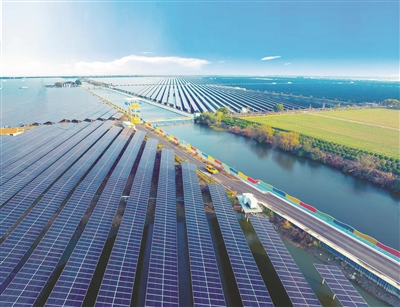
Core Viewpoint - The article highlights the successful grid connection of Jiangsu's largest aquaculture photovoltaic project, which integrates solar power generation with aquaculture, promoting both clean energy and ecological farming [1][5]. Group 1: Project Overview - The first phase of the project, located in Lusi Port Town, Qidong City, has a total installed capacity of 400 MW and is expected to generate an average annual power output of 490 million kWh over a 25-year operational period [2][3]. - The project utilizes approximately 5,850 acres of tidal flat area and consists of 121 photovoltaic units, each with a capacity of 3.3 MW, connected to the shore via a cable corridor [3]. Group 2: Environmental Impact - The project is projected to reduce carbon dioxide emissions by approximately 490,000 tons annually, contributing to environmental sustainability [3]. Group 3: Innovative Model - This large-scale tidal flat photovoltaic project adopts a "water-based power generation and underwater aquaculture" model, efficiently utilizing tidal flat resources while integrating clean energy with ecological farming [5].
滨州开启中国海洋分层确权大面积立体化利用新时代
Xin Lang Cai Jing· 2025-12-25 17:23
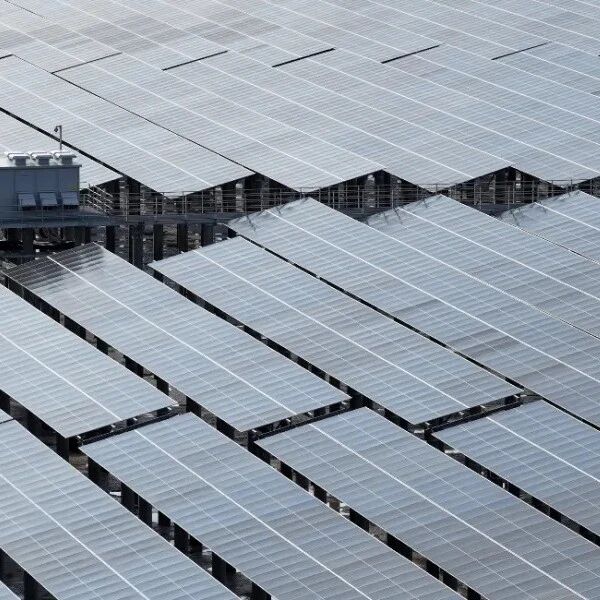
Core Insights - The Huaneng Shandong Binzhou Company's 850,000 kW photovoltaic project has achieved a significant milestone by surpassing 1 billion kWh of electricity generation since its full capacity launch in March 2025, indicating that the project has met its expected design standards [1] - The project represents a new era of large-scale three-dimensional utilization of marine resources in China, breaking traditional management practices that only allowed for flat spatial rights [1][3] - The project has been recognized as the first photovoltaic marine project approved by the State Council following the implementation of national policies for marine three-dimensional rights [2] Group 1: Project Details - The photovoltaic project occupies an area of 15,800 acres and is expected to generate 1.2 billion kWh of electricity annually, sufficient to power 600,000 households for a year, while saving 385,800 tons of standard coal and reducing carbon dioxide emissions by 917,700 tons [2] - The project utilizes a "fishing and solar" complementary model, which enhances the microenvironment for the growth of saltwater shrimp, providing shade during high-temperature days [2] Group 2: Policy and Innovation - In 2023, Binzhou City introduced the first provincial policy for marine three-dimensional rights, allowing for layered utilization of marine areas, which includes the establishment of rights for water surface, water body, seabed, and subsoil [1][2] - This innovative approach has significantly increased the economic output of the shared marine area, reportedly tripling the economic yield from the combined photovoltaic and shrimp farming activities [2]
创新海域管理模式助推海洋经济高质量发展
Xin Hua Ri Bao· 2025-12-16 00:30
Core Insights - The "Dongtai City Xingdong Investment 210 MW Fish-Solar Complementary Centralized Power Generation Project" has been recognized as a pioneering case in the innovative management of marine resources, marking a shift from flat to three-dimensional utilization of marine space [1][2] - The project exemplifies a win-win model of "one sea area, two outputs," combining solar power generation with ecological fish farming, thereby ensuring long-term rights for different operational entities [1][2] Group 1 - The project covers an area of approximately 267 hectares in the Dongtai coastal economic zone, utilizing a layered rights allocation model to clearly define marine usage rights above and below water [1][2] - The project has achieved significant comprehensive benefits, generating a total of 190 million kWh of electricity since its grid connection at the beginning of the year, with a projected total output of 6.57 billion kWh over its lifecycle [2] - The project is expected to save approximately 79,000 tons of standard coal annually and reduce carbon dioxide emissions by about 218,000 tons, contributing positively to regional energy structure optimization and carbon neutrality goals [2] Group 2 - The Dongtai Natural Resources and Planning Bureau has established a joint office and synchronized review mechanism with agriculture, rural affairs, and ecological environment departments to enhance approval efficiency [2] - The project employs modern technologies such as geographic information systems, remote sensing monitoring, and drone photography for precise delineation of marine usage areas and dynamic supervision [2] - Future plans include deepening marine management reforms and exploring additional integrated development models, such as "offshore wind power + aquaculture" and "marine tourism + ecology," to contribute to high-quality marine economic development [3]
从智慧养殖到网红园区,崇明打造上海乡村旅游“天花板”
Guo Ji Jin Rong Bao· 2025-11-20 04:57
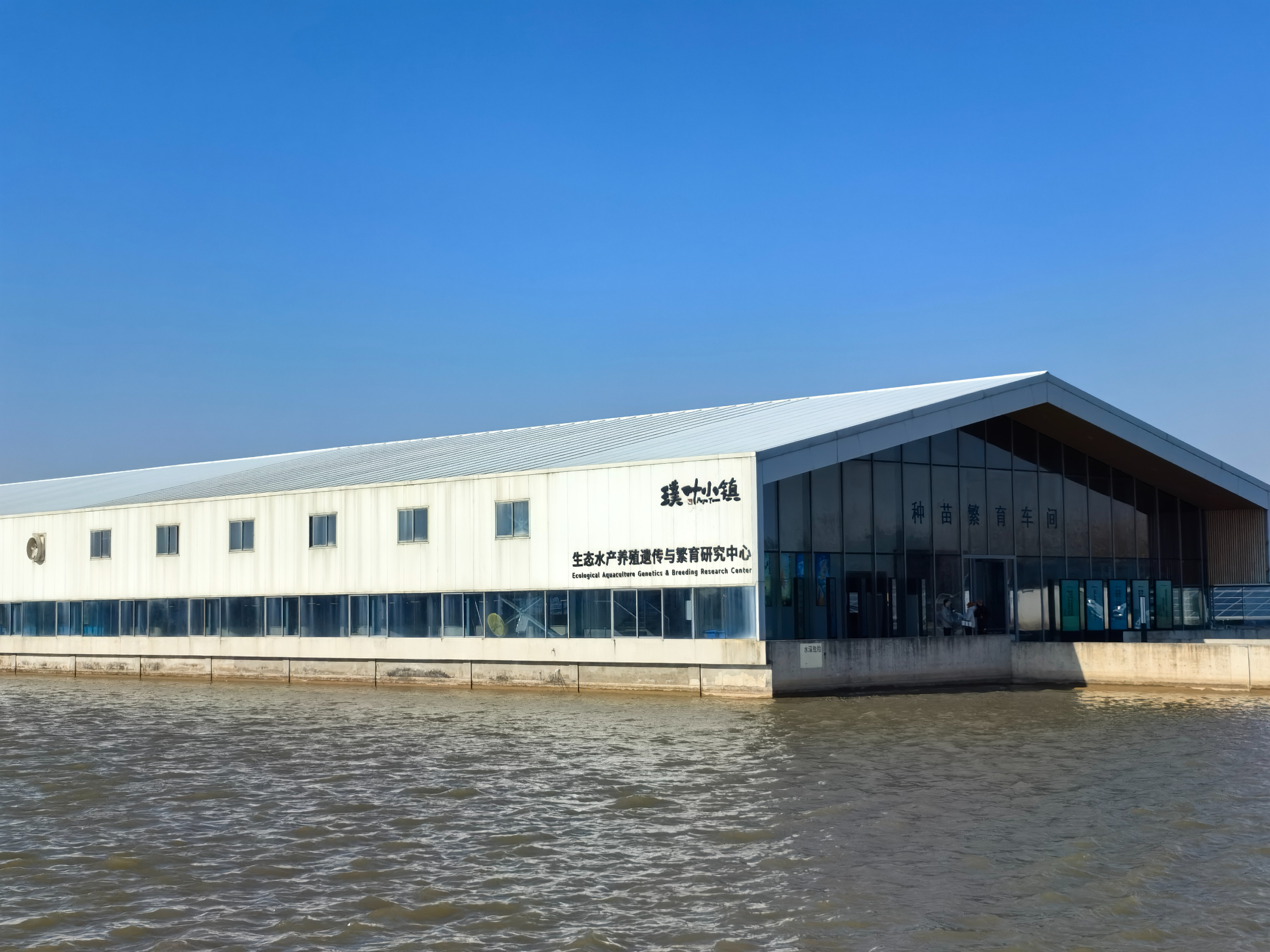
Group 1 - Chongming District is positioned as an ecological strategic space for Shanghai's development, leading in ecological civilization construction and implementing rural revitalization and marine power strategies [1] - Since the 14th Five-Year Plan, Chongming has adhered to the principle of ecological development, promoting the integration of ecological production and living, and striving to create a new national ecological civilization brand [1] - The Puyue Town project, with a total investment of approximately 950 million yuan, integrates photovoltaic power generation with aquaculture and agriculture, creating a composite economy that utilizes land resources effectively [4][7] Group 2 - The Puyue Town project aims to enhance renewable energy supply, with plans to exceed 1,400 megawatts of photovoltaic installed capacity by 2030 and increase the share of renewable energy in total electricity consumption to over 60% by 2035 [7] - The ecological breeding base at Puyue Town utilizes advanced technology such as automated feeding systems and digital water quality monitoring, achieving an average annual power generation of 145 million kilowatt-hours [16] - The breeding center produces 12 million fish seedlings annually and achieves over 200,000 jin in pond aquaculture output, showcasing a successful model of integrated aquaculture [16] Group 3 - Chongming's rural tourism has rapidly developed, becoming a preferred destination for Shanghai residents, with the M515 Cultural and Creative Industry Park attracting significant attention [17][24] - The M515 Park features diverse attractions, including a coffee art center and various cultural and culinary experiences, contributing to its popularity and visitor engagement [24][30] - The park has hosted numerous events, drawing over 150,000 visitors during the recent holidays, establishing itself as a new landmark for consumption in Chongming [32] Group 4 - The park leverages its ecological advantages to introduce water sports, filling a gap in local recreational offerings and enhancing the tourism experience [35] - Future plans include hosting water marathons and integrating cultural experiences, aiming to boost Chongming's tourism economy [35] - With improved transportation links, Chongming aims to enhance its appeal as a tourist destination, focusing on seamless visitor experiences [35]
“立体”用海 多层受益
Liao Ning Ri Bao· 2025-11-12 00:59
Core Insights - The Ministry of Natural Resources has released 12 typical cases of layered sea area usage rights, providing replicable and promotable practices for the utilization of marine areas nationwide [1] - Two cases from Dalian, namely Changhai County's layered aquaculture and Pulandian District's "fishing-solar complementary" project, have been selected as examples [1] Group 1: Changhai County Case - Changhai County has confirmed a sea area usage of 8.087 million acres, with 466,000 acres designated for layered aquaculture [2] - The layered usage rights allow aquaculture operators to cultivate shellfish, fish, and algae on the water surface and in the water body, while also breeding high-value species like abalone and sea cucumbers on the seabed [2] - The county's sea area usage fees have exceeded 380 million yuan for two consecutive years, with a projected fishery output of 732,000 tons and a fishery value of 10.09 billion yuan in 2024, reflecting a year-on-year growth of 3.7% [2] Group 2: Pulandian District Case - The "Dalian Coastal Tidal Flat Source Network and Energy Storage Integrated Demonstration Base Project" is the first coastal tidal flat power generation demonstration project in the province, covering an area of approximately 2,800 acres [2] - This project employs an innovative layered development model that integrates marine aquaculture with solar power generation, enhancing resource utilization and economic benefits [2] - The project emphasizes ecological protection, saving approximately 51,100 tons of standard coal annually and reducing carbon dioxide emissions by about 134,900 tons [3]
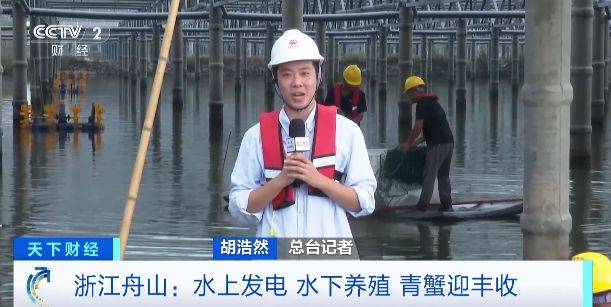
水上发电,水下养殖!浙江舟山青蟹迎来大丰收→
Sou Hu Cai Jing· 2025-10-18 13:47
Group 1 - The peak season for harvesting blue crabs on Dengbu Island in Zhoushan, Zhejiang, coincides with the first batch of blue crabs from the aquaculture ponds integrated with photovoltaic projects [1][3] - The average weight of the blue crabs is between 0.7 to 1 pound, with over 100 pounds harvested in a single morning [3] - The total expected production for this year is projected to exceed 40,000 pounds [3] Group 2 - The photovoltaic project consists of 12,991 solar panels covering an area of approximately 560,000 square meters, generating an annual electricity output of about 85 million kilowatt-hours [5] - The project contributes to a reduction of 69,100 tons of carbon emissions [5] - The design of the solar panel supports allows for a height of 3.5 meters above the water surface, providing a spacious environment for aquatic life and facilitating easier access for workers [7] Group 3 - The survival rate of aquatic species in the experimental ponds has increased by over 5%, while labor efficiency has improved by 50% [9] - The integration of smart aquaculture practices revitalizes the fishing industry on the island [9]