港股红利行情

Search documents
广发证券:如何看待年底的港股红利行情?
Zhi Tong Cai Jing· 2025-11-30 23:37
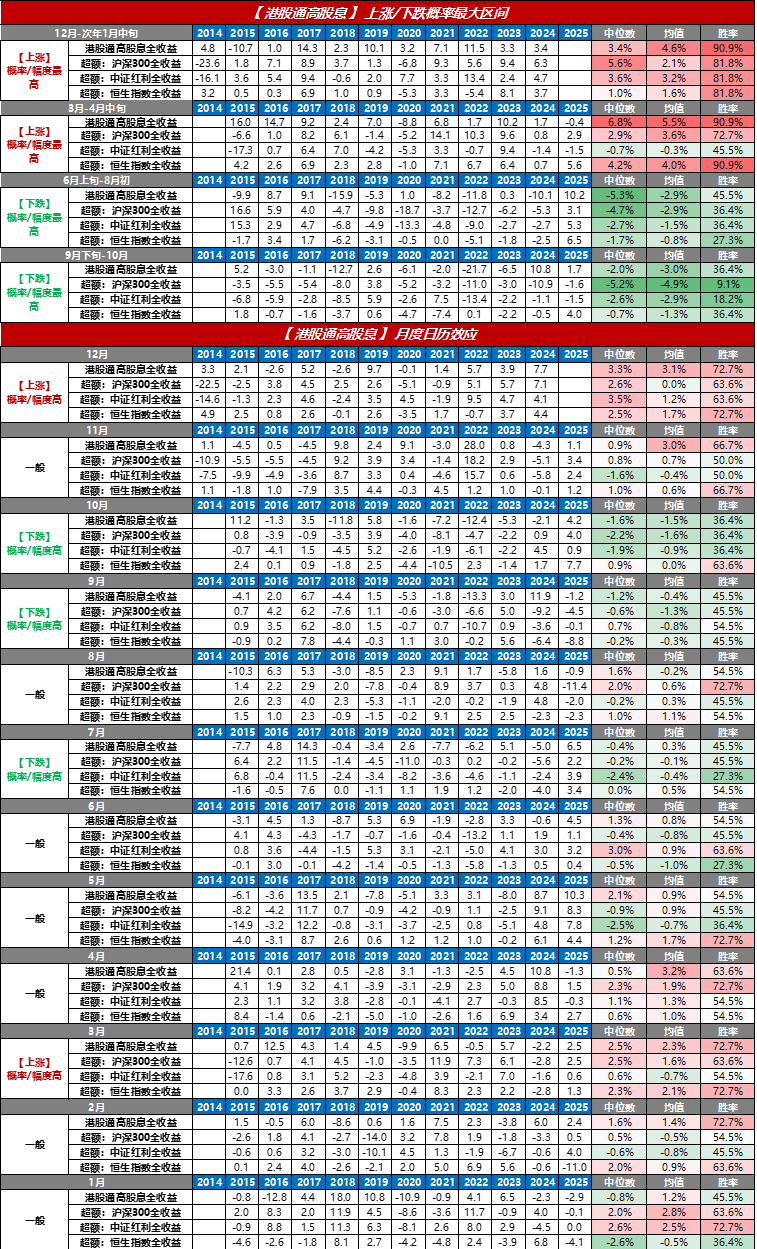
Group 1 - The core viewpoint is that the Hong Kong Stock Connect High Dividend Total Return Index is approaching the period with the strongest calendar effect of the year (from December to mid-January), where the probability of achieving absolute and excess returns is high, and the returns are expected to be significant [1] - The recommendation is to focus on the allocation opportunities in the Hong Kong Stock Connect High Dividend sector, which may serve as a potential way to increase returns at the end of the year and the beginning of the next [15] - Historical data from 2014 to present shows that from December to mid-January, the win rate against the CSI 300 Total Return, the CSI Dividend Total Return, and the Hang Seng Index Total Return is 82%, with an absolute return win rate of 91% [15] Group 2 - The absolute return probability is 90.9%, with median and average gains of 3.4% and 4.6% respectively, with the only loss occurring due to the market circuit breaker in early 2016 [2] - Compared to the CSI 300 Total Return, the excess return probability is 81.8%, with median and average returns of 5.6% and 2.1% respectively, with underperformance attributed to the leveraged bull market in 2014-2015 and the loose monetary policy bull market in 2020-2021 [2] - Against the CSI Dividend Total Return, the excess return probability is also 81.8%, with median and average excess returns of 3.6% and 3.2% respectively, with underperformance linked to the leveraged bull market in 2014-2015 [3] Group 3 - When compared to the Hang Seng Index Total Return, the excess return probability is again 81.8%, with median and average returns of 1.0% and 1.6% respectively, with underperformance due to the unexpected rise of Tencent at the end of 2020 and the end of 2022 [4] - The current trading volume of the Hong Kong Stock Connect High Dividend sector accounts for only 6.1%, indicating a relatively low level of crowding historically, which may present a reallocation opportunity [15] - The strong calendar effect during the year-end and early January is attributed to several factors, including institutional funds rebalancing their assets to lock in annual returns, leading to a shift towards high dividend stocks [6]