港股通高股息全收益指数

Search documents
历史数据显示:年底布局胜率较高!
Mei Ri Jing Ji Xin Wen· 2025-12-10 05:22
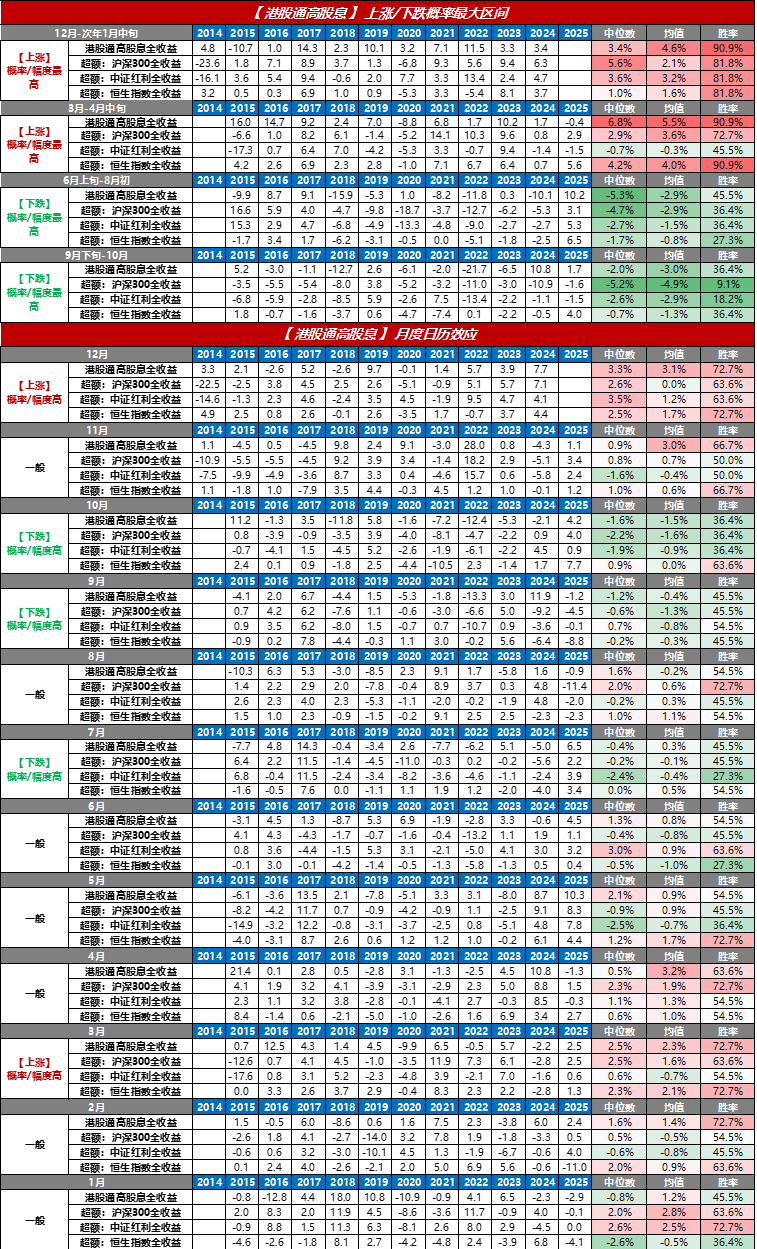
Core Viewpoint - The Hong Kong stock market's high dividend sector typically experiences a seasonal "bull market" from December to mid-January, driven by historical patterns known as the "calendar effect" [1] Historical Data Insights - The Hong Kong Stock Connect High Dividend Total Return Index shows a high absolute return probability of 90.9% from December to mid-January, with a median increase of 3.4% and an average increase of 4.6% since 2014 [2] - The probability of achieving excess returns compared to the A-share market (CSI 300) is 81.8%, with an average outperformance of approximately 2.1 percentage points [3] - The same probability of 81.8% applies when comparing to the A-share dividend index (CSI Dividend), with an average excess return of about 3.2 percentage points [4] - When compared to the Hong Kong market benchmark (Hang Seng Index), the probability of excess returns is also 81.8%, with an average excess return of approximately 1.6 percentage points [5] Exceptions and Insights - The only year with absolute return losses was from December 2015 to mid-January 2016, attributed to the A-share "leverage bull" collapse and liquidity crisis affecting the Hong Kong market. However, high dividend assets still outperformed the A-share market and the Hang Seng Index during this period [6] - Years where excess returns lagged behind the A-share market occurred mainly during the "fast bull" phases of 2014-2015 and 2020-2021, when growth stocks surged [6] - Excess returns lagging behind the Hang Seng Index were primarily due to significant movements in major stocks like Tencent, rather than a widespread trend [6] Investment Strategy - Investing in high dividend assets in the Hong Kong market at year-end is historically a high-probability strategy with both absolute and relative return potential, influenced by institutional portfolio adjustments and the dividend distribution system [7] - Among the high dividend stocks, those from state-owned enterprises (SOEs) may offer lower valuations and more stable dividend guarantees, as SOEs have implemented market value management and accountability systems [8] - The CSI Hong Kong Stock Connect SOE Dividend Index has a price-to-book ratio (PB) of 0.63, lower than the 0.66 for the broader high dividend index, providing a thicker "safety cushion" [8] - As of December 9, the one-year dividend yield for this index is 6.71%, surpassing the 4.84% yield of 10-year government bonds, with the largest investment vehicle tracking this index being the Hong Kong SOE Dividend ETF [8]
如何看待年底的港股红利行情?
Sou Hu Cai Jing· 2025-12-01 00:17
Core Viewpoint - The Hong Kong Stock Connect High Dividend Total Return Index is expected to experience its strongest calendar effect from December to mid-January, with a high probability of absolute and excess returns during this period [1]. Group 1: Performance Metrics - The absolute return probability is 90.9%, with median and average gains of 3.4% and 4.6% respectively [3][19]. - The probability of excess returns compared to the CSI 300 Total Return Index is 81.8%, with median and average excess returns of 5.6% and 2.1% respectively [3][19]. - The probability of excess returns compared to the CSI Dividend Total Return Index is also 81.8%, with median and average excess returns of 3.6% and 3.2% respectively [3][19]. - The probability of excess returns compared to the Hang Seng Index Total Return is 81.8%, with median and average excess returns of 1.0% and 1.6% respectively [3][19]. Group 2: Reasons for Calendar Effect - A key reason for the strong year-end effect is the rebalancing of assets by public funds seeking relative returns, leading to a shift from high-valuation growth stocks to high-dividend, high-safety Hong Kong stocks [4]. - December to January is a peak period for insurance premiums, prompting some insurance funds to quickly build positions in high-dividend assets to match liability costs, creating a rigid buying pressure [4]. - Year-end policy catalysts or announcements may also stimulate the Hong Kong dividend market, especially if supportive dividend policies are implemented or if growth stabilization policies fall short of expectations [4]. Group 3: Historical Context - The Hong Kong Stock Connect High Dividend Total Return Index has shown strong performance from December to mid-January since 2014, with a win rate of 82% compared to the CSI 300 Total Return, CSI Dividend Total Return, and Hang Seng Index Total Return [15][19]. - The index's trading volume currently represents only 6.1% of the market, indicating a relatively low level of crowding and potential for reallocation [15].

广发证券:如何看待年底的港股红利行情?
Zhi Tong Cai Jing· 2025-11-30 23:37
Group 1 - The core viewpoint is that the Hong Kong Stock Connect High Dividend Total Return Index is approaching the period with the strongest calendar effect of the year (from December to mid-January), where the probability of achieving absolute and excess returns is high, and the returns are expected to be significant [1] - The recommendation is to focus on the allocation opportunities in the Hong Kong Stock Connect High Dividend sector, which may serve as a potential way to increase returns at the end of the year and the beginning of the next [15] - Historical data from 2014 to present shows that from December to mid-January, the win rate against the CSI 300 Total Return, the CSI Dividend Total Return, and the Hang Seng Index Total Return is 82%, with an absolute return win rate of 91% [15] Group 2 - The absolute return probability is 90.9%, with median and average gains of 3.4% and 4.6% respectively, with the only loss occurring due to the market circuit breaker in early 2016 [2] - Compared to the CSI 300 Total Return, the excess return probability is 81.8%, with median and average returns of 5.6% and 2.1% respectively, with underperformance attributed to the leveraged bull market in 2014-2015 and the loose monetary policy bull market in 2020-2021 [2] - Against the CSI Dividend Total Return, the excess return probability is also 81.8%, with median and average excess returns of 3.6% and 3.2% respectively, with underperformance linked to the leveraged bull market in 2014-2015 [3] Group 3 - When compared to the Hang Seng Index Total Return, the excess return probability is again 81.8%, with median and average returns of 1.0% and 1.6% respectively, with underperformance due to the unexpected rise of Tencent at the end of 2020 and the end of 2022 [4] - The current trading volume of the Hong Kong Stock Connect High Dividend sector accounts for only 6.1%, indicating a relatively low level of crowding historically, which may present a reallocation opportunity [15] - The strong calendar effect during the year-end and early January is attributed to several factors, including institutional funds rebalancing their assets to lock in annual returns, leading to a shift towards high dividend stocks [6]