
滞胀冲击

Search documents
突发!伊朗宣布,袭击美国航母,“失去作战能力”!
券商中国· 2026-03-13 07:13
Core Viewpoint - The article discusses escalating military tensions between Iran and the United States, particularly focusing on the reported attack on the USS Abraham Lincoln aircraft carrier by the Iranian Revolutionary Guard Navy, which has allegedly rendered the carrier combat ineffective and forced its return to the U.S. [1][3] Group 1: Military Actions and Responses - The Iranian military claims to have attacked the USS Abraham Lincoln, stating it serves as a warning to aggressors, with further threats of increased losses for enemy forces as hostilities continue [3] - The U.S. Central Command asserts that the Lincoln strike group is actively projecting power at sea in support of military operations against Iran [2] - Israeli Prime Minister Netanyahu announced recent attacks on Iranian nuclear scientists and emphasized Israel's commitment to countering Iran's military capabilities, describing ongoing operations to dismantle Iran's nuclear infrastructure [7][8] Group 2: Broader Implications for Investment Strategies - The article highlights a shift in traditional investment strategies due to the ongoing conflict, noting that the typical inverse relationship between stocks and bonds is breaking down, leading to simultaneous declines in both asset classes [9][10] - Investors are adapting by exploring new strategies, including focusing on the U.S. dollar, selective stocks, and commodities like aluminum and soybean, as traditional hedging methods become less effective [10][11] - There is a growing interest in defensive strategies that include nuclear and digital economy-related stocks, with Chinese equities emerging as unexpected safe havens due to reduced reliance on oil imports [12]

美联储降息预期火热助推 全球股市勇闯历史巅峰
智通财经网· 2025-06-27 00:00
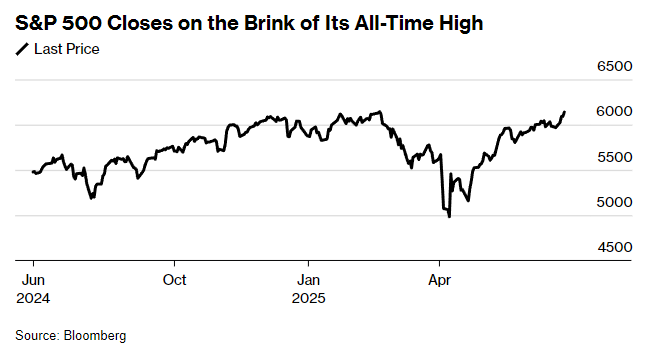
Group 1 - Global stock market indices reached all-time highs due to easing geopolitical tensions and increased expectations for interest rate cuts by the Federal Reserve [1] - Asian stock index futures rose across the board, following a 0.8% increase in the S&P 500 and a 0.9% rise in the Nasdaq 100, contributing to the MSCI global index reaching a new high [1] - The U.S. Treasury market strengthened as traders increased bets on rate cuts, with the interest rate swap market fully pricing in two cuts this year and a third cut being anticipated [1] Group 2 - U.S. economic data reinforced expectations for policy easing, with Q1 consumer spending growth hitting a pandemic-era low and GDP annualized growth rate revised down to -0.5% [4] - Despite a decrease in initial jobless claims, continuing claims rose to the highest level since 2021, indicating labor market challenges [4] - The U.S. dollar index fell alongside U.S. Treasury yields, while emerging market currencies rose for the third consecutive day [4] Group 3 - The Federal Reserve officials emphasized the need for more time to assess whether tariff-induced price increases would lead to sustained inflation [6] - San Francisco Fed President Daly acknowledged evidence suggesting tariffs may not cause widespread persistent inflation, keeping an open stance on potential rate cuts in the fall [7] - Economists expect the core PCE price index to show only a slight increase of 0.1% in May, marking the mildest performance in three years [7]
投行:如果霍尔木兹海峡关闭 股市可能暴跌20%
news flash· 2025-06-23 04:11
Core Viewpoint - The investment bank Panmure Liberum suggests that if Iran retaliates against attacks on its nuclear facilities without closing the Strait of Hormuz, the stock market may experience an initial decline of approximately 5%-10%. However, if Iran closes the Strait, a significant inflation shock could occur, potentially leading to a stock market drop of 10% to 20% [1]. Group 1 - If the Strait of Hormuz is closed, a severe stagflation shock similar to that of 2022 is expected [1]. - The bank indicates that the inflation impact from closing the Strait would be substantial but not enough to derail the markets and economies of the US, UK, and Eurozone in the long term [1]. - A potential new bear market could emerge if trade tensions escalate again in early July [1].
欧洲央行管委Rehn:如果中东危机延续,欧元区面临滞胀冲击的风险。
news flash· 2025-06-19 07:43
Core Viewpoint - The European Central Bank's Governing Council member Rehn warns that the ongoing Middle East crisis poses a risk of stagflation for the Eurozone [1] Group 1 - The Eurozone may face stagflation if the Middle East crisis continues [1]