灵长类基因组计划

Search documents
这些有趣的动物“冷知识”,你知道几个?
Xin Lang Cai Jing· 2025-12-20 07:48
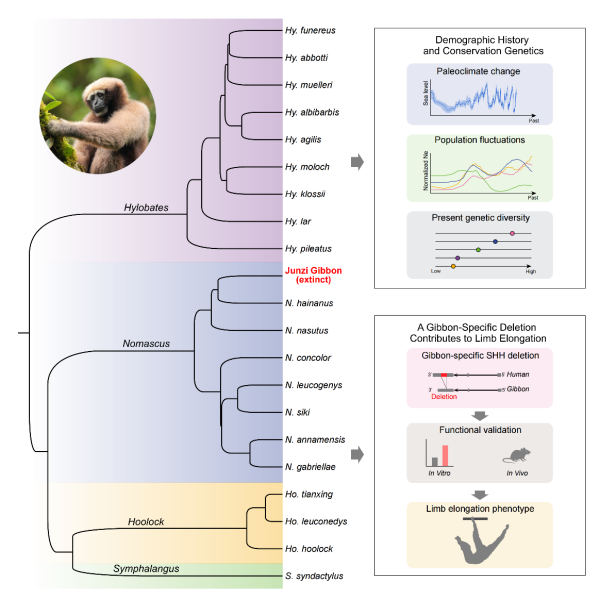
Group 1 - The research team from Kunming Institute of Zoology has sequenced the genomes of 17 ancient dogs, marking the first acquisition of ancient dog genomes from China, and constructed a lineage evolution map of domestic dogs from East Asia to Western Eurasia [1][2] - The study reveals that a unique ancient lineage of domestic dogs existed in China 5,000 years ago, with subsequent genetic influx from Siberian and Western ancient dog lineages, indicating a significant historical connection between dog migration and human movements [1][2] - The findings suggest that the movement of dog lineages over the past 10,000 years reflects the interconnectedness of ancient civilizations, with implications for exploring genetic resources in other domesticated animals [2] Group 2 - The Kunming Institute has initiated a "Macaque Biological Resource Bank" project, collecting genomic data from 919 Chinese macaques, revealing unique genetic advantages such as higher genetic diversity and lower genetic load [3] - The study identifies harmful mutations in the DISC1 gene that lead to phenotypes in macaques similar to human mental disorders, providing an ideal animal model for mental health research [3] - Significant differences in drug target gene functions among individual macaques suggest the need for genotyping or sequencing before conducting pharmacological evaluations [3] Group 3 - The international "Primate Genome Project" led by Kunming Institute has elucidated the evolutionary history and population dynamics of gibbons, providing a comprehensive genomic dataset covering 18 extant gibbon species [4] - The research identifies a specific deletion in a regulatory region of core genes controlling limb development, which may have played a crucial role in the evolution of elongated limbs in gibbons [4] - Experimental results from transgenic mouse models indicate that the structural variation associated with gibbons leads to significant relative growth of limb bones compared to wild-type mice, supporting the evolutionary significance of this genetic change [4]
这些动物“冷知识”,看看意外不意外(趣科普)
Ren Min Ri Bao· 2025-12-19 22:10
Group 1 - The research team from Kunming Institute of Zoology has sequenced the genomes of 17 ancient dogs, marking the first acquisition of ancient dog genomes from China, and constructed a lineage evolution map of domestic dogs from East Asia to Western Eurasia [2][3] - The study reveals that a unique ancient lineage of domestic dogs existed in China 5,000 years ago, with subsequent gene flow from Siberian and Western ancient dog lineages, while ancient East Asian ancestry spread widely across the Eurasian steppe [2] - The findings indicate that the migration events of domestic dogs closely coincide with human migrations over the past 10,000 years, reflecting the intimate relationship between dogs and humans throughout history [3] Group 2 - The Kunming Institute of Zoology has initiated the "Macaque Biological Resource Bank" project, collecting genomic data from 919 Chinese macaques and 52 phenotypic data points, revealing unique genetic advantages such as higher genetic diversity and lower genetic load [4] - The study identifies harmful mutations in the DISC1 gene that lead to phenotypes in macaques similar to human mental disorders, providing an ideal animal model for mental health research [4] - Significant differences in drug target gene functions among individual macaques suggest the need for genotyping or sequencing of relevant drug target genes before conducting pharmacological evaluations [4] Group 3 - The international "Primate Genome Project" led by Kunming Institute of Zoology has systematically elucidated the evolutionary history and population dynamics of gibbons, as well as the genetic basis for their distinctive long arms [5] - The research team constructed the most comprehensive gibbon genome dataset to date, covering 18 extant gibbon species, and provided genomic evidence for the evolutionary relationships among various gibbon genera [5] - A specific deletion in a regulatory region of core genes controlling limb development was identified, which may play a crucial role in the evolutionary elongation of gibbon limbs [5]


【科技日报】我国科学家破解长臂猿演化三大谜题
Ke Ji Ri Bao· 2025-11-10 03:04
Core Insights - The research led by the Kunming Institute of Zoology has successfully unraveled the evolutionary relationships, endangered history, and genetic basis of the gibbon phenotype, providing scientific support for species conservation [2][3] Group 1: Research Findings - The study utilized advanced genomic techniques to construct the most comprehensive gibbon genome dataset to date, covering 18 extant gibbon species and three ancient samples, including the extinct "Gentle Gibbon" [2] - The research established the evolutionary sequence of the four major gibbon genera, resolving a century-long classification dispute and confirming the "Gentle Gibbon" found in the tomb of Emperor Qin's grandmother belongs to the Hoolock genus [3] - Genetic analysis indicated that most gibbons experienced a population bottleneck during the Late Pleistocene, approximately 100,000 to 200,000 years ago, with a synchronous recovery around 70,000 years ago, closely linked to global climate changes [3] Group 2: Genetic Mechanisms - The study identified a specific deletion in the SHH gene regulatory region, which is crucial for the long-limbed "brachiation" characteristic of gibbons, revealing the core genetic mechanisms behind the evolution of gibbon traits [3] Group 3: Future Implications - This research is a significant achievement in the international "Primate Genome Project" initiated by the Kunming Institute of Zoology, which will continue to provide a high-throughput, precise research platform for life sciences in China and globally, aiding in biomedicine development and biodiversity conservation [4]