
热电联供

Search documents
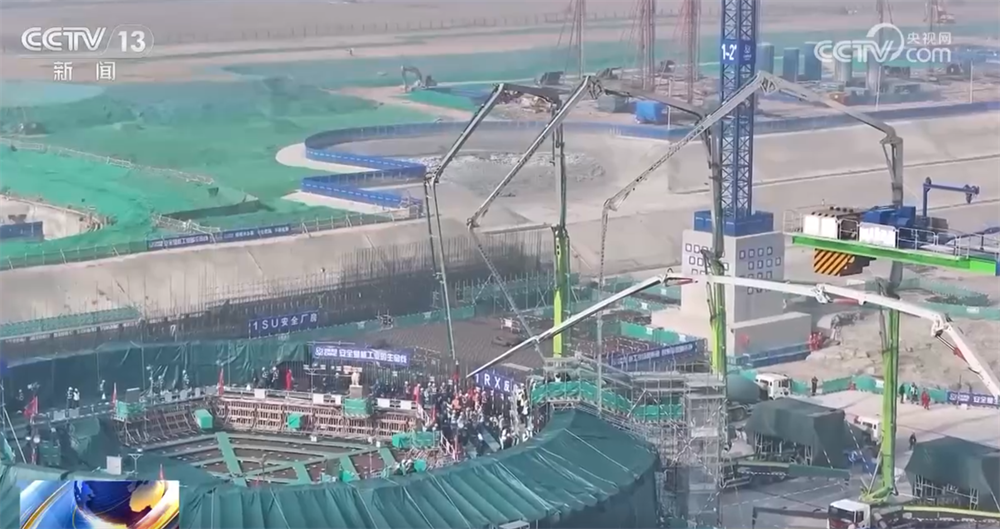
全球首个、从发电为主向多元供给转型!我国核能项目建设刷新“进度条”
Yang Shi Wang· 2026-01-16 08:04
Core Viewpoint - The Jiangsu Xuwei Nuclear Heating Power Plant's Unit 1 has entered the main construction phase, marking China's transition from primarily electricity generation to a diversified energy supply model [1] Group 1: Project Overview - Jiangsu Xuwei Nuclear Heating Power Plant's Unit 1 is the world's first project integrating the "Hualong One" pressurized water reactor with a high-temperature gas-cooled reactor, serving both electricity generation and high-quality steam supply [3] - The project aims to supply 32.5 million tons of industrial steam annually and generate over 11.5 billion kilowatt-hours of electricity, significantly reducing coal consumption by 7.26 million tons and CO2 emissions by 19.6 million tons [6] Group 2: Technological Innovations - The project features two "Hualong One" pressurized water reactor units and one high-temperature gas-cooled reactor unit, designed to provide a comprehensive energy solution that supports China's climate change initiatives and carbon neutrality goals [8] - Advanced construction techniques, including modular construction and the use of 47 intelligent and digital equipment technologies, are being employed to enhance safety and efficiency during the construction process [11] Group 3: Construction Challenges and Solutions - The construction layout is more complex than typical nuclear power plants, with a T-shaped arrangement of the reactor units, which increases construction difficulty [9] - Innovative technologies such as laser welding are being utilized to improve welding quality and efficiency, achieving over three times the efficiency compared to manual operations [13]

SOFC行业动态交流
2025-11-16 15:36
Summary of SOFC Industry Conference Call Industry Overview - The Solid Oxide Fuel Cell (SOFC) industry is characterized by a wide power range from kilowatt to megawatt levels, suitable for distributed generation, backup power for data centers, and combined heat and power applications. The combined heat and power efficiency can reach 80%-90%, while the power generation efficiency is between 50%-60% [1][2][3]. Key Features and Advantages - SOFCs have a modular design that allows for flexible scaling, making them suitable for data centers. Their power generation efficiency exceeds that of traditional gas units (50% vs 40%), and they operate quietly. However, the current acquisition cost is high, expected to decrease from 10,000-20,000 yuan per kilowatt to around 1,000 yuan in the next three to five years [1][5][6]. - SOFCs can utilize various fuels such as methane, biogas, methanol, and ethanol, unlike Proton Exchange Membrane Fuel Cells (PEMFCs) which require high-purity hydrogen. SOFCs operate at higher temperatures (550-800°C), providing advantages in specific scenarios [1][6]. Market Dynamics - The domestic SOFC market is primarily composed of demonstration projects and military applications, with a small scale. The global market remains fragmented and immature, relying on the development of the upstream renewable energy sector. In the U.S., the electricity gap and government subsidies promote SOFC applications, but domestic companies face challenges entering the U.S. market [3][21][22]. - The competition in the domestic SOFC field is intense, with Caoyuan Sanhuan leading in sintering technology. Investment in SOFC should focus on production equipment, testing equipment, and supporting services [3][29]. Commercialization and Cost Analysis - The current cost of SOFC systems is approximately 10,000-20,000 yuan per kilowatt, while PEMFCs cost around 2,000 yuan per kilowatt. Despite PEMFCs having a cost advantage, their strict fuel requirements limit their applicability compared to SOFCs [6][19]. - The cost of electricity generated by SOFCs using hydrogen is about 1.5 yuan per kilowatt-hour, with potential for further reduction as technology advances [17][19]. Challenges and Future Outlook - The theoretical lifespan of SOFCs can reach 40,000-50,000 hours, but actual usage is typically only 5,000-6,000 hours. To extend lifespan, integration with energy storage devices and optimization of processes and control strategies are necessary [14][15]. - The SOFC industry is expected to grow significantly if the upstream renewable energy sector develops well. The U.S. market benefits from abundant shale gas resources and substantial government subsidies, which could accelerate SOFC adoption [21][20]. Conclusion - The SOFC industry presents significant potential for growth, driven by technological advancements and market demand for efficient and flexible energy solutions. However, challenges such as high initial costs, competition, and market entry barriers must be addressed to realize this potential [19][24][30].
SOFC行业最新进展
2025-11-14 03:48
Summary of SOFC Industry Conference Call Industry Overview - The conference call focused on the Solid Oxide Fuel Cell (SOFC) industry, particularly the advancements in metal-supported SOFC technology, which operates at lower temperatures (600-650°C) and offers advantages in material selection, cost reduction, and rapid start-up times [1][5][36]. Key Points and Arguments - **Technological Advancements**: The company has partnered with Chris to gain key technology licenses for stack design and cell manufacturing, aiming to complete pilot line construction by the end of 2026 and achieve annual production capacity in the tens of megawatts by 2027 [1][10]. - **Cost Structure**: The current cost of the B1 model SOFC device is approximately 20,000 to 30,000 RMB per kilowatt, with plans to reduce this to below 10,000 RMB per kilowatt through mass production and in-house stack manufacturing. The long-term goal is to reach a cost of 900 USD per kilowatt by 2030 [1][21][23]. - **Market Strategy**: The company intends to focus on selling complete SOFC systems rather than just stacks, providing a more competitive and sustainable solution. This strategy is expected to leverage economies of scale to significantly reduce processing costs [1][22][23]. - **Application Areas**: SOFC technology is particularly promising in data centers and combined heat and power (CHP) applications, offering nearly double the efficiency of gas turbines, despite higher initial construction costs [3][36][38]. Technical Considerations - **Support Structures**: There are three main support types for SOFC: anode-supported, electrolyte-supported, and metal-supported. Metal-supported SOFCs are advantageous due to their lower operating temperatures and ability to use cheaper materials [2][5]. - **Performance Metrics**: The company aims for a lifespan of over 30,000 hours for its SOFC systems, with industry standards targeting 50,000 to 60,000 hours by 2030 [14][25]. - **Production Strategy**: The company plans to produce key components in-house while sourcing raw materials externally. The production methods for components include stamping, etching, and laser cutting, with a focus on cost-effective techniques [8][20]. Competitive Landscape - **Market Position**: The company holds a significant advantage in the SOFC market due to its extensive experience in supporting systems, which account for 60% of the total system cost, compared to competitors who focus primarily on stack sales [17][28]. - **Challenges in North America**: The primary challenge in the North American market is product certification rather than trade friction, emphasizing the importance of product stability and certification capabilities [3][32][36]. Future Outlook - **Expansion Plans**: The company anticipates completing pilot line construction by the end of 2026 and achieving small-scale production by 2027. The potential for scaling up to 1 GW capacity will depend on market demand [15][35]. - **Technological Development**: The company is also exploring the development of Solid Oxide Electrolysis Cells (SOEC) for hydrogen production, indicating a strategic shift towards broader applications of its technology [19][38]. Additional Insights - **Cost Reduction Strategies**: The company aims to achieve cost reductions primarily through economies of scale and in-house production of stacks, which will lower procurement costs and overall system prices [23][24]. - **Market Dynamics**: The competitive landscape includes companies like Delta and Dou Shan, which are still in the early stages of developing supporting systems, while the company has established itself as a leader in this area [27][33]. This summary encapsulates the key insights and strategic directions discussed during the conference call, highlighting the company's position and future plans within the SOFC industry.