热肿瘤

Search documents
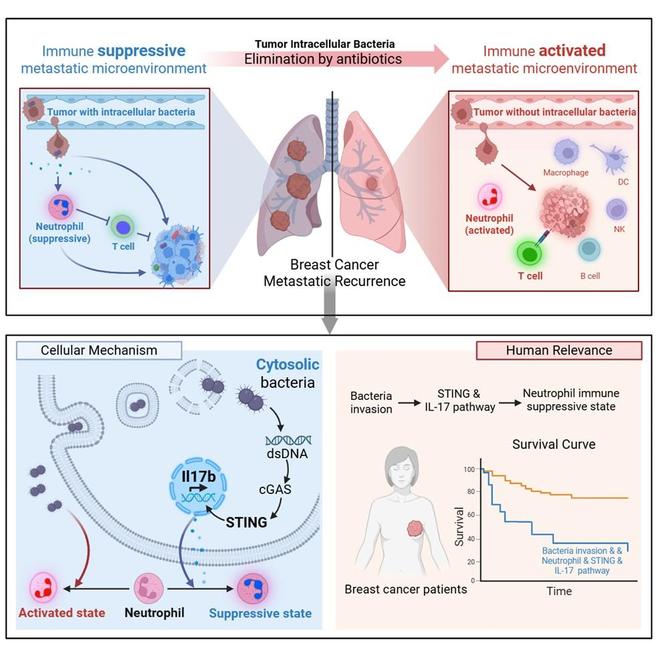
我国科学家首次揭示瘤内细菌调控肿瘤复发新机制
Huan Qiu Wang Zi Xun· 2026-02-06 02:06
Core Insights - The research team at Westlake University has revealed that intratumoral bacteria have a dual role in regulating tumor immunity, providing a new perspective for cancer recurrence prevention and treatment [1][3] Group 1: Research Findings - The study indicates that tumors can be classified into "hot tumors," which are immune-activated, and "cold tumors," which are immune-suppressed, affecting patient response to immunotherapy [1] - The presence of intracellular bacteria significantly increases the recurrence rate of breast cancer, with a recurrence rate of 65% when bacteria are present, dropping to 6.7% after their removal [3] - In a preclinical postoperative recurrence model, mice with strong bacterial invasion signals showed an 80% recurrence rate, which decreased to 20% after the elimination of intracellular bacteria [3] Group 2: Mechanisms of Action - Intracellular and extracellular bacteria have distinctly different effects on immune regulation; while both induce neutrophil accumulation, intracellular bacteria convert them into immune-suppressive cells, whereas extracellular bacteria promote them as "anti-cancer warriors" [4] - The study found that live intracellular bacteria activate specific signaling pathways in tumor cells, leading to the secretion of IL-17B, which suppresses T cell function and promotes tumor recurrence [4] - This research suggests that intratumoral bacteria are not merely accompanying flora but are critical biological factors influencing tumor progression, opening new avenues for cancer treatment by potentially manipulating the growth and function of these bacteria [4]

四川大学最新Cell子刊论文:仿生纳米生物催化剂,让冷肿瘤变热,增强免疫治疗效果
生物世界· 2025-09-14 04:05
Core Viewpoint - Immunotherapy, particularly immune checkpoint blockade (ICB), has transformed cancer treatment but remains ineffective in "cold tumors" due to immune suppression in the tumor microenvironment (TME) [2][5][6] Group 1: Research Findings - A new biomimetic Ru/TiO₂ nanobiocatalyst system inspired by natural enzyme reaction systems (ERS) has been developed, capable of rapid, pH-dependent generation of reactive oxygen species (ROS) and oxygen (O₂), effectively converting cold tumors into hot tumors [3][6][7] - The Ru/TiO₂ system enhances anti-tumor immunity and suppresses tumor metastasis when used in conjunction with ICB therapy [3][7] - This research establishes a precedent for adaptive nanobiocatalysts in the TME and paves the way for the development of next-generation immunotherapies targeting drug-resistant cancers [3][6] Group 2: Mechanism of Action - The study demonstrates that Ru/TiO₂ can mediate immunogenic cell death (ICD) in melanoma cells through endoplasmic reticulum stress, while also inhibiting hypoxia-induced immune suppression [7] - The design of Ru/TiO₂ aims to reverse immune suppression and enhance immunogenicity, transforming "immune cold" tumors into "immune hot" tumors [7] Group 3: Clinical Implications - The findings suggest that the rational design of robust and efficient biocatalytic materials could extend beyond cancer treatment, opening new avenues for immune modulation in other diseases [3][6]