
肿瘤免疫

Search documents
中国生物制药:2025年实现营收318.3亿元 BD动作频频加码创新赛道
Zhong Zheng Wang· 2026-03-27 03:20
Core Insights - The company reported a revenue of 31.83 billion yuan for the year 2025, representing a year-on-year growth of 10.3% [1] - Adjusted net profit attributable to shareholders reached 4.54 billion yuan, with a year-on-year increase of 31.4%, marking four consecutive reporting periods of double-digit growth [1] Business Development Activities - In January 2026, the company acquired Hegia, a siRNA company, for 1.2 billion yuan, gaining access to its long-acting siRNA delivery platform [1] - In February 2026, a global collaboration was established with Sanofi for the JAK/ROCK inhibitor Rovasi, setting a record transaction amount in the transplantation field [1] - In July 2025, the company fully acquired Lixin Pharmaceutical for 950 million USD, obtaining its antibody discovery and ADC technology platform, along with several products in critical clinical stages [1] Pipeline Development - The company employs an "internal R&D + external mergers and acquisitions" strategy, with multiple globally promising products in its pipeline [2] - In the oncology sector, LM-302 (Claudin18.2 ADC) has completed enrollment for a Phase III trial in third-line gastric cancer, while a Phase III trial for first-line gastric cancer has been initiated [2] - LM-108 (CCR8 monoclonal antibody) has entered Phase III for second-line gastric cancer [2] - In liver disease and cardiovascular metabolism, Kylo-11 LPA siRNA is in Phase II clinical trials, with Kylo-12 (APOC3 siRNA) expected to start Phase II in the second half of 2026 [2] - The company has several products in the weight loss and muscle gain sector, with HJY-10 (INHBE siRNA) anticipated to enter clinical trials by 2026 [2] - Data from a Phase I trial of a PD-1/VEGF dual antibody, licensed to Merck, is planned to be presented at AACR in 2026 [2]

医药生物行业:创新药BD持续,建议关注小核酸、GLP、肿瘤免疫等领域
Jianghai Securities· 2026-02-25 06:29
Investment Rating - The industry investment rating is maintained at "Overweight" [7] Core Insights - The report highlights the continuous upgrading of policies in the Heilongjiang biomanufacturing industry, focusing on innovative traditional Chinese medicine and innovative medical devices [4] - The report emphasizes the significant revisions to the Drug Administration Law, which provides institutional support for pharmaceutical innovation and high-quality development [4] - The report identifies three major transformations in China's innovative drug business development (BD) in 2026: technology output combined with product authorization, platform cooperation, and global parallel innovation [8] Summary by Sections Industry Performance - Over the past 12 months, the industry has shown a relative return of -7.06% compared to the CSI 300 index, with an absolute return of 11.53% [3] Investment Highlights - The report notes that BD transactions in the pharmaceutical sector are focused on unmet clinical needs, technological differentiation, and global value [6] - Key areas of focus include oncology therapies such as dual antibodies, ADCs, and TCE combinations, with significant financial agreements highlighted, such as a $650 million upfront payment for a PD-1/VEGF dual antibody [6] - The metabolic disease sector is centered on long-acting GLP-1 and small nucleic acid precision therapies, with notable collaborations resulting in substantial upfront payments and potential total amounts [6] Company-Specific Developments - Companies like Andover Pharmaceuticals and Frontier Biotech have secured significant collaborations with major pharmaceutical firms, indicating a trend towards platform-based cooperation and technology output [7] - Specific collaborations include a $1.05 billion deal for a CTLA-4 inhibitor and a $400 million agreement for small nucleic acid drugs, showcasing the growing interest in innovative therapies [7] - The report suggests monitoring companies such as Rebio Biotech and WuXi AppTec for their advancements in small nucleic acids and platform capabilities [8]

我国科学家首次揭示瘤内细菌调控肿瘤复发新机制
Huan Qiu Wang Zi Xun· 2026-02-06 02:06
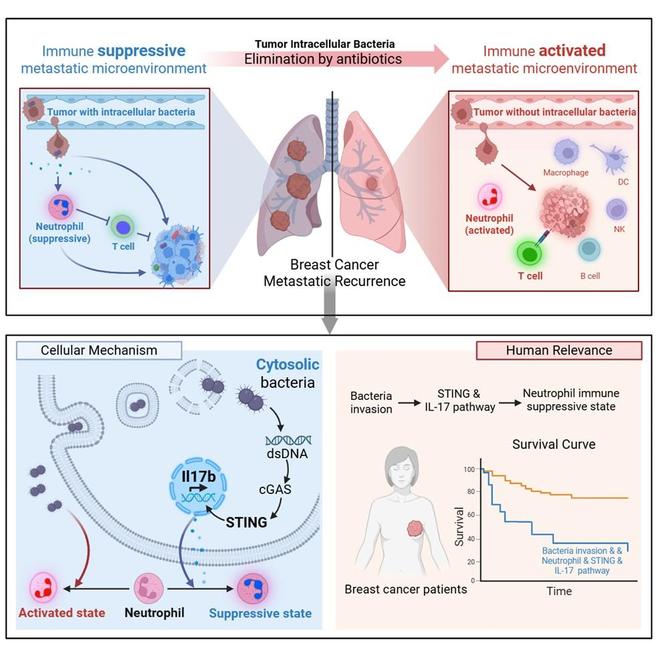
Core Insights - The research team at Westlake University has revealed that intratumoral bacteria have a dual role in regulating tumor immunity, providing a new perspective for cancer recurrence prevention and treatment [1][3] Group 1: Research Findings - The study indicates that tumors can be classified into "hot tumors," which are immune-activated, and "cold tumors," which are immune-suppressed, affecting patient response to immunotherapy [1] - The presence of intracellular bacteria significantly increases the recurrence rate of breast cancer, with a recurrence rate of 65% when bacteria are present, dropping to 6.7% after their removal [3] - In a preclinical postoperative recurrence model, mice with strong bacterial invasion signals showed an 80% recurrence rate, which decreased to 20% after the elimination of intracellular bacteria [3] Group 2: Mechanisms of Action - Intracellular and extracellular bacteria have distinctly different effects on immune regulation; while both induce neutrophil accumulation, intracellular bacteria convert them into immune-suppressive cells, whereas extracellular bacteria promote them as "anti-cancer warriors" [4] - The study found that live intracellular bacteria activate specific signaling pathways in tumor cells, leading to the secretion of IL-17B, which suppresses T cell function and promotes tumor recurrence [4] - This research suggests that intratumoral bacteria are not merely accompanying flora but are critical biological factors influencing tumor progression, opening new avenues for cancer treatment by potentially manipulating the growth and function of these bacteria [4]

Nature系列综述:傅阳心/卢长征系统解读靶向cGAS-STING通路在癌症治疗中的机遇与挑战
生物世界· 2026-01-07 00:21
Core Viewpoint - The cGAS-STING pathway plays a crucial role in detecting tumor-derived DNA, influencing both spontaneous and treatment-induced responses, and establishing a delicate balance between pathological inflammation and protective immune responses [2][3]. Group 1: Overview of cGAS-STING Pathway - The review published in Nature Reviews Cancer discusses the dual roles of the cGAS-STING pathway in cancer, highlighting both its pro-cancer and anti-cancer effects [5]. - It provides a comprehensive analysis of the diverse sources of cGAS-STING activating ligands and their prevalence in various human cancers, including DNA abnormalities caused by chromosomal instability, replication stress, telomere shortening, and treatment-induced DNA damage [7][8]. Group 2: Dual Role in Tumor Progression - The review emphasizes the different outcomes mediated by cGAS-STING activation at various stages of tumor initiation, progression, and metastasis, noting its critical anti-tumor role during tumor initiation and potential pro-tumor effects during tumor progression [8][12]. Group 3: Clinical Implications and Challenges - The review systematically reviews clinical trial results of STING agonists, such as ADU-S100 and MK-1454, and analyzes the limited efficacy due to factors like short drug half-life and differences in tumor microenvironments between humans and mice [14]. - It details the multi-layered negative regulatory networks that limit the anti-tumor effects of the cGAS-STING pathway, including DNA uptake barriers and differential responses of innate and adaptive immune cells [14]. Group 4: Future Directions - The review proposes several optimization strategies for enhancing the efficacy of cGAS-STING-targeted therapies, such as selective induction of mitochondrial DNA release and the development of drug delivery systems that enable spatiotemporal control of activation [15]. - It also suggests that transient inhibition of cGAS-STING signaling may normalize immune responses and enhance the effectiveness of immunotherapy, referencing recent successful cases in early clinical trials [16][17].

STTT:中南大学袁霞/周艳宏合作发现结直肠癌治疗新靶点——INHBA
生物世界· 2025-12-26 08:45
Core Viewpoint - Colorectal cancer (CRC) remains a significant health challenge globally, with high incidence and mortality rates, necessitating further research into molecular mechanisms and potential therapeutic targets [1][2]. Group 1: Research Findings - The study published in Signal Transduction and Targeted Therapy indicates that Inhibin beta A (INHBA) drives CRC progression by reprogramming tumor-associated macrophages (TAM) to the M2 phenotype and suppressing mitochondria-dependent ferroptosis in CRC cells [2][7]. - Elevated INHBA expression in CRC tissues correlates with poor clinical outcomes, promoting cancer cell growth, migration, and invasion, while silencing INHBA inhibits these malignant behaviors [5][7]. - Mechanistically, INHBA activates the succinate/SUCNR1 signaling axis by upregulating SLC25A10, promoting M2-like TAM polarization, and inhibits ferroptosis in CRC cells through the mitochondrial glutathione/GPX4 pathway [5][7]. Group 2: Implications for Treatment - The findings provide a theoretical basis for developing INHBA-targeted inhibitors or combined immunotherapy strategies that induce ferroptosis, potentially improving CRC treatment outcomes [2][7].
启明创投、华安基金等机构参投,明宇制药拟赴港IPO
Xin Lang Cai Jing· 2025-11-26 09:48
Core Viewpoint - Mingyu Pharmaceutical Co., Ltd. has submitted an application for a mainboard listing on the Hong Kong Stock Exchange, with Morgan Stanley, Bank of America, and CITIC Securities as joint sponsors [1] Company Overview - Established in 2018, Mingyu Pharmaceutical is a biotechnology innovation company nearing commercialization, employing a dual-engine development strategy of "tumor immunity + autoimmune" [1] - The company has 13 drug candidates in development, with 10 in clinical stages, featuring a diverse product pipeline that includes ADC drugs, bispecific antibodies, and autoimmune therapies [1] Product Pipeline - In the oncology sector, the core product TROP-2 ADC drug MHB036C targets a multi-billion dollar solid tumor market and is currently undergoing combination therapy studies with PD-1/VEGF bispecific antibody MHB039A, including Phase I/II studies for non-small cell lung cancer and Phase II studies for breast cancer [1] - Another core product, B7-H3 ADC drug MHB088C, has entered Phase III clinical trials for second-line monotherapy in small cell lung cancer and is also being studied in combination with MHB039A [1] - In the autoimmune sector, the core product IGF-1R antibody MHB018A is in Phase III trials for active thyroid eye disease, while topical JAK inhibitor MH004 is set to submit a new drug application for atopic dermatitis in China by 2025 [1] Financial Performance - Financial data shows that the company reported revenues of 0 yuan for 2023 and 2024, with projected revenue of 264 million yuan for the first half of 2025, primarily from licensing B7-H3 ADC drug rights to Qilu Pharmaceutical, valued at 1.345 billion yuan [2] - R&D expenditures for the same periods were 182 million yuan, 281 million yuan, and 98 million yuan, with a cumulative net loss of 587 million yuan [2] Market Potential - According to a report by Zhi Shi Consulting, the global PD-(L)1 bispecific antibody market is expected to grow from 300 million USD in 2024 to 19.16 billion USD by 2035, with the Chinese market projected to reach 3.37 billion USD by 2035 [2] Funding and Valuation - Mingyu Pharmaceutical has completed five rounds of financing, with notable investors including Aobo Capital, Qiming Venture Partners, Huazhong Fund, Tigermed, and IDG Capital [2] - Following a 131 million USD Series C financing round in July 2025, the post-money valuation of the company reached 3.936 billion yuan [2] - The shareholding structure indicates that Dr. Cao Guoqing and his wife collectively hold 36.27% of the shares [2] Use of Proceeds - The funds raised from the Hong Kong listing will primarily be used for core product R&D, production capacity building, commercialization efforts, and working capital supplementation [2]
肺癌下一代免疫“新药王”争夺赛已打响
第一财经· 2025-11-12 03:41
Core Viewpoint - Merck's PD-1 monoclonal antibody, Keytruda, has achieved over $20 billion in annual sales in both 2023 and 2024, solidifying its position as the global leader in the lung cancer treatment market [3]. Group 1: Company Updates - Jun Zhu, CEO of Junshi Biosciences, announced plans for at least eight Phase III clinical trials for HLX43, a PD-L1 ADC targeting non-small cell lung cancer (NSCLC) [5]. - HLX43 demonstrated an objective response rate (ORR) of 33.3% and a disease control rate (DCR) of 75.8% in squamous NSCLC patients, with ORR rising to 48.6% and DCR reaching 94.3% in non-squamous patients [4]. - Junshi Biosciences reported a revenue of 2.82 billion yuan in the first half of the year, a 2.7% increase year-on-year, with a net profit of 390 million yuan, remaining stable compared to the previous year [10]. Group 2: Industry Trends - The competition for the next generation of immune therapies in lung cancer is intensifying, with companies like Junshi Biosciences, Kintor Pharmaceutical, and Innovent Biologics all vying for leadership [6]. - The rise of targeted and immune therapies has reshaped the treatment landscape for lung cancer, expanding the boundaries of treatment options from ADCs to bispecific antibodies and tumor vaccines [5]. - Kintor Pharmaceutical is advancing its PD-1/VEGF bispecific antibody, Ivorin, with plans for eight Phase III clinical studies, while Innovent Biologics is collaborating with Takeda Pharmaceutical on a new generation immune therapy, IBI363 [8].

引爆市场!信达、武田达成百亿美元合作,ADC与肿瘤免疫管线同步上线
Ge Long Hui· 2025-10-25 12:00
Core Insights - The strategic collaboration between Innovent Biologics and Takeda involves three innovative drugs, with a total transaction value exceeding $10 billion, marking a significant milestone for domestic companies in licensing-out agreements [1][3][12] - This partnership is one of the largest licensing deals in China's biotechnology sector to date, highlighting the growing value of Chinese innovative drugs in the global pharmaceutical market [1][12] Summary by Sections Transaction Details - The agreement includes an upfront payment of $1.2 billion (including a $100 million premium for nearly 30% equity stake) and potential milestone payments, bringing the total deal value to a maximum of $11.4 billion, along with sales revenue sharing [3][12] - This transaction sets a new record for licensing deals by Chinese biotech companies and aligns with Takeda's strategic focus on competing in the oncology market, similar to Merck's approach with its K drug [3][12] Drug Pipeline - The collaboration focuses on three key investigational drugs: IBI363 (PD-1/IL-2α-bias), IBI343 (CLDN18.2 ADC), and IBI3001 (EGFR/B7H3 ADC), all of which are at the forefront of tumor immunotherapy and antibody-drug conjugate (ADC) development [3][4] - IBI363 is a globally innovative PD-1/IL-2α-bias bispecific antibody fusion protein, currently undergoing a global Phase III clinical trial for advanced non-small cell lung cancer patients who have failed previous treatments [4][6] - IBI343 has received breakthrough therapy designations for three indications: third-line gastric cancer, second-line pancreatic cancer, and third-line pancreatic cancer, while IBI3001 is the first EGFR/B7H3 ADC currently in Phase I clinical trials [7][9] Market Context - The collaboration reflects a broader trend where global pharmaceutical giants are reassessing the value of Chinese innovative drugs, as evidenced by Merck's success with its K drug, which transformed its oncology business [12] - The partnership between Takeda and Innovent is positioned to compete in the multi-billion dollar global immunotherapy and ADC market, potentially reshaping the global pharmaceutical landscape over the next decade [12]

乐普生物-B(2157.HK):MRG003获批在即 联合PD-1大有可为-聚焦肿瘤免疫 ADC联合IO差异化竞
Ge Long Hui· 2025-10-18 08:56
Group 1 - The company is a leading domestic innovative pharmaceutical enterprise in the ADC and IO layout, with expectations for rapid market penetration of MRG003 upon approval [1] - The company has a robust product pipeline and is exploring business development opportunities abroad, indicating strong long-term growth potential [1] - The initial coverage rating is set to "Buy," with projected revenues of 853 million, 1.204 billion, and 1.665 billion yuan for 2025-2027, respectively [1] Group 2 - MRG003 has received priority review qualification from the CDE for the treatment of R/M NPC, with an NDA submission expected in March 2025, indicating a high likelihood of domestic approval soon [2] - In combination therapy, MRG003 has been officially included as a breakthrough therapy by the NMPA for patients with recurrent or metastatic nasopharyngeal carcinoma who have failed prior platinum and PD-1/L1 treatments [2]
信达生物20250910
2025-09-10 14:35
Summary of the Conference Call for Innovent Biologics Industry and Company Overview - The conference call focuses on Innovent Biologics, a biopharmaceutical company specializing in the development of innovative therapies in oncology, metabolism, and autoimmune diseases [2][5]. Key Points and Arguments - **Revenue Goals**: Innovent aims to achieve total revenue of 20 billion yuan by 2027, with a significant increase expected in the second half of the year following the launch of its weight loss drug at the end of June [2][3]. - **Product Launch**: The company has launched the world's first GLP-1 and GCGR dual-target weight loss drug, which is sold through both hospital and e-commerce channels. Sales peak is anticipated to exceed expectations [2][4]. - **Clinical Trials**: The PD-2 interleukin dual antibody product, IBI363, has initiated multiple Phase III clinical trials and showcased positive data at the ASCO conference for lung cancer, colorectal cancer, and melanoma, indicating its potential as a cornerstone immunotherapy drug [2][4]. - **Future Product Pipeline**: Innovent plans to have five products enter global multi-center Phase III clinical trials by 2030, with IBI363 already in progress [2][5]. - **Financial Performance**: In the first half of 2025, Innovent reported sales revenue of 5.95 billion yuan, a 50% year-on-year increase, and a net profit of 1.21 billion yuan, indicating substantial profitability. The total revenue for the year is expected to reach 12 billion yuan [3]. Additional Important Insights - **Diverse Portfolio**: Innovent has a rich portfolio in oncology, metabolism, and autoimmune diseases, including both self-developed and collaborative CGT projects [2][5]. - **Autoimmune Developments**: The company has launched the first new generation anti-IL-23 monoclonal antibody in China and is advancing TSLRP, anti-IL-2, and anti-IL-4 dual antibodies into Phase I clinical trials [6]. - **Metabolic Innovations**: In addition to the launched weight loss drug, Innovent is developing multiple synergistic weight loss targets and small molecule oral GLP-1 drugs, positioning itself at the forefront of the market [6].