
煤电灵活性改造

Search documents
东北负电价破局之路(下篇)——火电技术改造的转型逻辑
Zhong Guo Dian Li Bao· 2026-02-27 00:46
Core Insights - The article discusses the unprecedented negative electricity prices in Northeast China during the 2026 Spring Festival, highlighting the challenges faced by coal-fired power companies in balancing supply and demand amidst high renewable energy generation [2][3] - It draws parallels with European experiences, particularly Denmark, where similar issues were addressed through technological upgrades and market reforms, allowing coal power to transition from a primary energy source to a flexible service provider [3][9] Group 1: Market Dynamics - From February 14 to 23, 2026, the weighted average price in the Liaoning real-time market was negative for 9 trading days, with 8 days hitting the lower limit of -100 yuan per megawatt-hour, and negative price periods accounting for 96.98% of the time [2] - In contrast to the higher renewable energy penetration in Europe, Northeast China's lower renewable share (31.9% in Heilongjiang, 24.09% in Liaoning, and 36.83% in Inner Mongolia) resulted in longer negative price durations, indicating that the issue stems from the inflexibility of coal-fired power plants [3] Group 2: Technological Solutions - European coal power plants have achieved world-leading flexibility metrics, with Denmark's advanced units operating at minimum outputs as low as 15%-20%, and Germany's large hard coal units reaching 25%-30% [4] - The article emphasizes the importance of decoupling heat and power generation, utilizing technologies such as thermal storage tanks and electric boilers to allow coal plants to operate flexibly and efficiently [4][9] Group 3: Profitability Strategies - Post-upgrade, coal power plants have shifted their profit sources from basic electricity generation to diversified market revenues, including risk mitigation and arbitrage during negative price periods [7] - The ability to participate in ancillary service markets has become a significant revenue stream, with flexible units achieving response rates of 4%-6% Pe/min, which is substantially higher than standard electricity prices [7][8] - Stable cash flows from heat supply contracts provide a buffer against electricity market volatility, allowing coal plants to maintain profitability even during low electricity price periods [8] Group 4: Future Outlook - The transition of coal power from a primary energy source to a flexible service provider is essential for addressing the challenges posed by negative electricity prices, as demonstrated by European practices [9] - The article suggests that the integration of demand-side heating solutions and supply-side flexibility upgrades must work in tandem to effectively resolve the negative pricing issues in Northeast China [9]
广西煤电由“电量主体”向“调节主力”转型
Guang Xi Ri Bao· 2025-11-17 02:35
Core Viewpoint - The Southern Power Grid Guangxi Electric Power Company has successfully transformed coal power from being the main source of electricity to a key player in flexible regulation, achieving a significant reduction in coal power utilization hours and enhancing the capacity for clean energy consumption [1][2] Group 1: Coal Power Flexibility and Utilization - 84% of coal power units in the region have met national flexibility adjustment capability requirements, with peak regulation depth reduced to 36% [1] - The coal power utilization hours in the region are only 1,836 hours, the lowest among the five southern provinces, allowing for the release of 28.8 billion kilowatt-hours of clean energy consumption space [1] - The company is focusing on optimizing coal storage, transportation, maintenance plans, and operational methods to alleviate the conflict between output variation and heating stability [1] Group 2: Industrial Heating and Support - Coal power units in Guangxi are crucial for both grid regulation and providing stable steam heat sources for industrial parks, highlighting the importance of resolving the conflict between output changes and heating stability [1] - The Guoneng Yongfu Power Plant has become a leader in coal power upgrades, achieving a deep peak regulation capability of 35% while reducing the minimum guaranteed heating load from 282,000 kilowatts to 110,000 kilowatts [1] Group 3: Technological Upgrades - The Southern Power Grid Guangxi Electric Power Company has implemented a "three modifications" strategy focusing on heating transformation, flexibility transformation, and coal-saving modifications, resulting in a reduction of the output lower limit by 1.2 million kilowatts [2]
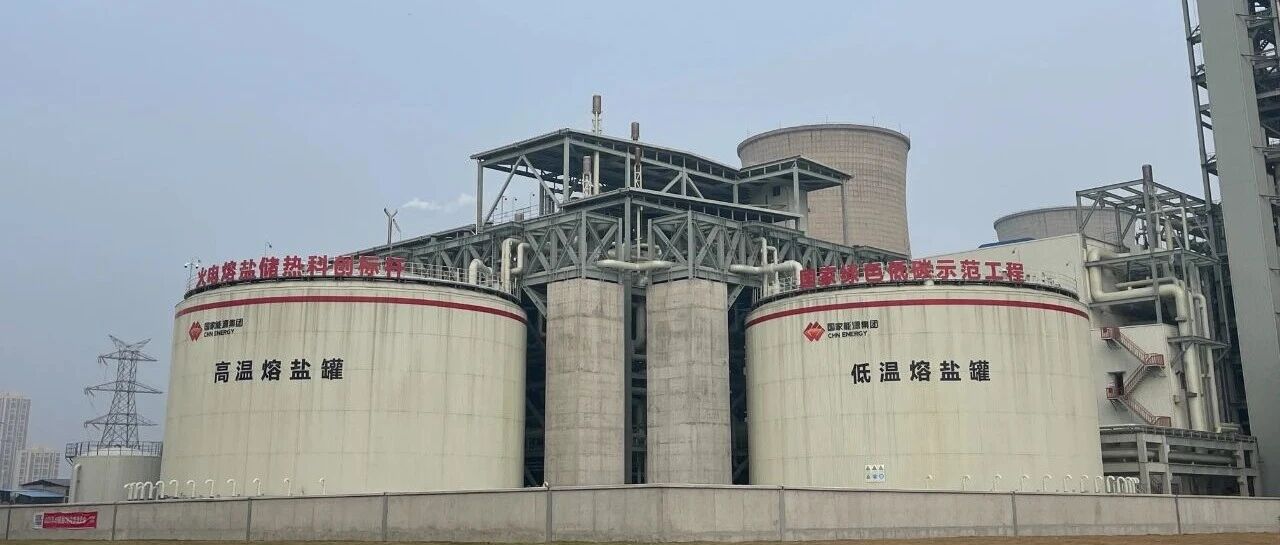
“熔盐储能+煤电”千亿元级市场待激活
中国能源报· 2025-11-16 00:38
Core Viewpoint - The article discusses the challenges and opportunities of "molten salt energy storage" in the context of its integration with coal power plants, highlighting the need for policy guidance, technological innovation, and industry collaboration to overcome existing barriers [1][3][8]. Group 1: Project Overview - The largest domestic molten salt energy storage project combined with coal power, a 350 MW demonstration project at Anhui Guoneng Suzhou Power Plant, has been launched, showcasing significant market potential [3][5]. - The project utilizes two large molten salt tanks, one for high-temperature and one for low-temperature storage, with a total heat storage capacity of 1000 MWh [5][6]. - The project allows for a reduction in minimum technical output from 50% to 30% and increases maximum load from 80% to 100%, demonstrating enhanced flexibility in power generation [5][7]. Group 2: Market Potential - The combination of "molten salt energy storage + coal power" is expected to activate a market potential worth billions, with further applications in high-heat industries like steel and chemicals potentially expanding the market to hundreds of billions [3][5][7]. - If 30% of the existing coal power capacity of approximately 1.1 billion kW were to adopt molten salt energy storage systems, it could lead to significant market investments [7]. Group 3: Challenges in Scaling - High customization requirements for different coal power plants pose a significant challenge, necessitating tailored designs for each system [9][10]. - The initial investment for molten salt energy storage projects is high, with the Suzhou project costing around 340 million yuan, which may deter some power plants from investing [9][10]. - The lack of national standards for molten salt tank design and safety regulations creates additional risks and uncertainties for the industry [9][10]. Group 4: Recommendations for Development - Industry experts suggest that policy support is crucial, including integrating molten salt energy storage into new power system planning and establishing clear compensation mechanisms for peak shaving [11][12]. - Technological innovations aimed at reducing costs and improving efficiency are essential for the widespread adoption of molten salt energy storage [11][12]. - Establishing national standards for design, construction, and acceptance of molten salt storage tanks is necessary to ensure safety and efficiency [11][12].

青达环保(688501):归母净利润实现高增,积极拓展海外市场
Xinda Securities· 2025-11-03 12:01
Investment Rating - The report does not specify an explicit investment rating for the company [1] Core Insights - The company achieved significant growth in total operating revenue and net profit in the first three quarters of 2025, with total revenue reaching 1.47 billion yuan, a year-on-year increase of 91.13%, and net profit attributable to the parent company reaching 124 million yuan, a year-on-year increase of 267.14% [1] - The company is actively expanding its overseas market presence, having signed a major contract for a power plant project in Vietnam worth approximately 181 million yuan [2] - The flexibility transformation of coal-fired power plants is expected to accelerate, which may benefit the company as it develops intelligent solutions for energy management and equipment operation [2] - Revenue forecasts for 2025-2027 are projected at 1.73 billion yuan, 2.17 billion yuan, and 2.61 billion yuan, with corresponding growth rates of 31.7%, 25.3%, and 20.2% [2] Financial Summary - Total operating revenue is projected to grow from 1.03 billion yuan in 2023 to 2.61 billion yuan in 2027, with a compound annual growth rate of 20.2% [3] - Net profit attributable to the parent company is expected to increase from 87 million yuan in 2023 to 293 million yuan in 2027, reflecting a significant growth trajectory [3] - The company's gross margin is expected to stabilize around 33% over the forecast period [3] - The return on equity (ROE) is projected to rise from 9.9% in 2023 to 32.8% in 2027, indicating improved profitability [3]

烟台龙源电力技术股份有限公司2024年年度报告摘要
Shang Hai Zheng Quan Bao· 2025-04-10 19:15
Core Viewpoint - The company is actively adapting to the evolving energy landscape in China, focusing on flexibility and low-carbon transformation of coal power plants, while also expanding its energy-saving and new energy technologies to drive future growth [4][6][7][8]. Company Overview - The company has maintained its accounting firm as Zhongxinghua Accounting Firm (Special General Partnership) for the reporting period, receiving a standard unqualified audit opinion [2]. - The company has proposed a cash dividend of 1.00 yuan per 10 shares to all shareholders, with no stock dividends [3]. Industry Context - As of the end of 2024, China's total installed power generation capacity is projected to reach 3.35 billion kilowatts, with non-fossil energy surpassing coal power for the first time [4]. - By the end of 2025, coal power's share of total installed capacity is expected to drop to one-third, while solar and wind power will exceed coal capacity [4]. Business Performance - The company achieved a revenue of 1.276 billion yuan, a year-on-year increase of 13.06%, while total profit decreased by 31.33% to 79.77 million yuan [8]. - The energy-saving segment saw a revenue increase of 65.18%, driven by the company's focus on coal power flexibility and new energy storage technologies [8]. - The environmental protection segment's revenue decreased by 57.02%, attributed to fewer upgrade projects as most coal power plants completed their ultra-low emission modifications [9]. - The new energy segment's revenue decreased by 45.84%, with biomass coupling technology still in the early demonstration phase [10]. Technological Advancements - The company is promoting deep flexibility transformation technologies for coal power plants, including plasma ignition and digital boiler technologies, to enhance efficiency and adaptability [6]. - The company has made significant progress in low-carbon transformation technologies, achieving stable operation of ammonia co-firing in coal-fired boilers, recognized as a top innovation in the energy sector [7].
