熊彼特式内生增长模型

Search documents
21评论丨诺贝尔经济学奖:在全球经济低迷中探索内生增长动力
2 1 Shi Ji Jing Ji Bao Dao· 2025-10-15 00:08
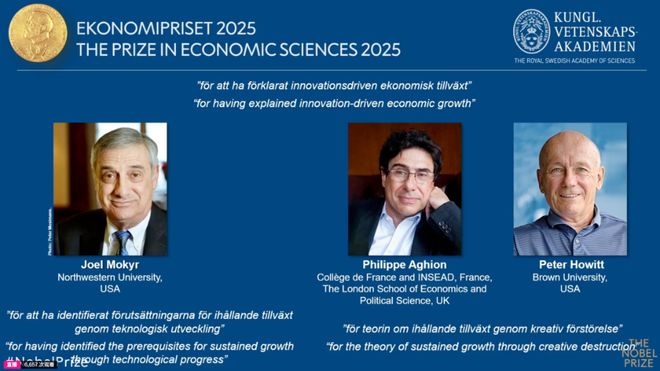
Core Insights - The Nobel Prize in Economic Sciences 2025 was awarded to Joel Mokyr, Philippe Aghion, and Peter Howitt for their contributions to the understanding of innovation-driven economic growth [2][3] Group 1: Theoretical Contributions - Mokyr's research emphasizes the role of knowledge and institutions in long-term growth, particularly how the transformation of knowledge production and dissemination mechanisms contributed to the Industrial Revolution [5] - Aghion's core contribution is the "Schumpeterian endogenous growth model," which highlights the dual role of monopoly rents and competition in driving innovation and productivity growth [6] - Howitt's work, in collaboration with Aghion, integrates financial frictions and market structures into the endogenous growth framework, exploring the impact of credit constraints and institutional quality on innovation [7] Group 2: Practical Implications - The Nobel Committee's choice reflects the practical significance of their research, particularly in addressing productivity stagnation in developed economies through innovation-driven frameworks [9] - Aghion and Howitt's framework links innovation speed, market dynamics, and human capital directly to long-term productivity, providing actionable policy recommendations for decision-makers [9] - Their research on green innovation emphasizes the importance of price signals and R&D support in transitioning from "dirty" to "clean" technologies, relevant in the context of carbon neutrality goals [9] Group 3: Recommendations for China - The scholars advocate for enhancing competition and innovation incentives in China by lowering entry barriers in key industries and strengthening antitrust enforcement [11] - They suggest a tailored approach to policy adaptation based on proximity to technological frontiers, emphasizing competition and original R&D in leading sectors while focusing on absorption and standardization in lagging sectors [12] - The promotion of green technology transitions through carbon pricing, green credit, and government procurement is recommended to capture first-mover advantages in clean technology [12]

21评论|诺贝尔经济学奖:在全球经济低迷中探索内生增长动力
2 1 Shi Ji Jing Ji Bao Dao· 2025-10-13 16:04
Core Insights - The Nobel Prize in Economic Sciences was awarded to Joel Mokyr, Philippe Aghion, and Peter Howitt for their contributions to understanding innovation-driven economic growth [2][3] Group 1: Theoretical Contributions - Mokyr's research emphasizes the role of knowledge and institutions in long-term growth, particularly in the context of the Industrial Revolution, highlighting the importance of practical knowledge accumulation and dissemination [4][5] - Aghion's core contribution is the "Schumpeterian endogenous growth model," which posits that creative destruction drives productivity growth through quality-enhancing innovations, establishing a relationship between competition and innovation [6][7] - Howitt, in collaboration with Aghion, integrates financial frictions and market structures into the endogenous growth framework, exploring the impact of credit constraints and institutional quality on innovation [7][8] Group 2: Policy Implications - The scholars advocate for a combination of innovation policies that balance incentives and knowledge diffusion, including moderate competition, reasonable patent durations, and R&D tax incentives [9][10] - They emphasize the need for tailored industrial and green policies that consider the specific conditions of advanced and catching-up economies, suggesting differentiated tools for different economic contexts [10][11] - The research highlights the importance of inclusive growth strategies to address income inequality resulting from innovation-driven growth, advocating for education, social security, and retraining programs [11][12] Group 3: Relevance to China - The scholars have engaged with Chinese academic institutions, providing insights on enhancing competition and innovation incentives, and suggesting a "frontier-catcher" policy approach [19][20] - They recommend directionality in technological change and green transformation through carbon pricing and emission standards, particularly in sectors like renewable energy and electric vehicles [21][22] - The emphasis on building a robust knowledge ecosystem and open scientific culture is crucial for China's innovation landscape, advocating for the establishment of engineering communities and industry associations [22]