熊彼特式增长范式

Search documents
2025年诺贝尔经济学奖得主菲利普·阿吉翁教授受聘中央财经大学名誉教授并作专题讲座
Xin Lang Cai Jing· 2025-11-15 05:28
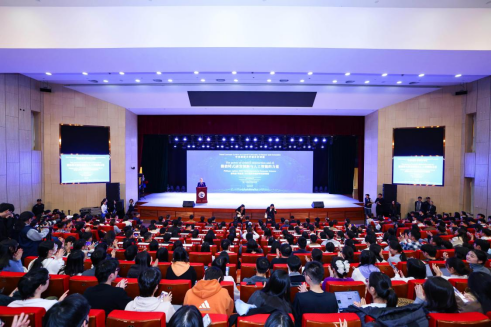
Group 1 - Philippe Aghion, the 2025 Nobel Prize winner in Economics, was appointed as an honorary professor at Central University of Finance and Economics, highlighting the university's commitment to internationalization and academic excellence [1][3] - The university aims to collaborate with Aghion in high-level academic cooperation across multiple fields, promoting interdisciplinary research and international exchange to contribute to global economic development [3][5] Group 2 - Aghion's lecture titled "Schumpeterian R&D Innovation and the Power of Artificial Intelligence" discussed the concept of "creative destruction" and its role in economic growth, emphasizing the tension between monopoly profits that incentivize innovation and potential barriers to entry [5][6] - He countered the pessimistic view that AI primarily leads to job displacement, presenting evidence that AI can enhance productivity, create new tasks, and promote employment, while advocating for policies that foster competition and invest in education and human capital [6][8]

诺贝尔经济学奖,重新发现企业家 | 新京报专栏
Sou Hu Cai Jing· 2025-10-13 15:12
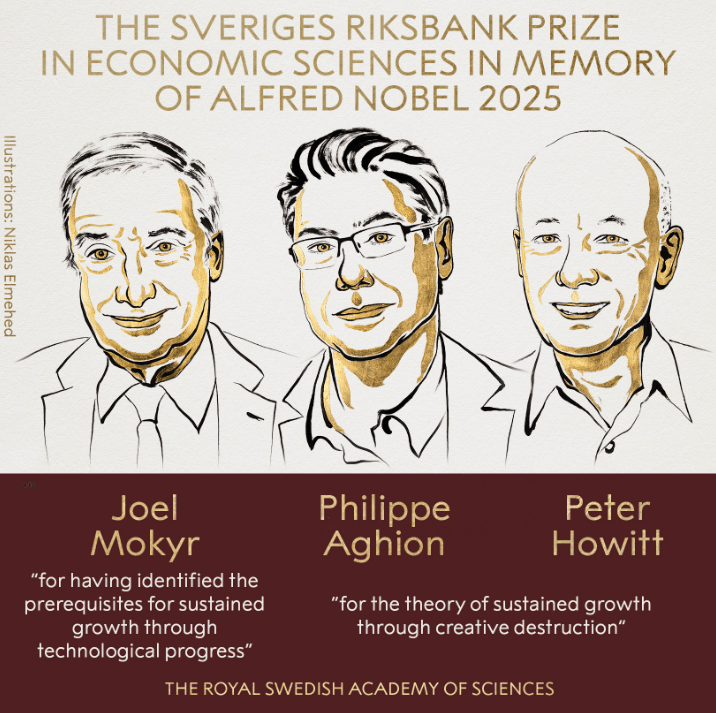
Core Insights - The 2025 Nobel Prize in Economic Sciences was awarded to economists Joel Mokyr, Philippe Aghion, and Peter Howitt for their contributions to the theory of innovation-driven economic growth [4][5] - This award signals a shift in economic research focus from abstract mathematical models to the role of entrepreneurs and entrepreneurial spirit in driving economic activity [4][5] Group 1: Contributions of the Awardees - Mokyr's research emphasizes the historical and cultural context necessary for the emergence of entrepreneurial spirit, highlighting the importance of a society that encourages exploration and allows for disruptive ideas [5][6] - Aghion and Howitt developed the "Schumpeterian growth paradigm," which portrays economic growth as a dynamic process of continuous industry iteration, characterized by "creative destruction" where new technologies and business models replace old ones [6][7] - The combined work of these three scholars presents a more comprehensive view of economic growth, integrating cultural, institutional, and individual agency into the analysis [6][7] Group 2: Implications for Economic Research - The 2025 Nobel Prize reflects a victory for a research paradigm that acknowledges the complexity and dynamism of economic activities, emphasizing the central role of human agency [7] - Aghion's insights suggest that managing the waves of creative destruction is crucial for achieving inclusive prosperity, reinforcing the need to recognize the often-overlooked entrepreneurial spirit in economic theory [7]