物价上涨对策

Search documents
【环球财经】日本国会通过本财年补充预算案
Xin Hua Cai Jing· 2025-12-16 09:25
Core Viewpoint - The Japanese government has approved a supplementary budget for the fiscal year 2025, which is the largest since the pandemic, aimed at addressing rising prices and promoting economic growth [1] Budget Overview - The supplementary budget amounts to 18.3 trillion yen (approximately 118.5 billion USD), representing an increase of over 30% compared to the previous year's budget [1] - 64% of the budget will be financed through the issuance of new government bonds [1] Key Spending Areas - The budget includes 8.9 trillion yen allocated for "living security and price measures" to address rising costs through tax cuts and subsidies [1] - 6.4 trillion yen is designated for "crisis management and growth investment," focusing on AI research, shipbuilding, and space strategy [1] - 1.7 trillion yen is earmarked for strengthening defense and diplomatic expenditures [1] Economic Implications - Media and experts express concerns that the government's focus on large-scale spending avoids discussions on fiscal sources and fundamental reforms, potentially leading to further depreciation of the yen and increased inflation [1] - There are worries that this approach may exacerbate the lack of demand for Japanese government bonds, undermining the credibility of both Japanese bonds and currency [1]
日本首相提名将延期,高市面临困难开局
日经中文网· 2025-10-09 08:00
Core Viewpoint - The delay in the coalition agreement between the Liberal Democratic Party (LDP) and Komeito is likely to lead to policy stagnation and could impact Japan's diplomatic agenda, with potential consequences for the new government's stability and longevity [2][5][10]. Group 1: Coalition and Leadership Dynamics - The coalition agreement between the LDP and Komeito has been unusually postponed, with the prime minister's nomination likely pushed to after October 20 [2]. - High-ranking officials within the LDP, including influential Vice President Taro Aso, are distancing themselves from Komeito, raising concerns about the stability of the coalition [5]. - Komeito's leader, Tetsuo Saito, has expressed the need for clarity on political funding issues, particularly regarding the appointment of members with unreported political funds [4][5]. Group 2: Economic Policy and Budget Challenges - High市 has emphasized the urgency of addressing rising prices and has proposed expanding support funds for local governments, but the delay in forming a government complicates the passage of the 2025 supplementary budget [5][6]. - The current government lacks a majority in both houses of parliament, making it difficult to pass budget proposals without support from opposition parties [6]. - The proposed tax reforms and budget for 2025 are under scrutiny, with the National Democratic Party opposing the budget due to insufficient funding guarantees [6]. Group 3: Diplomatic Engagements - High市 plans to attend the ASEAN summit in Malaysia starting October 26, but delays in her appointment could reduce preparation time for diplomatic engagements [8]. - Upcoming meetings with U.S. President Trump and discussions on trade agreements and security cooperation are anticipated, highlighting the importance of timely leadership transition [9]. - The new government's approach to historical issues and relations with China and South Korea will be closely monitored, as past administrations have maintained high approval ratings initially [10].

日本自民党总裁选举发布公告,5人参选
日经中文网· 2025-09-22 08:00
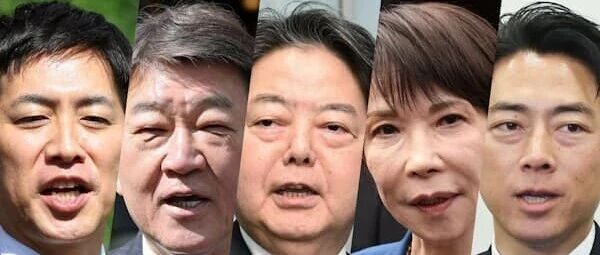
Core Viewpoint - The upcoming leadership election of Japan's ruling Liberal Democratic Party (LDP) is primarily focused on economic policies, particularly measures to address rising prices, as well as foreign and security policies. The election will take place on October 4, following a series of debates and discussions among the candidates [2][5][7]. Group 1: Candidates and Their Proposals - The candidates for the LDP leadership include former Economic Security Minister Takashi Kobayashi, former LDP Secretary-General Toshimitsu Motegi, Chief Cabinet Secretary Yoshihide Suga, former Economic Security Minister Sanae Takaichi, and Agriculture Minister Shinjiro Koizumi. All five have previously participated in the presidential election in September 2024 [2][4]. - Takashi Kobayashi advocates for a flat tax reduction for young and working individuals to combat rising prices. Toshimitsu Motegi proposes a special local grant of several trillion yen to support living expenses. Yoshihide Suga suggests making a 1% annual increase in real wages a standard practice [5][6]. Group 2: Election Context and Process - This election marks the first leadership contest for the LDP after suffering significant losses in both the House of Representatives and the House of Councillors elections in 2024, resulting in the party becoming a minority ruling party. The ability to pass budgets and legislation will depend on cooperation with opposition parties [7]. - The election will utilize a "full-scale" voting method, where each LDP member of the Diet receives one vote, totaling 295 votes from Diet members, alongside an equal number of votes distributed to party members and supporters, resulting in a total of 590 votes [7]. - If no candidate secures a majority in the first round, the top two candidates will proceed to a runoff, where the weight of Diet member votes remains the same, but the distribution of party member votes will change [8].