物料成本上升

Search documents
Omdia:2025年第三季度东南亚智能手机出货量下降1%
Huan Qiu Wang Zi Xun· 2025-11-18 08:16
Group 1 - The Southeast Asian smartphone market is projected to decline by 1% year-on-year in Q3 2025, with shipments reaching 25.6 million units, marking the third consecutive quarter of decline [1][3] - Entry-level smartphone shipments are experiencing increased volatility, making management more challenging, yet they remain a key factor in market share rankings [3] - OPPO and vivo are focusing on value rather than volume, while Honor and Xiaomi are increasing shipments to enhance brand penetration, with Honor's Q3 shipments doubling compared to the same period in 2024 [3] Group 2 - After a sluggish first half of 2025, manufacturers are expected to adopt more aggressive strategies in the second half, including the early launch of new products, due to healthier inventory levels [3] - Rising material costs driven by increased memory and storage prices will significantly impact low-priced devices, especially in a price-sensitive market where over 60% of smartphones are priced below $200 [3] - Manufacturers will need to balance competitive pricing with adjustments in selling prices, reductions in hardware costs, or cuts in marketing expenditures to protect profit margins [3]


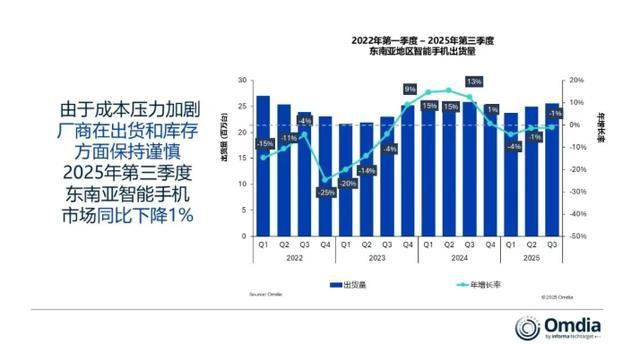
Omdia:成本压力加剧 三季度东南亚地区智能手机出货量同比下滑1%
智通财经网· 2025-11-18 05:52
Core Insights - The Southeast Asian smartphone market is experiencing a decline, with a year-on-year decrease of 1% in Q3 2025, resulting in a total shipment of 25.6 million units, marking the third consecutive quarter of decline [1][9] Market Performance - Samsung leads the region with a shipment of 4.6 million units and an 18% market share, benefiting from a high-end product mix in markets like Thailand, Vietnam, and Malaysia [3] - Transsion follows closely with 4.6 million units and an 18% market share, maintaining slight year-on-year growth [4] - Xiaomi ranks third with 4.3 million units and a 17% market share, driven by the success of its POCO series [4] - OPPO is fourth with 3.8 million units and a 15% market share, facing a significant decline due to weak demand and channel adjustments [4] - Vivo rounds out the top five with 2.9 million units and an 11% market share, supported by its new Y series models [5] Competitive Strategies - The entry-level smartphone segment is becoming increasingly volatile, with brands like OPPO and Vivo focusing on value rather than volume, while Honor and Xiaomi aim to increase market penetration through higher shipments [5] - Transsion's competitive pricing in Indonesia and the Philippines is crucial, but rising memory and storage costs may challenge its pricing strategy [7] - Samsung's early launch of the A17 and A07 series has been pivotal in maintaining its lead in traditional strongholds like Thailand and Vietnam [7] - Xiaomi's strong performance in Malaysia, particularly with the Redmi 15, highlights its ability to accelerate the adoption of 5G devices in the mass market [7]

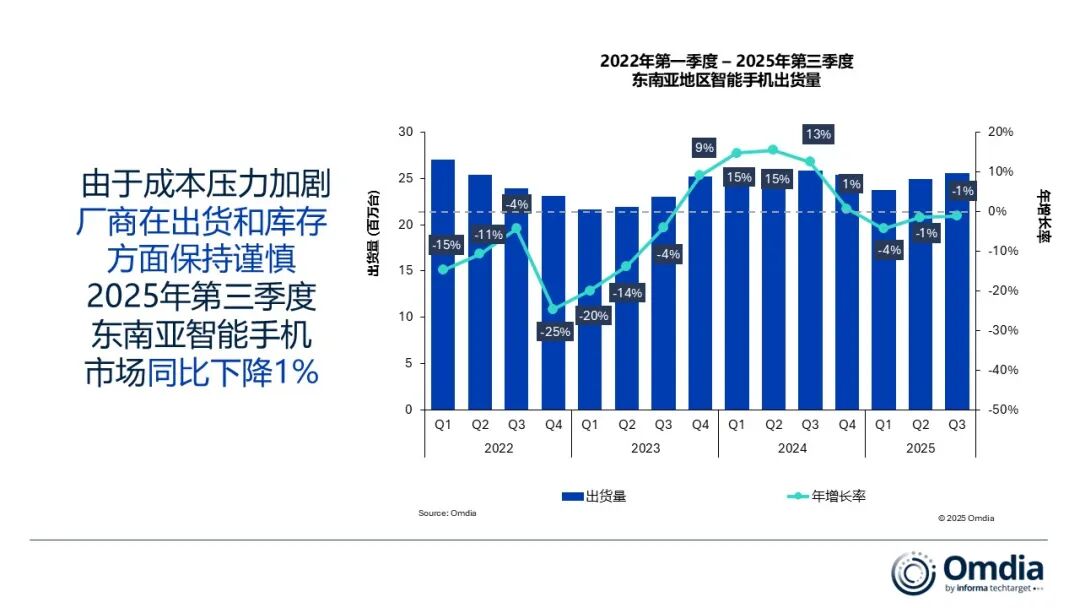
Omdia:2025年第三季度东南亚智能手机出货量下降1%,三星重回榜首,厂商面临成本压力加剧
Canalys· 2025-11-18 04:12
Core Insights - The Southeast Asian smartphone market is experiencing a decline, with a year-on-year drop of 1% in Q3 2025, resulting in a total shipment of 25.6 million units, marking the third consecutive quarter of decline [2] Group 1: Market Performance - Samsung leads the region with a shipment of 4.6 million units and an 18% market share, benefiting from a high-end product mix in markets like Thailand, Vietnam, and Malaysia [2] - Transsion follows closely with 4.6 million units and an 18% market share, maintaining slight year-on-year growth [2] - Xiaomi ranks third with 4.3 million units and a 17% market share, driven by a surge in shipments from the POCO series [2] - OPPO holds fourth place with 3.8 million units and a 15% market share, facing significant declines due to weak demand and channel adjustments [2] - Vivo rounds out the top five with 2.9 million units and an 11% market share, supported by the new Y series models [2] Group 2: Brand Strategies - Entry-level smartphone shipments are becoming increasingly volatile, posing management challenges, yet remain crucial for market share rankings [4] - OPPO and Vivo focus more on value rather than sheer volume, while brands like Honor and Xiaomi aim to increase shipments for broader brand penetration [4] - Following a sluggish first half of 2025, manufacturers are expected to adopt more aggressive strategies in the latter half, including early launches of new products [4] - Rising material costs due to increased memory and storage prices will significantly impact low-priced devices, especially in a market where over 60% of smartphones are priced below $200 [4] Group 3: Competitive Landscape - Transsion leads in Indonesia and the Philippines with its cost-effective Infinix and TECNO models, although rising memory and storage costs may threaten its pricing strategy [7] - Samsung maintains a strong position in Thailand and Vietnam, showcasing resilience amid intensified competition, aided by the early launch of the A17 and A07 series [7] - Xiaomi achieved market leadership in Malaysia with the strong release of the Redmi 15, highlighting its capability to accelerate the adoption of 5G devices in the mass market [7]