
猪肉价格走势

Search documents
2月白条猪肉价格或先涨后跌 均价或环比上涨
Xin Hua Cai Jing· 2026-01-27 07:17
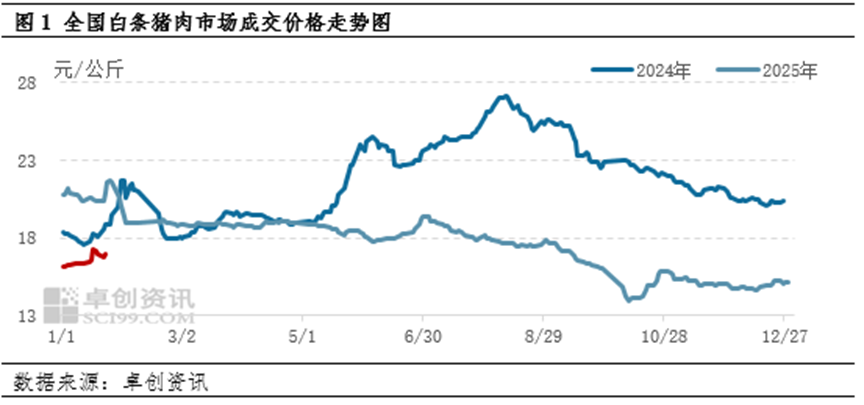
Group 1 - The core viewpoint is that due to the reduction in breeding sow capacity, the supply of live pigs and pork has decreased, leading to a rise in pork prices from Q4 2025 to January 2026 [1][3] - The average transaction price of white strip pork in January 2026 was 16.56 yuan per kilogram, an increase compared to December 2025 [1] - The decline in the number of breeding sows has resulted in a reduced output of live pigs, which, combined with a high price for fattened pigs, has led to a tightening of pork supply [3][6] Group 2 - In January 2026, the demand for pork improved as temperatures dropped, leading to an increase in order volumes and supporting price growth [4] - Looking ahead to February, it is expected that pork prices may rise initially and then fall, with an overall increase in average prices compared to January [6][7] - The demand is anticipated to peak in early February due to the upcoming Spring Festival, which may lead to increased purchasing activity from downstream distributors [7]

猪肉春节前价格上行预期有限
Sou Hu Cai Jing· 2025-12-01 23:57
Core Viewpoint - The traditional seasonal characteristics of pork consumption are weakening, with the upcoming festive season not showing significant demand due to persistently low market prices [1] Group 1: Market Trends - The pork market is entering a festive consumption peak, but the characteristics of the traditional pre-Spring Festival peak may not be evident this year [1] - As of November 27, the national average pork price was 15.18 yuan per kilogram, reflecting a month-on-month increase of 2.89% but a year-on-year decrease of 28.96% [1] - The highest price recorded in November was 15.76 yuan per kilogram, while the lowest was 14.74 yuan per kilogram [1] Group 2: Consumer Behavior - There is a noted shift in consumer dietary structure and consumption concepts, leading to a gradual decline in traditional peak consumption periods such as "Golden September and Silver October" and winter sausage and cured meat production [1] - Analysts indicate that the seasonal characteristics of pork consumption are expected to further weaken by 2025 [1]
10月进口猪肉成交活跃度下降,价格缓跌为主
Zhong Guo Jin Rong Xin Xi Wang· 2025-10-27 07:31
Core Viewpoint - The overall trend of imported frozen pork prices in China is showing a slight decline as of October 2025, primarily due to the continuous decrease in domestic fresh and frozen pork prices [1][3]. Price Trends - As of October 24, 2025, the average transaction price for imported pork products is as follows: - Foreleg: 17,416.67 RMB/ton, down 1.88% from the beginning of the month - Neck bone: 9,500 RMB/ton, unchanged - Ribs: 33,287.18 RMB/ton, down 2.21% - Pig heads: 10,600 RMB/ton, down 5.50% [1][3]. Domestic Pork Prices - Domestic fresh pork prices have rapidly declined, with the price of fresh No. 2 and No. 4 pork dropping to 17.38 RMB/kg by mid-October, reflecting decreases of 7.33% and 7.54% respectively from the start of the month. - By late October, the average transaction prices were: - Fresh No. 2 pork: 17.71 RMB/kg, down 5.56% - Fresh No. 4 pork: 17.75 RMB/kg, down 5.54% - Frozen No. 2 pork: 17.72 RMB/kg, down 5.03% - Frozen No. 4 pork: 17.76 RMB/kg, down 5.30% [3]. Market Dynamics - The price advantage of imported products is diminishing, leading to a cautious purchasing approach from downstream customers, who are reducing their procurement of imported products. - The sales speed of imported frozen pork is slowing down, with most imported pork products experiencing price declines. However, limited port inventory and the intention of importers to maintain prices have resulted in smaller price drops compared to domestic pork [3][5]. Future Outlook - For the fourth quarter, the import volume of pork and pork by-products is expected to be limited, with small port inventories and manageable sales pressure for importers. - The demand during the peak consumption season in November and December may lead to a slight rebound in domestic pork prices, but overall levels are expected to remain low, indicating weak purchasing intentions for imported frozen products [5][6]. - It is anticipated that imported pork prices will continue to decline in November and December, but the extent of the decline is expected to be limited [6].

猪肉市场:四季度中后期价格有望止跌回升
Sou Hu Cai Jing· 2025-10-24 10:25
Core Viewpoint - The Ministry of Agriculture and Rural Affairs indicates that pig prices are expected to stop declining and begin to rise in the later part of the fourth quarter, with narrow fluctuations anticipated [1] Production Insights - Since the second quarter, the number of newborn piglets has increased, leading to a peak in pig slaughter volume in the fourth quarter [1] - The previous backlog of large pigs is being cleared, and secondary fattening has decreased, resulting in a stable slaughter rhythm [1] - The increase in pork supply is expected to be lower than the increase in slaughter volume [1] Consumption Factors - With the drop in temperatures, southern regions are expected to start processing cured meat, which will boost pork consumption [1] Trade Dynamics - Due to the implementation of temporary anti-dumping measures on imported pork and pork by-products from the European Union, the volume of pork imports is likely to decline further [1]
9月猪肉价格或继续偏弱
Xin Hua Cai Jing· 2025-08-22 07:10
Group 1 - The core viewpoint indicates that the pork market in September is likely to remain in a state of oversupply, leading to continued weak prices [3] - After the Spring Festival, the average transaction price of white strip pork in August was 17.72 yuan/kg, a month-on-month decrease of 4.77% and a year-on-year decrease of 32.10%, primarily due to oversupply [1] - The supply side shows that most large-scale farms are still actively selling, but the enthusiasm for secondary fattening is more cautious, indicating a potentially sufficient pork supply [1][3] Group 2 - On the demand side, the start of school in September has slightly boosted orders from wholesale markets, supermarkets, and direct sales stores, but this increase is not enough to match the supply growth [1] - The seasonal index indicates a seasonal decline in demand in September, which is unfavorable for pork prices [2]