环保型涂料

Search documents
中国电泳漆市场现状研究分析与发展前景预测报告
QYResearch· 2025-12-31 09:24
Core Viewpoint - The electrophoretic paint market in China is characterized by moderate scale, technical intensity, and stable growth, driven by both domestic demand and global industry trends. The market is expected to grow from $1,504.1 million in 2024 to $1,855.5 million by 2031, with a CAGR of 2.80% from 2025 to 2031 [3][9]. Market Size and Growth Trends - The Chinese electrophoretic paint market is projected to reach $1,504.1 million in sales revenue by 2024 and $1,855.5 million by 2031, indicating a stable growth trend with a CAGR of 2.80% from 2025 to 2031 [3]. Demand Analysis - The automotive and home appliance sectors are the primary consumers of electrophoretic paint, with automotive applications requiring high corrosion resistance and compatibility with subsequent coatings. The demand from the home appliance sector is characterized by large-scale, standardized needs [9]. Competitive Landscape - The market features a mix of international giants and local specialized manufacturers. Multinational companies dominate the high-end market due to their advanced formulation technologies and relationships with major automotive manufacturers, while local firms excel in the mid-to-low-end market segments [10][13]. Key Players - Major players in the Chinese market include PPG Industries, BASF, Haolisen, Xiangjiang Kansai, Axalta, Nippon Paint, and Jinlitai, with the top three companies holding approximately 38.63% of the market share in 2024 [13]. Industry Chain Analysis - Upstream - Key raw materials for electrophoretic paint include resins, solvents, additives, and pigments, with the chemical industry being the primary upstream sector. The market is competitive, and product costs are closely linked to fluctuations in crude oil prices [16]. Industry Chain Analysis - Midstream - Foreign brands hold a strong position in the automotive OEM paint sector, with six major companies controlling about 90% of the market share in automotive coatings. Domestic companies are gradually gaining market share in non-passenger vehicle segments [17]. Industry Chain Analysis - Downstream - The downstream industries include automotive manufacturing and other sectors such as engineering machinery, motorcycles, hardware, and home appliances, which are closely tied to macroeconomic conditions and exhibit cyclical characteristics [18]. Development Drivers - Key drivers for the industry include government support for environmentally friendly coatings, advancements in technology leading to diverse and functional products, and stable growth in downstream industries such as automotive and home appliances [21]. Development Constraints - The industry faces challenges such as risks from macroeconomic fluctuations, volatility in raw material prices, and intense competition, particularly from foreign brands in the high-end market [21].

2025年中国轨道交通装备用涂料行业壁垒、政策、发展规模、应用市场结构、竞争格局及发展趋势研判:市场需求持续扩容,国内龙头企业积极向高端市场渗透[图]
Chan Ye Xin Xi Wang· 2025-12-24 01:33
Core Viewpoint - The rail transit equipment coating industry is experiencing significant growth driven by the expansion of the rail transit sector in China, with a dual growth pattern of "new construction + maintenance" [1][7]. Industry Overview - Rail transit equipment coatings are essential for protecting and beautifying train surfaces, providing anti-rust and anti-corrosion properties, which are critical for product quality [1][7]. - The market demand for rail transit coatings is expected to grow, with a projected demand of 73,921 tons in 2024 and 77,572 tons in 2025 [1][7][8]. - The market size for rail transit coatings is anticipated to reach 2.206 billion yuan in 2024 and 2.337 billion yuan in 2025 [1][7]. Market Structure - The rail transit coating market is divided into new vehicle matching (28.59% in 2024) and maintenance (71.41% in 2024) segments, with the latter dominating the market [1][7]. - By 2025, the new vehicle matching segment is expected to increase to 30.35%, while the maintenance segment will decrease to 69.64% [1][7]. Industry Chain - The upstream core raw materials for rail transit coatings include resins, pigments, additives, and solvents, with epoxy and polyurethane resins being widely used [8]. - The midstream involves the research and production of rail transit coatings, while the downstream applications include high-speed trains, subways, and freight trains [8]. Competitive Landscape - The market shows a mix of diversification and concentration, with large multinational companies like PPG and AkzoNobel dominating the high-end market, while domestic leaders focus on narrowing the technology gap [10]. - Key domestic companies include Zhuzhou Feilu High-tech Materials Co., Ltd., Qingdao Aierjiacai New Materials Co., Ltd., and others, with a focus on innovation and quality [10][12]. Development Trends - The industry is moving towards high-end functional coatings with higher added value, including self-repairing and smart sensing coatings, which are expected to drive profit growth [13]. - The integration of new materials and technologies will continue to inject vitality into the industry, with advancements in intelligent coating technologies enhancing efficiency and quality [13].

全球与中国3C涂料市场现状及未来发展趋势
QYResearch· 2025-07-03 10:09
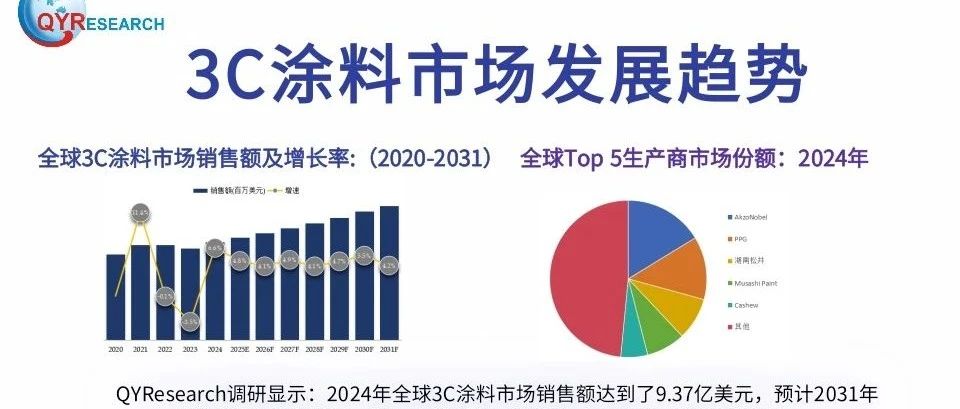
Core Viewpoint - The 3C coating industry is experiencing stable growth and structural transformation, driven by the recovery in demand from mobile phones, laptops, and wearable devices, particularly in emerging manufacturing bases like China, India, and Vietnam [3][10]. Industry Current Status - The overall demand for 3C coatings is expected to recover in 2024, reaching a market size of $937 million, with China holding a dominant market share of 62.86% [3][10]. - The global manufacturing focus is shifting, with Vietnam and India emerging as new locations for brand manufacturers to diversify risks, prompting international coating companies like AkzoNobel and PPG to increase capacity in Southeast Asia [3][10]. - There is a rapid acceptance of environmentally friendly coatings, such as water-based and low VOC systems, leading to the accelerated iteration of traditional solvent-based PU systems [3][10]. Development Trends - The future of the 3C coating industry will focus on environmental sustainability, functionality, and automation [5]. - Water-based UV and low-temperature curing systems are expected to replace traditional solvent-based coatings, becoming mainstream choices for high-end mobile phones and laptops [5]. - The functional sub-market is anticipated to grow quickly, with multi-functional coatings featuring fingerprint resistance, anti-glare, and anti-blue light properties being widely adopted in emerging electronic products like foldable screens and OLED panels [5]. Global Market Size Analysis - The global 3C coating market is projected to reach $937 million in sales in 2024 and grow to $1.284 billion by 2031, with a CAGR of 4.57% from 2025 to 2031 [7]. - The growth is primarily driven by the rising demand for appearance treatment due to the upgrade of smart terminal products and the gradual replacement trend of water-based eco-friendly systems [7]. Market Share and Competition - In 2024, the top five manufacturers, including AkzoNobel, PPG, and Hunan Songjing, will hold a combined market share of 51.54% [12]. - International brands focus on high-end mobile and laptop segments, while local brands dominate the mid-to-high-end Android model supply chain in China, showcasing a differentiated competitive landscape [12]. Policy Analysis - Recent policies encourage the development of low VOC content, environmentally friendly coatings for key industries, including electronics [16]. - The regulatory environment is tightening, promoting the use of low (or no) VOC content materials in coatings, which aligns with the industry's shift towards sustainability [16].