生态化生存

Search documents
阿维塔冲刺港股IPO:以生态合力,破局2026行业深水区
Mei Ri Jing Ji Xin Wen· 2025-12-30 03:52
Core Insights - The Chinese electric vehicle market is at a critical juncture in 2026, facing challenges due to reduced purchase tax incentives and increased technological barriers, leading to a reshuffling of the industry focused on profitability and core technology [1] - Companies are adjusting their strategies, with Avita Technology taking an aggressive stance by filing for an IPO in Hong Kong and forming partnerships with major players like JD.com and Haier to build a unique ecosystem [1][3] Group 1: IPO Significance - Avita's IPO represents a milestone as the first central enterprise electric vehicle brand to apply for listing on the Hong Kong Stock Exchange, validating its governance and compliance capabilities [3] - The financial data disclosed in the prospectus shows a robust growth trajectory, with revenue projected to increase from 5.645 billion yuan in 2023 to 15.195 billion yuan in 2024, marking a year-on-year growth of 169.16% [3] - The company achieved a significant improvement in profitability, with gross margin turning positive in 2024 and reaching 10.1% in the first half of 2025, indicating potential for sustainable self-funding in the high-end market [3] Group 2: Funding Utilization - The funds raised from the IPO will primarily be used for developing new products and platforms, brand building, expanding sales networks, and supplementing working capital, indicating a strategic push rather than merely seeking financial support [4] - Avita's cash reserves, exceeding 13 billion yuan as of June 2025, combined with the IPO proceeds, will provide a strong financial buffer for the competitive landscape in 2026 and beyond [5] Group 3: Business Model and Ecosystem - Avita's rapid growth is attributed to its unique CHN model and a light-asset operational system, focusing on integrating top resources and core value rather than heavy asset investments [7] - The company has established deep collaborative ecosystems with Huawei and CATL, ensuring access to cutting-edge technology and creating additional revenue streams beyond vehicle sales [9] - Avita's international expansion strategy has led to entry into over 38 countries since September 2024, adopting a high-end pricing strategy to build a global luxury brand image [9] Group 4: Strategic Differentiation - In the face of uncertainty in 2026, Avita is pursuing a differentiated path by integrating ecosystems instead of competing in isolation, focusing on strategic concentration rather than blind expansion [11] - The IPO serves as a culmination of the achievements from the CHN model and a crucial resource mobilization for future competition, positioning Avita to leverage its unique advantages in a rapidly evolving market [11]


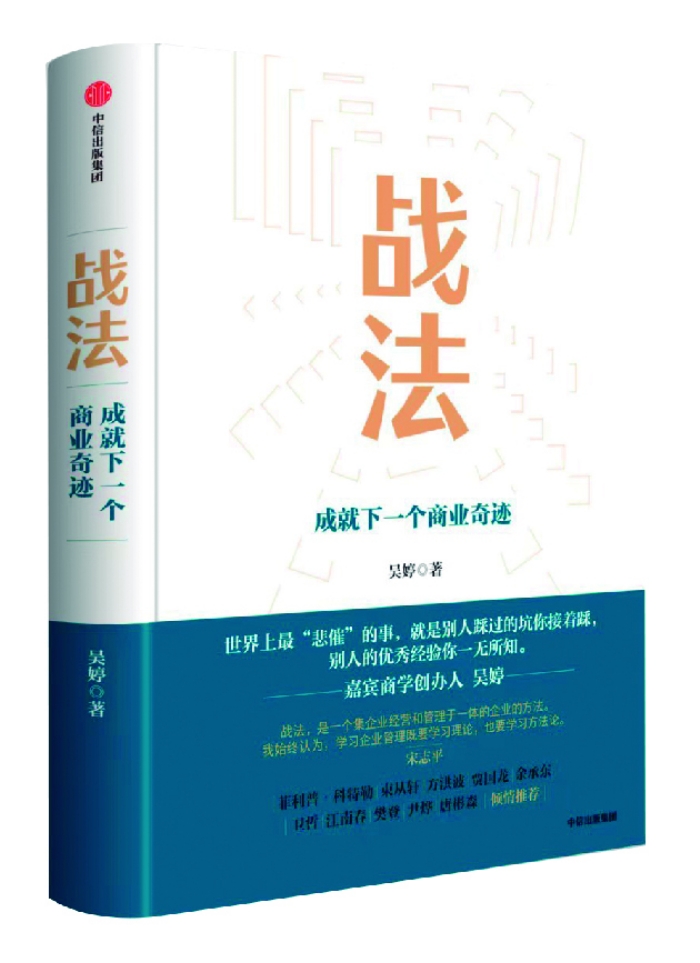
以财经逻辑解码企业战略——读《战法:成就下一个商业奇迹》
Shang Hai Zheng Quan Bao· 2025-05-05 18:18
Core Insights - The book "Strategy: Achieving the Next Business Miracle" by Wu Ting provides a strategic toolbox for business managers through in-depth analysis of 40 classic business cases, addressing the complexities of the competitive environment in 2025 [3][4] Group 1: Business Strategies - The author categorizes business growth into five core paths: speed, precision, strength, innovation, and stability, creating a tactical framework that is transferable and replicable [5] - The book emphasizes the importance of emotional connection and brand persona during crises, illustrated by the case of Laoxiangji during the COVID-19 pandemic [4] - The analysis of Huawei's "Iron Triangle Model" reveals how organizations can achieve agility by breaking down hierarchical structures [4] Group 2: Financial Logic and Decision-Making - The author discusses General Electric's transformation under Jack Welch, highlighting the importance of capital return rate in strategic decision-making, which aligns with modern enterprise value management [7] - Tencent's internal competition mechanism is analyzed to show how "appropriate waste" can enhance innovation success rates, effectively lowering long-term innovation risks [8] - The book introduces the concept of "innovation ROI," stressing that innovation investments must be linked to financial returns, which is crucial for high-tech companies' valuation premiums [9] Group 3: Resilience and Adaptation - The "anti-fragile" strategy is presented as a framework for businesses to thrive in uncertainty, focusing on cash flow resilience, organizational agility, and depth of technological reserves [9] - The case of BYD's transition to new energy illustrates how companies can build resilience amid uncertainty by adopting a platform and ecosystem strategy [8] - The book serves as a strategic guide for business managers and a lens for investors to understand industry trends, emphasizing the need for systematic thinking in navigating complexities [10]