
生成式AI2.0

Search documents
直击CES|Mini LED是彩电焦点,中韩企业比拼谁更出色
Di Yi Cai Jing· 2026-01-06 15:00
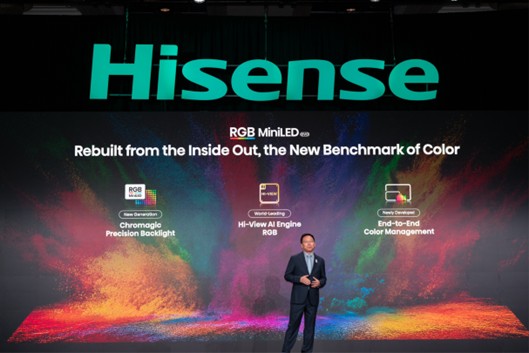
Core Insights - The focus of the 2026 CES is the competition between Chinese and Korean companies in the Mini LED television market, highlighting advancements in RGB-Mini LED technology [2][4] - Major brands like Hisense, Samsung, LG, and TCL are showcasing high-end Mini LED televisions, emphasizing color richness and realism, with AI integration expected to deepen in the industry [2][4] Group 1: Technology Advancements - Hisense introduced RGB-Mini LED technology, incorporating a fourth cyan LED chip to address color issues and achieve 110% BT.2020 color gamut, while reducing blue light and energy consumption [3] - Samsung's Micro RGB Mini LED television utilizes sub-100 micron LED chips to enhance image quality, and LG's Micro RGB Mini LED also achieves 100% BT.2020 color gamut [3][5] - TCL's SQD-Mini LED television combines quantum dot technology with Mini LED, achieving 100% BT.2020 color gamut and a peak brightness of 8500 nits [3][5] Group 2: Market Trends - Mini LED televisions are expected to challenge OLED's position in the high-end market and are projected to grow significantly, with an estimated shipment of 21.1 million units in 2026, a 58% increase year-on-year [9] - Despite an overall decline in global television shipments, Mini LED televisions are anticipated to grow by 40%, reaching a market penetration of 10% [9] - The global shipment of Mini LED televisions is expected to reach 16.12 million units in 2026, marking a 30.1% increase, with the Chinese market leading the growth [10] Group 3: Competitive Landscape - Chinese brands are narrowing the gap with global leaders in the television market, with predictions that they may challenge for the top position by 2026-2027 [11] - The competition among brands has shifted from basic specifications to differentiated display technologies focusing on light sources, chips, and color management systems [5] - AI technology is set to play a significant role in enhancing television experiences, with expectations for deeper integration in 2026, moving towards generative AI applications [11]


CES2026:Mini LED是彩电焦点,中韩企业比拼谁更出色
Di Yi Cai Jing· 2026-01-06 12:38
Core Viewpoint - The industry is entering a phase of growth for RGB-Mini LED TVs and generative AI 2.0, with Mini LED TVs expected to experience growth despite market challenges [1][3]. Group 1: Mini LED TV Market Dynamics - Major brands like Hisense, Samsung, LG, and TCL are focusing on high-end Mini LED TVs at CES 2026, emphasizing color richness and realism [3][5]. - RGB-Mini LED technology is becoming a significant branch of high-end television technology, narrowing the quality gap with OLED TVs and even surpassing them in color gamut [5][6]. - Mini LED TVs are projected to grow in market share, with an expected shipment of 21.1 million units in 2026, representing a 58% year-on-year increase [10]. Group 2: Competitive Landscape - Hisense's RGB-Mini LED technology introduces a fourth cyan LED chip, achieving 110% BT.2020 color gamut and reducing blue light [4][6]. - Samsung's Micro RGB TVs utilize smaller LED chips to enhance image quality, while TCL's SQD-Mini LED TVs achieve high brightness levels and color accuracy [4][6]. - The competition among brands has shifted from basic specifications to differentiated display technologies, focusing on light sources, chips, and color management systems [6][12]. Group 3: Future Projections - Despite an overall decline in global TV shipments, Mini LED TVs are expected to grow by 40% in 2026, reaching a market penetration of 10% [10]. - The global shipment of Mini LED TVs is anticipated to reach 16.12 million units in 2026, marking a significant growth of 30.1% year-on-year [11]. - Chinese brands are expected to narrow the gap with global leaders, potentially challenging for the top position in the global TV market by 2026-2027 [12]. Group 4: AI Integration - The integration of AI in the television industry is expected to deepen, with companies like Samsung, LG, Hisense, and TCL focusing on AI-driven enhancements for user interaction and content generation [12]. - The industry is entering a generative AI 2.0 phase, enhancing user experience through improved audio-visual quality and multi-modal interactions [12].