
电力可靠性管理

Search documents
构建电力可靠性管理新格局 推动电力可靠性工作高质量发展
Zhong Guo Dian Li Bao· 2025-11-28 06:01
Core Insights - The article highlights the significant achievements in power reliability management in China over the past 40 years, emphasizing its role in ensuring the safe and stable operation of the power system and supporting economic and social development [2][3]. Group 1: Historical Achievements - The establishment of the Power Reliability Management Center in 1985 marked the beginning of specialized management in China's power reliability, leading to a comprehensive management system that includes government leadership and industry service [1][2]. - Over 3,000 power companies are now included in reliability statistics, with more than 6,000 professionals dedicated to reliability management and information statistics [2]. Group 2: Improvements in Reliability Metrics - The reliability level of China's power system has significantly improved, with unplanned outages for coal and hydro power units decreasing by over 93% compared to 40 years ago [3]. - Key equipment such as transformers and circuit breakers now have an equivalent availability factor exceeding 99% [3]. Group 3: Enhancements in User Experience - The average outage time for urban users has decreased by 94.55 hours since 1991, with major cities achieving average outage times of less than one hour [4]. - Rural users have seen an 83.67-hour reduction in average outage time since 2004, addressing issues like frequent outages and low voltage [4]. Group 4: Future Challenges and Requirements - The transition to a new energy system requires innovative reliability management methods to address the complexities introduced by renewable energy sources and electric vehicles [5][6]. - There is a need for improved reliability statistics that encompass low-voltage users and renewable energy sources, as current data only covers a fraction of installed capacity [7]. Group 5: Strategic Directions for Development - The focus is on enhancing the reliability management framework to support high-quality economic development and meet the increasing expectations of the public regarding power reliability [8][10]. - The establishment of a professional education system for reliability management is essential to improve the overall competency in the sector [11].
署名文章丨国家能源局副局长何洋:构建电力可靠性管理新格局 推动电力可靠性工作高质量发展
国家能源局· 2025-11-26 10:46
Core Viewpoint - The article emphasizes the importance of enhancing power reliability management in China to support high-quality economic and social development, addressing new challenges and requirements in the context of modern energy systems [2][8]. Historical Achievements - Over the past 40 years, China's power reliability management has evolved significantly, establishing a comprehensive management system that includes government leadership, industry service, and enterprise responsibility [4][5]. - The average unplanned outage frequency for coal and hydropower units has decreased by over 93%, with many coal-fired units operating for more than 1,000 days without interruption [5]. Current Challenges - The transition to a new energy system introduces complexities such as increased randomness and volatility in power generation and consumption, necessitating innovative reliability management methods [9]. - There is a disparity in power reliability statistics, with only 36.14% of wind power and 13.46% of solar power capacity included in reliability assessments, highlighting the need for broader data coverage [10]. Future Directions - The focus is on ensuring reliable power supply to meet the demands of high-quality development, with an emphasis on addressing imbalances in power reliability across urban and rural areas [12][13]. - The article calls for deepening research and pilot projects in power system reliability, enhancing data collection methods, and expanding the coverage of reliability statistics to include emerging energy sources [14][15]. Systematic Improvements - There is a need to establish a robust framework for reliability management, including clear responsibilities at all levels and the development of standardized procedures across various sectors of the power industry [16].


能源早新闻丨市场监管总局:撤销1557张!
中国能源报· 2025-11-12 22:32
Group 1: Energy Sector Developments - The National Energy Administration emphasizes that by 2030, integrated development will become a significant approach for renewable energy, enhancing reliability and market competitiveness, thus supporting a comprehensive green transformation of the economy [2] - Major energy state-owned enterprises are accelerating their relocation to Xiong'an New Area, with headquarters and subsidiaries establishing a collaborative development pattern that includes headquarters, research bases, and supporting enterprises [2] - In October, China's production of power and other batteries reached 170.6 GWh, marking a year-on-year increase of 50.5% and a month-on-month increase of 12.9% [4] - Two 500 kV substations in Sichuan have been put into operation, adding a total of 480 MVA capacity, which will support the electricity supply and high-quality development in the Chengdu-Chongqing economic circle [4] - A significant natural gas discovery in Daban City, Xinjiang, has been reported, with an estimated geological resource of over 200 billion cubic meters, indicating potential for a large oil and gas field [5] Group 2: Regulatory and Market Changes - The Market Supervision Administration has revoked 1,557 mandatory product certification certificates following a validity check on 3,001 batches of products, indicating a focus on compliance in the certification process [3] - The global largest 65-ton lithium battery counterbalance forklift has been launched, representing a technological benchmark in the heavy-duty electric vehicle sector [3] Group 3: International Energy Market Impact - Bulgaria faces a fuel supply crisis due to U.S. sanctions on Russian oil companies, with available gasoline stocks sufficient for only about 35 days [6] - Russian shareholders of Serbia's oil company are willing to transfer control to a third party in response to U.S. sanctions, indicating potential shifts in ownership and operational control in the energy sector [6] Group 4: Power Demand Trends - Xinjiang's power grid recorded a historical peak load of 49.6 million kilowatts, reflecting a stable operation and reliable power supply amidst increasing demand [7]
国家能源局公布名单,282名国家级电力专家!
中国能源报· 2025-11-12 03:10
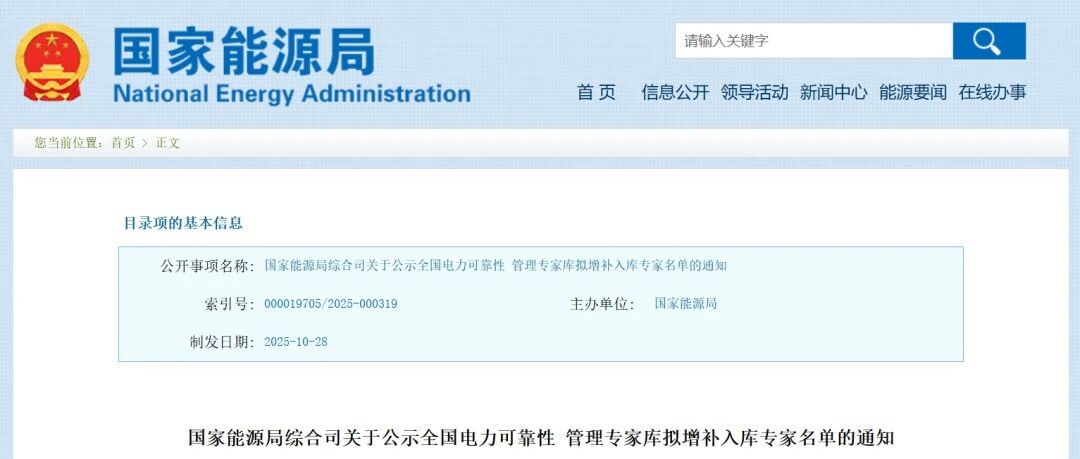
Core Points - The National Energy Administration announced the addition of 282 experts to the National Power Reliability Management Expert Database to enhance technical support in theoretical research, field verification, and data analysis [1][2][20] Group 1: Expert Database Announcement - The National Energy Administration published the list of 282 newly added experts to the National Power Reliability Management Expert Database [1] - The purpose of this addition is to meet the needs of power reliability management and to leverage the expertise of these professionals [1][2] Group 2: Expert Selection - Power companies and relevant agencies can select experts from the newly supplemented expert database as needed [2]

282位国家级电力专家,名单公示!
中关村储能产业技术联盟· 2025-11-01 11:50
Core Viewpoint - The National Energy Administration has announced the public notice for the proposed addition of experts to the National Power Reliability Management Expert Database, totaling 282 experts across various specialties [2][3]. Group 1: Expert Categories - The proposed additions include 191 experts in power supply reliability management, 23 in low-voltage supply reliability management, 49 in power system reliability management, and 19 in information system development and operation [2][3][4][14][17][19]. Group 2: Public Notice Details - The public notice period is from October 30, 2025, to November 5, 2025, during which any objections to the proposed experts can be submitted to the National Energy Administration [3][4]. Group 3: Expert List Highlights - The list of experts includes professionals from various organizations, with a significant number from State Grid Corporation and other regional power companies, indicating a strong representation from established entities in the power sector [4][5][6][14][17][19].
282位国家级电力专家,名单公示!
中国能源报· 2025-11-01 09:56
Core Points - The National Energy Administration has announced the public notice for the addition of 282 experts to the National Power Reliability Management Expert Database, covering various specialties including power supply reliability management, low-voltage power supply reliability management, power system reliability management, and information system development and operation [1][3]. Group 1: Power Supply Reliability Management - A total of 191 experts are proposed for the power supply reliability management specialty [4][15]. - The list includes professionals from various companies, primarily from the State Grid Corporation [4][15]. Group 2: Low-Voltage Power Supply Reliability Management - The low-voltage power supply reliability management specialty includes 23 experts [15][17]. - Experts are affiliated with organizations such as the State Grid and various regional power companies [15][17]. Group 3: Power System Reliability Management - There are 49 experts proposed for the power system reliability management specialty [18][19]. - This group includes professionals from the State Grid and other regional power dispatch centers [18][19]. Group 4: Information System Development and Operation - The information system development and operation specialty consists of 19 experts [20][22]. - Experts in this category are associated with companies like State Grid Information Communication Industry Group and various technology firms [20][22].

2025年电力行业可靠性高质量发展暨电力可靠性管理40周年主题论坛成功举办
Zhong Guo Jing Ji Wang· 2025-10-22 03:50
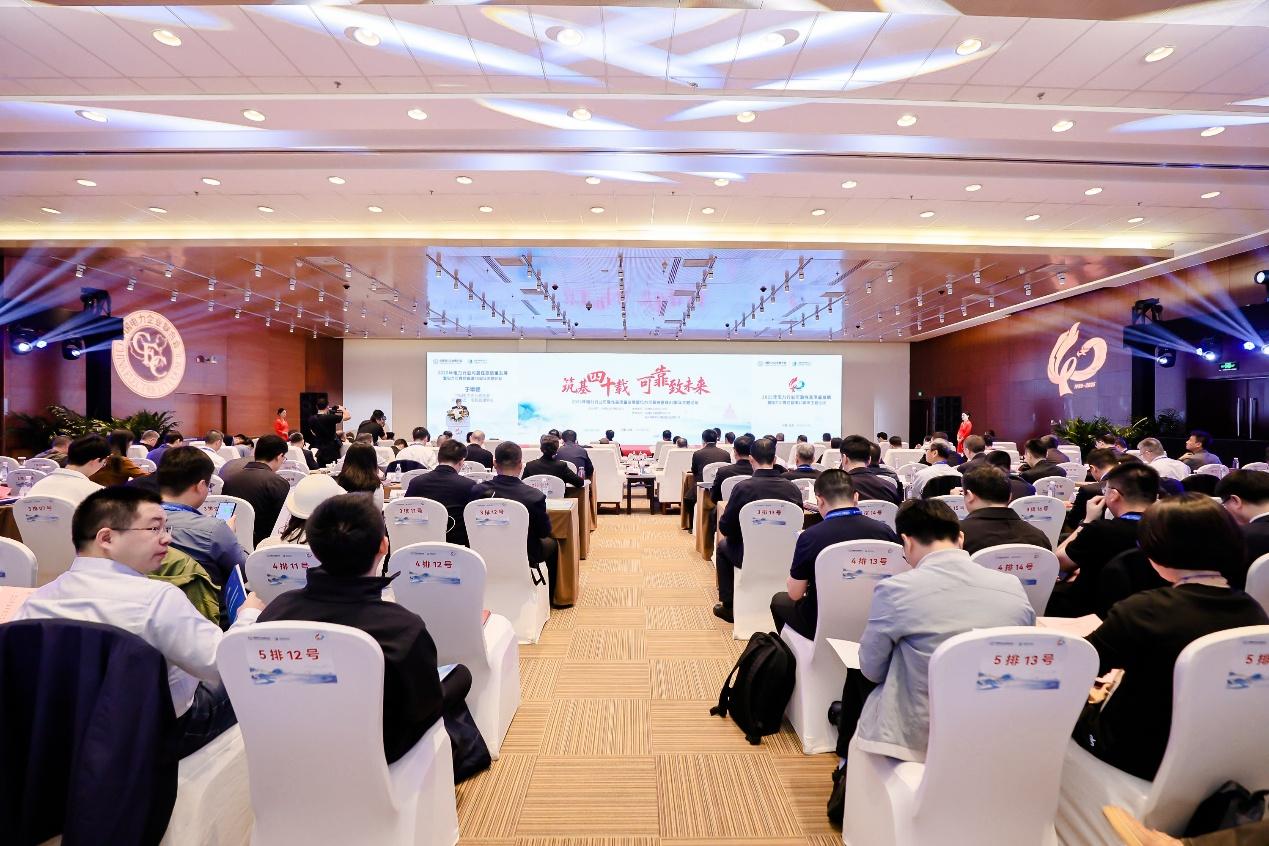
Core Viewpoint - The forum on high-quality development of power reliability management in China marks the 40th anniversary of the country's efforts in this field, highlighting significant achievements and future directions for enhancing power reliability management [1][2]. Group 1: Achievements in Power Reliability Management - Over the past 40 years, China's power reliability management has evolved significantly, with the average unplanned outages for main coal-fired units decreasing from 6.22 times in 1985 to 0.6 times in 2024 [2]. - The average annual power outage time per user has reduced from 94.55 hours in 1991 to 6.71 hours in 2024, with the national average power supply reliability reaching 99.924% [2]. - The availability coefficient of 220 kV and above transformers remains high, and the energy availability rate of direct current systems has been maintained above 95.6% over the past five years, surpassing international standards [2]. Group 2: Future Directions and Goals - The China Electricity Council (CEC) aims to strengthen its role as a think tank, enhance the innovation of power reliability management measures, and improve the quality control of statistical work and professional talent training [2]. - Emphasis will be placed on building a new reliability management framework that adapts to the new power system, driven by reform and innovation, and focusing on data application and quality [4]. - The conference served as a platform for sharing experiences and insights on energy security, emergency response, and power system reliability, contributing to the high-quality development of the energy sector [5]. Group 3: Key Participants and Contributions - The forum featured speeches from key figures, including Yang Kun, Lu Junling, and Wang Yonggan, who reflected on the historical journey and future aspirations of power reliability management in China [2][3]. - Reports from various experts highlighted the foundational role of power reliability management in ensuring stable electricity supply and safety in production [3][4]. - The event included the announcement of awards for exemplary cases in power reliability management and the release of benchmark units for generator reliability for 2024 [5].
我国电力可靠性水平大幅提升 供电可靠率达99.924%
Zhong Guo Xin Wen Wang· 2025-10-16 17:48
Core Insights - The reliability level of China's electricity supply has significantly improved due to the joint efforts of the government, industry, and enterprises, with the average power outage time per user decreasing from 94.55 hours in 1991 to 6.71 hours in 2024, and the average power supply reliability reaching 99.924% [1][2] Group 1: Historical Progress - Over the past 40 years, China's electricity industry has undergone rapid development, transitioning from initial exploration to catching up and now leading in electricity reliability management [2] - The average unplanned outage frequency of major coal-fired power units has decreased from 6.22 times in 1985 to 0.6 times in 2024 [1] Group 2: Current Performance Metrics - The availability coefficient of transformers at 220 kV and above remains high, with the energy availability rate of direct current systems maintained at over 95.6% for the past five years, generally surpassing international standards [1] - The emphasis on electricity reliability management is crucial for ensuring reliable power supply and supporting safe electricity production [2]
我国电力可靠性实现跨越式发展
Ke Ji Ri Bao· 2025-10-16 12:11
Core Viewpoint - The forum on the 40th anniversary of power reliability management in China highlighted significant achievements and experiences in the field, emphasizing the need for continued innovation and collaboration to enhance the quality of power reliability management in the future [1][3][4]. Group 1: Achievements in Power Reliability Management - Over the past 40 years, China's power reliability management has evolved significantly, with the average unplanned outage frequency of main coal-fired units decreasing from 6.22 times in 1985 to 0.6 times in 2024 [3]. - The average power outage time per user has reduced from 94.55 hours in 1991 to 6.71 hours in 2024, with the national average power supply reliability reaching 99.924% [3]. - The availability coefficient of transformers at 220 kV and above remains high, and the energy availability rate of DC systems has been maintained at over 95.6% for the past five years, generally surpassing international standards [3]. Group 2: Future Directions and Goals - The forum emphasized the foundational role of power reliability management in ensuring reliable power supply and supporting safe production in the power sector [4]. - There is a call for power reliability management professionals to remain committed to their responsibilities and continuously push for higher quality and standards in the field [4]. - The China Electricity Council plans to strengthen its role as a think tank, enhance the innovation of reliability management measures, and improve the quality control of statistical work and professional talent training [3][4]. Group 3: Key Participants and Contributions - The forum featured speeches from key figures, including Yang Kun, Secretary of the Party Committee of the China Electricity Council, and Lu Junling, Chief Economist of the National Energy Administration, who reflected on the historical journey and future challenges of power reliability management [4][5]. - A report titled "Forty Years to Start Again: Building a New Pattern of Power Reliability Management" was presented, focusing on the achievements and experiences gained over the past four decades [4]. - The event also included the announcement of typical case evaluations and the release of benchmark units for generator reliability for 2024 [6].
国家能源局总经济师鲁俊岭:全国供电可靠率达到世界领先水平
Zheng Quan Ri Bao Wang· 2025-10-16 07:28
Core Insights - The forum hosted by the China Electricity Council focused on the achievements and future of power reliability management in China over the past 40 years, emphasizing the need for high-quality development in this sector [1] Group 1: Achievements in Power Reliability Management - Over the past 40 years, China's power reliability management has significantly improved, with the average unplanned outage frequency for main coal-fired units decreasing from 6.22 times in 1985 to 0.6 times in 2024 [2] - The average power outage time per user has reduced from 94.55 hours per user in 1991 to 6.71 hours per user in 2024, with a national average power supply reliability rate reaching 99.924% [2][3] - The availability coefficient of transformers at 220 kV and above remains high, with the energy availability rate of direct current systems maintaining over 95.6% in the past five years, surpassing international standards [2] Group 2: Future Directions and Goals - The China Electricity Council plans to strengthen its role as a think tank, enhance innovation in power reliability management measures, and improve the quality of statistical work and professional talent training [2] - Future efforts will focus on ensuring reliable power supply, enhancing safety in power system operations, and addressing new tasks and challenges posed by economic development and the construction of new power systems [3][4] - Emphasis will be placed on data application, establishing a reliability management system suited for new power systems, and ensuring data quality as a fundamental principle in management [4]