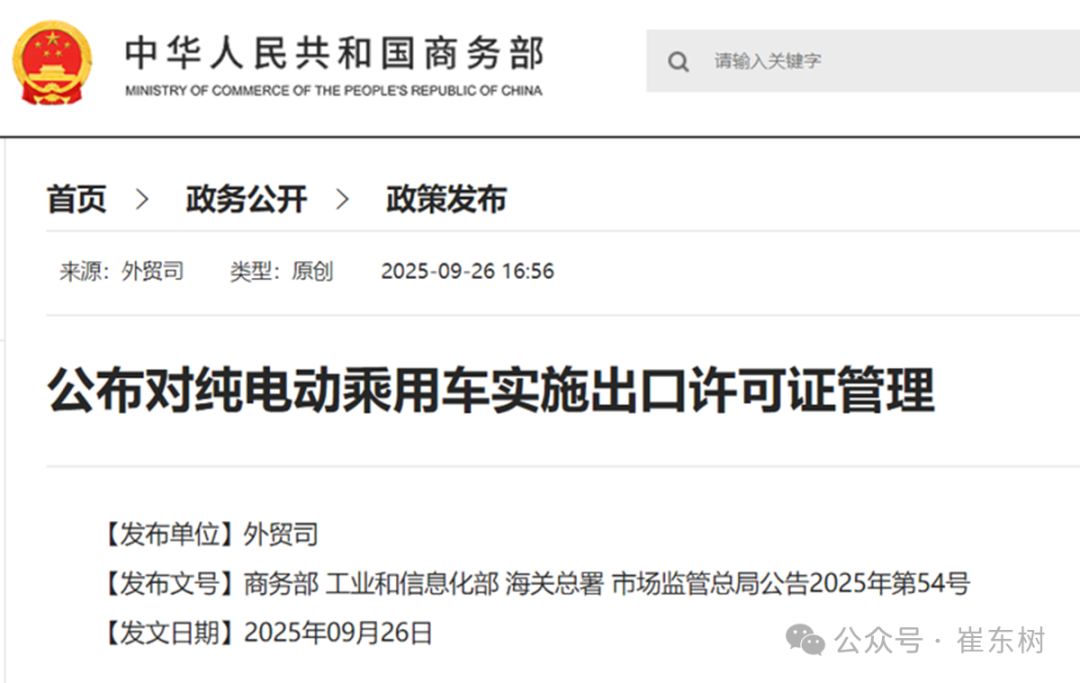
电动车出口规范管理

Search documents
崔东树:电动车出口的许可证新政堵塞漏洞实现高质量发展
Zhi Tong Cai Jing· 2025-09-27 12:09
Core Viewpoint - The Chinese government has implemented export license management for pure electric passenger vehicles to promote healthy development in the electric vehicle trade, aiming to regulate export entities and ensure product quality [1][2][7]. Group 1: Export License Management - The new export license policy aims to regulate export entities, allowing only automobile manufacturers and their authorized dealers to apply for export licenses, thereby cutting off unauthorized export channels [2][11]. - Strict qualification thresholds are set, including listing in the Ministry of Industry and Information Technology's announcement and obtaining CCC certification, to prevent low-price dumping and promote a shift from price competition to technology competition [2][13]. - The policy requires companies to establish overseas service networks to enhance user trust and brand image, ensuring accountability for exported products [2][12]. Group 2: Market Dynamics and Product Categories - The export of pure electric passenger vehicles is complex, with low-speed electric vehicles being a significant part of the initial export phase, which lacked strict regulation [5][6]. - Low-speed electric vehicles, often priced between 0.5 to 3 million yuan, cater to economically limited groups and are primarily exported to emerging markets like Southeast Asia and Africa, where they enjoy competitive advantages due to favorable policies [6][10]. - The average price of compliant products in the 87038010 category is approximately $20,640, while the average price for non-VIN products in the 87038090 category is around $2,050, indicating a significant price disparity [9][10]. Group 3: Regulatory Framework and Quality Control - The export license management is part of a comprehensive regulatory framework that includes production access, license application, and customs inspection, ensuring traceability and compliance of exported products [12][13]. - The customs classification and regulatory system for electric vehicles have been improved, with 70% of the 870380 category products being compliant vehicles produced by standard manufacturers [9][10]. - The new regulations aim to address the chaotic export order and prevent low-quality vehicles from being exported, which has harmed the international reputation of Chinese-made electric vehicles [7][11]. Group 4: Future Development and Innovation - The policy encourages companies to invest in research and development, focusing on core areas such as smart driving and solid-state batteries, to enhance product competitiveness and avoid price wars [14]. - Companies are urged to strengthen brand building through international exhibitions and overseas marketing channels, leveraging unique technologies as selling points in foreign markets [14]. - There is an emphasis on compliance with international regulations and risk management to ensure sustainable development in the global market [14].