
短剧衍生业务

Search documents
字节跳动 “撤退”:掌阅科技上市首亏,量子跃动拟再度减持套现
Guo Ji Jin Rong Bao· 2026-01-14 13:08
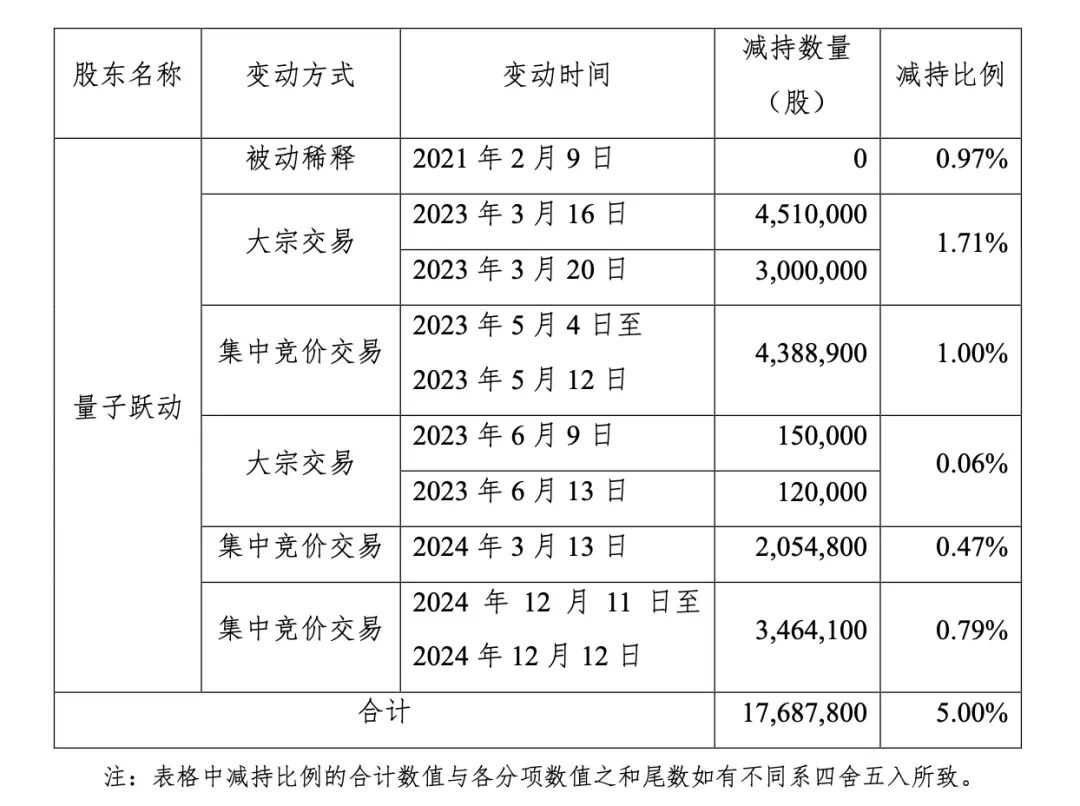
Core Viewpoint - The major shareholder of Zhangyue Technology, Quantum Leap Technology, plans to reduce its stake in the company after the announcement of expected losses for the fiscal year 2025, indicating a strategic shift in investment focus [1][6]. Shareholder Reduction Plan - Quantum Leap intends to reduce its holdings by up to 4.389 million shares, which represents no more than 1% of the company's total share capital, within three months following the announcement [1]. - As of the announcement date, Quantum Leap holds 26.2572 million shares, accounting for 5.98% of Zhangyue Technology's total shares [1]. Historical Shareholding Changes - Quantum Leap acquired 45.045 million shares in 2020, representing 11.23% of the company at that time, through a share purchase agreement for approximately 1.1 billion yuan at a price of 24.42 yuan per share [2]. - Due to a non-public offering in 2021, Quantum Leap's stake was diluted to 10.26% [2]. - From February 2021 to December 2024, Quantum Leap's shareholding decreased from 11.23% to 6.23%, with a total reduction of 5% through various transactions [4]. Financial Performance and Strategic Shift - In 2022, Zhangyue Technology's revenue from digital reading reached 2.229 billion yuan, a year-on-year increase of 43.25%, but net profit fell over 60% to 57.5772 million yuan due to increased marketing expenses [5]. - By 2023, revenue growth slowed significantly, with net profit further declining to 34.8343 million yuan [5]. - The company is shifting focus to derivative businesses, particularly short dramas, which generated 838 million yuan in the first half of 2025, a year-on-year increase of 149.09%, surpassing digital reading as the largest revenue source [5]. Market Context - ByteDance, the parent company of Quantum Leap, has been optimizing its investment portfolio, particularly in the competitive digital reading market, where free reading products have gained significant market share [5][6]. - The announcement of Quantum Leap's stake reduction coincides with Zhangyue Technology's forecast of a net loss for 2025, marking the first annual loss since its IPO in 2017 [6].


掌阅科技2024年扣非净利同比增长185.38% 衍生业务成第二增长曲线
Zheng Quan Shi Bao Wang· 2025-04-18 13:37
Core Viewpoint - In 2024, Zhangyue Technology (掌阅科技) reported significant growth in revenue and profit, driven by strategic transformation and expansion into derivative businesses, particularly short dramas and AI applications in digital reading [1][2][3] Financial Performance - The company achieved a revenue of 2.583 billion yuan in 2024, with a net profit of 49.2917 million yuan, representing a year-on-year increase of 41.46% [1] - The non-net profit reached 32.3977 million yuan, showing a remarkable growth of 185.38% year-on-year [1] - In Q4 2024, the net profit was 86.122 million yuan, reflecting a quarter-on-quarter growth of approximately 692% [1] Strategic Transformation - Zhangyue Technology is committed to a strategic transformation, focusing on the steady development of free reading services while aggressively expanding derivative businesses [1] - The company has enhanced its quality content reserve by introducing thousands of premium digital books and audio content, solidifying its content barrier [1] Derivative Business Development - The derivative business generated 776 million yuan in revenue, marking a year-on-year increase of 189.99% and accounting for 30.02% of total revenue, establishing it as a second growth curve for the company [2] - The company has developed various forms of short dramas, collaborating with multiple production and technology partners, and has released hundreds of short dramas across diverse genres [2] AI Integration - Zhangyue Technology is actively advancing the application of AI models in digital reading and derivative businesses, leveraging its advantages in content copyright resources and user base [3] - The "Zhangyue AI Assisted Reading" feature has been launched on the "Zhangyue" app, enhancing user reading efficiency through AI technology [3]