石油租金

Search documents
美制裁奏效!俄石油收入崩塌,油价低至每桶仅22美元
Jin Shi Shu Ju· 2026-01-30 08:47
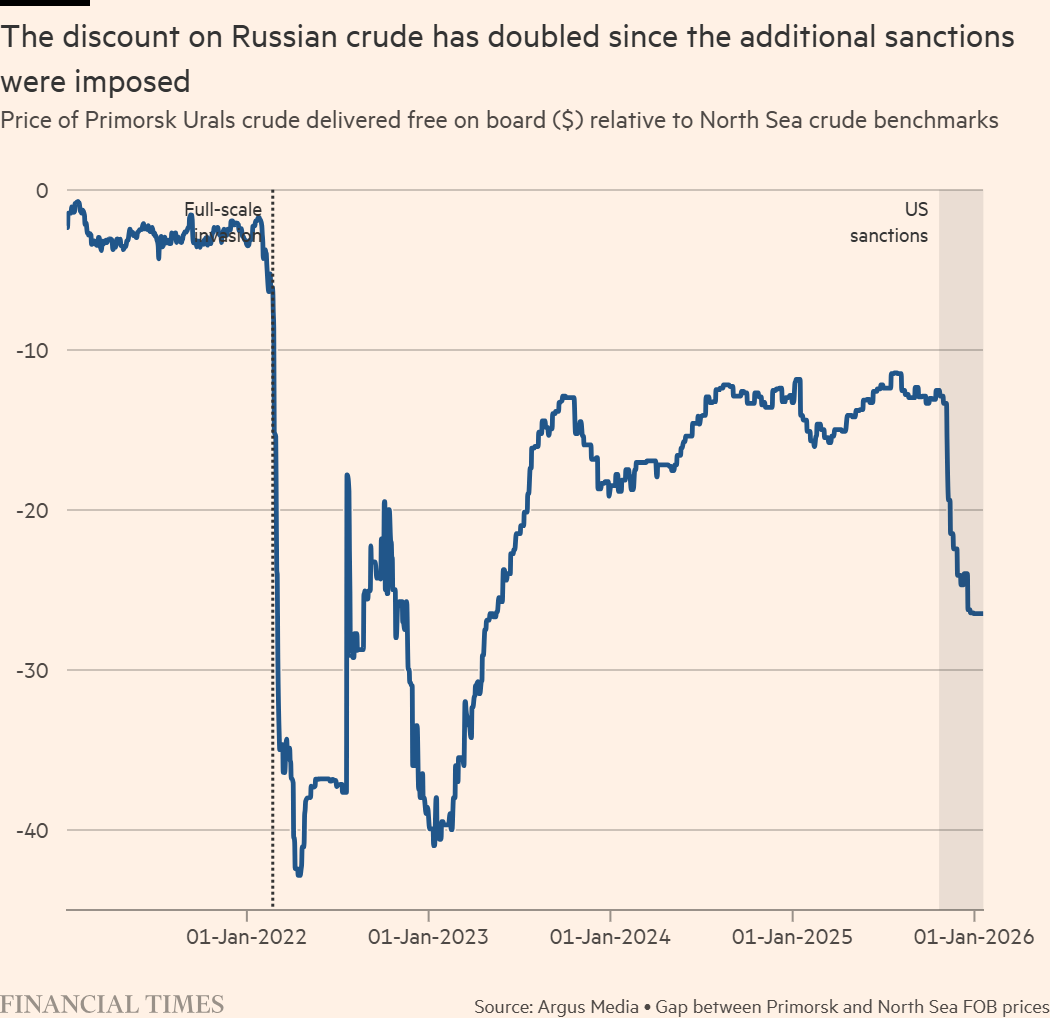
Core Viewpoint - The sanctions imposed by the U.S. on Russian oil companies have significantly widened the price gap between Urals crude oil and Brent crude oil, indicating a substantial impact on Russia's oil revenue and economic stability [1][4]. Group 1: Price Impact and Revenue Decline - The discount on Urals crude oil has increased from approximately $15 per barrel to over $24 per barrel, leading to a projected 20% year-on-year decline in Russia's energy revenue by 2025 [4]. - In December, the price of Urals crude oil fell to $39.2 per barrel, marking the lowest level since the COVID-19 pandemic [4]. - A former Russian energy executive reported that Urals crude oil sold to India has been priced as low as $22 to $25 per barrel, barely covering production costs [5]. Group 2: Fiscal Pressure and Deficit - Russia's fiscal deficit is expected to reach 2.6% of GDP by 2025, five times the planned level, marking the longest deficit period in Putin's tenure [5]. - The Russian government anticipates a significant budget deficit in early 2026 due to reduced energy revenues and increased government spending [6]. - If Urals crude oil prices deviate by $10 from budget expectations, Russia's fiscal revenue could decrease by 1.5 to 1.8 trillion rubles [6]. Group 3: Changes in Export Dynamics - The structure of Russian oil exports has shifted, with a 23% increase in crude oil exports to China in December, while exports to India dropped by 29% [6]. - The number of oil tankers with undisclosed destinations has increased, indicating a rise in floating storage of crude oil [7]. - The use of transshipment points like Egypt and Singapore has surged, as these locations serve as intermediaries for Russian oil exports [9]. Group 4: Long-term Economic Implications - The share of energy revenue in Russia's fiscal budget has decreased from over 50% at its peak to about 24%, the lowest in at least a decade [10]. - The ongoing sanctions are creating a "slow and cumulative squeezing effect" on Russia's fiscal stability, potentially harming long-term economic growth and increasing macroeconomic imbalances [10]. - The reliance on oil revenue remains high, and the current market conditions have left Russia in a vulnerable position [12].