礼乐制度

Search documents
聆听礼乐文明悠远回响——山东文物特展亮相银川
Xin Lang Cai Jing· 2026-01-17 19:45
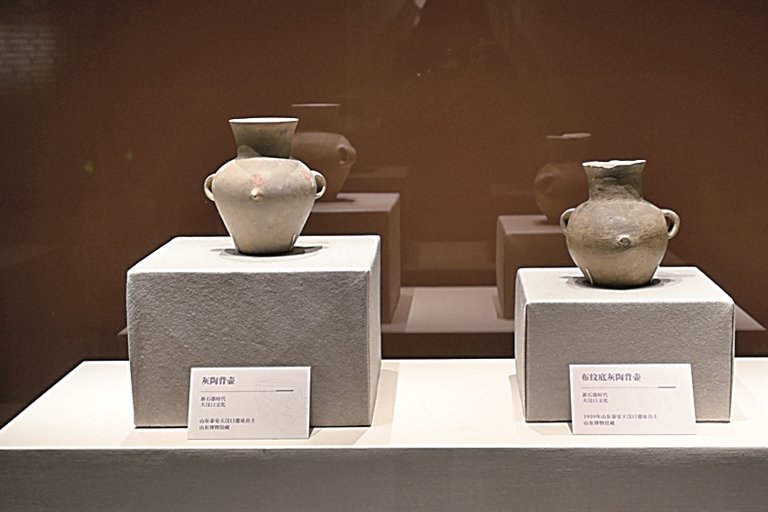
Core Viewpoint - The exhibition "Harmony of Rites and Music - Shandong Cultural Relics Exhibition" showcases over 100 artifacts, including jade, pottery, and bronze items, highlighting the evolution of Chinese civilization through the lens of ritual and music [1][2]. Group 1: Artifacts and Their Significance - The exhibition features a black pottery high-handled cup from the Longshan culture, noted for its delicate craftsmanship, representing the pinnacle of prehistoric pottery techniques [5]. - Jade artifacts from the Neolithic era, such as jade cong and jade axes, illustrate the early social structure and spiritual evolution, with jade becoming a symbol of moral and ethical values [2]. - The exhibition includes pottery that reflects the development of ritual practices from everyday life, indicating how these items transitioned from utilitarian to ceremonial purposes [2]. Group 2: Cultural Insights - The integration of jade into the ritual system signifies a deeper connection between material culture and moral values, as jade embodies qualities like benevolence and wisdom [2]. - The transition from pottery to bronze during the Shang and Zhou dynasties marks a significant evolution in ritual practices, with bronze items becoming symbols of state power and authority [5]. - The exhibition emphasizes the historical significance of ritual and music in shaping the values of Chinese civilization, promoting ideals such as virtue and harmony [7]. Group 3: Exhibition Details - The exhibition is held at the Ningxia Museum and will run until March 8 [8].

文明的细节:来自陶寺的调研报告
Xin Hua She· 2025-03-31 02:41
Core Viewpoint - The Taosi site is a significant archaeological discovery that provides crucial evidence for the early development of Chinese civilization, indicating a mature early civilization form existed around 4300 years ago, showcasing advanced engineering, astronomical observation, and social organization [6][10][28]. Group 1: Archaeological Significance - The Taosi site is recognized as one of the four major urban archaeological sites in the exploration of Chinese civilization origins, alongside Liangzhu, Shijiahe, and Erlitou [6]. - The discovery of the ancient observatory at Taosi, which allowed the early inhabitants to accurately divide the year into 20 solar terms, is a precursor to the traditional 24 solar terms [8][10]. - The site has revealed a complete timekeeping system, including a sand timer that closely aligns with the modern 24-hour day [11][12]. Group 2: Cultural and Technological Developments - The Taosi civilization demonstrated advanced agricultural practices, with evidence of crop domestication and a sophisticated understanding of seasonal changes [15][16]. - Artifacts such as the "gui chi" (measuring rod) indicate that the Taosi people had developed standards for measurement and spatial concepts [13][12]. - The site has yielded early forms of writing, with characters that resemble later oracle bone script, suggesting a continuity in the development of Chinese writing [28][29][31]. Group 3: Social Structure and Governance - The archaeological findings indicate a clear social hierarchy, with distinct burial practices reflecting class differences, including large tombs for elites and simpler graves for commoners [25][27]. - The discovery of a large city wall and palace complex suggests that Taosi was an early example of a state-level society with organized governance and social stratification [20][21][24]. - The presence of specialized workshops and storage areas indicates a degree of economic complexity and social organization, characteristic of early state societies [19][20][35]. Group 4: Environmental and Climatic Context - Evidence from the site suggests that the Taosi region experienced significant climatic changes over time, impacting agricultural practices and settlement patterns [18][42]. - The discovery of various animal fossils indicates a rich and diverse ecosystem that supported the early inhabitants [18]. Group 5: Historical Context and Legacy - The Taosi site is believed to be linked to the legendary Yao period, providing archaeological support for historical narratives surrounding early Chinese civilization [46][48]. - The findings at Taosi reflect a transitional phase in Chinese history, marking the shift from mythological to historical understanding of early Chinese states [47][49]. - The site serves as a testament to the cultural exchanges and interactions that shaped the development of early Chinese civilization, highlighting its role as a melting pot of various cultural influences [28][49].