社交媒体功能障碍

Search documents
不是算法的错?AI模拟实验揭示社交媒体撕裂的真相
3 6 Ke· 2025-11-06 03:24
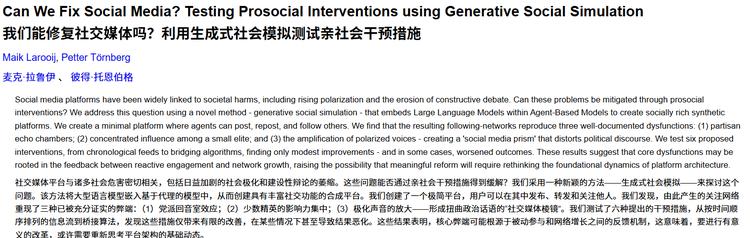
Core Insights - The article challenges the common belief that social media issues are primarily caused by algorithmic recommendations, suggesting instead that these problems may stem from deeper structural mechanisms inherent in social media platforms [10][11]. Group 1: Research Findings - A study conducted by researchers from the University of Amsterdam simulated a minimalist social media platform without algorithmic recommendations, revealing that even in this environment, issues such as echo chambers, concentrated traffic, and amplification of extreme voices emerged naturally [4][5][9]. - The simulation involved 500 AI users with diverse political views and backgrounds, who interacted freely, leading to the formation of isolated groups and the dominance of extreme content [4][9]. Group 2: Intervention Measures - The research team tested six intervention measures aimed at improving the platform's dynamics, including chronological sorting of posts and promoting diverse viewpoints, but none were effective in fundamentally resolving the issues [6][7][8]. - A "seesaw effect" was observed, where improvements in one area often led to deterioration in another, indicating the complexity of social media dynamics [8]. Group 3: Human Behavior and Network Dynamics - The study highlights that the root of social media issues lies in human behavior, particularly the tendency to share emotionally charged content, which reinforces existing biases and creates homogenous networks [9][10]. - Users are more likely to engage with and share content that elicits strong emotional responses, leading to a self-reinforcing cycle that exacerbates polarization [9][10]. Group 4: Implications for Users - The findings suggest that improving the online discourse environment requires a shift in user behavior rather than solely relying on technological fixes [12][13]. - Users are encouraged to reflect on their sharing habits, consciously engage with diverse viewpoints, and be cautious about amplifying emotionally charged content [13][14][15][16]. Group 5: Rethinking Social Media - The research emphasizes the need to rethink the fundamental dynamics of interaction and visibility on social media platforms, proposing that the issues are not merely technical but also deeply rooted in the nature of social media as a medium [17]. - It calls for a broader understanding of how content sharing and social relationship building are intertwined, suggesting that meaningful change may require a fundamental redesign of these processes [17].