
社会主义法治国家建设

Search documents
如何更好支持和保障律师依法执业?最高检有新要求!
Xin Lang Cai Jing· 2026-01-14 14:27
Core Viewpoint - The Supreme People's Procuratorate emphasizes the need to better support and ensure lawyers' lawful practice, aligning with Xi Jinping's rule of law thought, to contribute to the construction of a higher-level socialist rule of law state [1] Group 1: Support for Lawyers - The Supreme People's Procuratorate, led by Chief Prosecutor Ying Yong, visited the National Lawyers Association to gather opinions on supporting lawyers [1] - There is a clear requirement to safeguard lawyers' rights during all stages of case handling [1] - The procuratorial authority aims to supervise law enforcement and judicial bodies that obstruct lawyers from practicing law [1]
弘扬宪法精神,开创法治中国建设新局面——写在第十二个国家宪法日
Xin Hua Wang· 2025-12-05 01:48
Core Viewpoint - The article emphasizes the importance of promoting constitutional spirit and establishing a new phase in the construction of a rule-of-law China, particularly in the context of the 12th National Constitution Day and the implementation of Xi Jinping's rule of law thought [1][2]. Group 1: Constitutional Significance - The Constitution is recognized as the fundamental legal basis for governance and social life in China, holding the highest legal authority and effectiveness [2][3]. - The 20th Central Committee of the Communist Party of China has set the goal of achieving a higher level of socialist rule of law during the 14th Five-Year Plan period, emphasizing the need for comprehensive implementation and supervision of the Constitution [2][3]. Group 2: Party Leadership and Legal Framework - The Constitution confirms the leadership position of the Communist Party of China, which is essential for its effective implementation and the correct political direction of constitutional development [3][4]. - There is a call to strengthen the Party's comprehensive leadership over constitutional work to ensure the Constitution's effective implementation and its role in promoting national unity and social stability [3][4]. Group 3: Legal System Development - The construction of a socialist legal system with Chinese characteristics is highlighted as a key approach to advancing the rule of law [3][4]. - The article advocates for the enhancement of the legal framework, particularly in emerging and foreign-related areas, to improve the effectiveness of the rule of law in modernizing national governance [4]. Group 4: Public Engagement and Education - Strengthening constitutional theory research and public education is deemed crucial for fostering a deep-rooted respect for the Constitution among the populace [5]. - The implementation of the "Law on Popularization of Law" and the inclusion of "Xi Jinping's rule of law thought" in national legal texts are significant steps towards promoting constitutional awareness [5].
人民日报评论员:尊崇法治 厉行法治 ——写在第十二个国家宪法日
Ren Min Ri Bao· 2025-12-04 09:24
Group 1 - The core viewpoint emphasizes that the rule of law is a crucial guarantee for Chinese-style modernization, with ongoing efforts to promote constitutional awareness and legal education across society [1][4] - The construction of a modern legal system in China is highlighted through the development of various laws, including the Civil Code and laws promoting private economy and personal information protection, reflecting the evolving legal framework [1][2] - The implementation and supervision of the rule of law are being advanced through initiatives aimed at creating a law-based business environment and reforming law enforcement and judicial responsibilities [1][3] Group 2 - The 20th Central Committee of the Communist Party has outlined a grand blueprint for the next five years, emphasizing the construction of a socialist rule of law state as a key goal for economic and social development [2] - The importance of utilizing legal thinking and methods to address challenges and enhance governance is underscored, particularly in the context of urban modernization and the development of free trade zones [2][3] - The establishment of a unified national market is being pursued through the introduction of regulations to eliminate local protectionism and ensure fair competition, reinforcing the legal foundation for governance [3] Group 3 - The 40th anniversary of national legal education is marked by the implementation of the Law on Legal Publicity and Education, signifying a new era of institutionalized and standardized legal education in China [3] - The integration of legal education into daily life and grassroots governance is emphasized, aiming to cultivate a society that respects and adheres to the rule of law [3][4] - The collective effort to uphold the authority of the constitution and promote the rule of law as a common belief is seen as essential for advancing the construction of a rule of law in China [4]
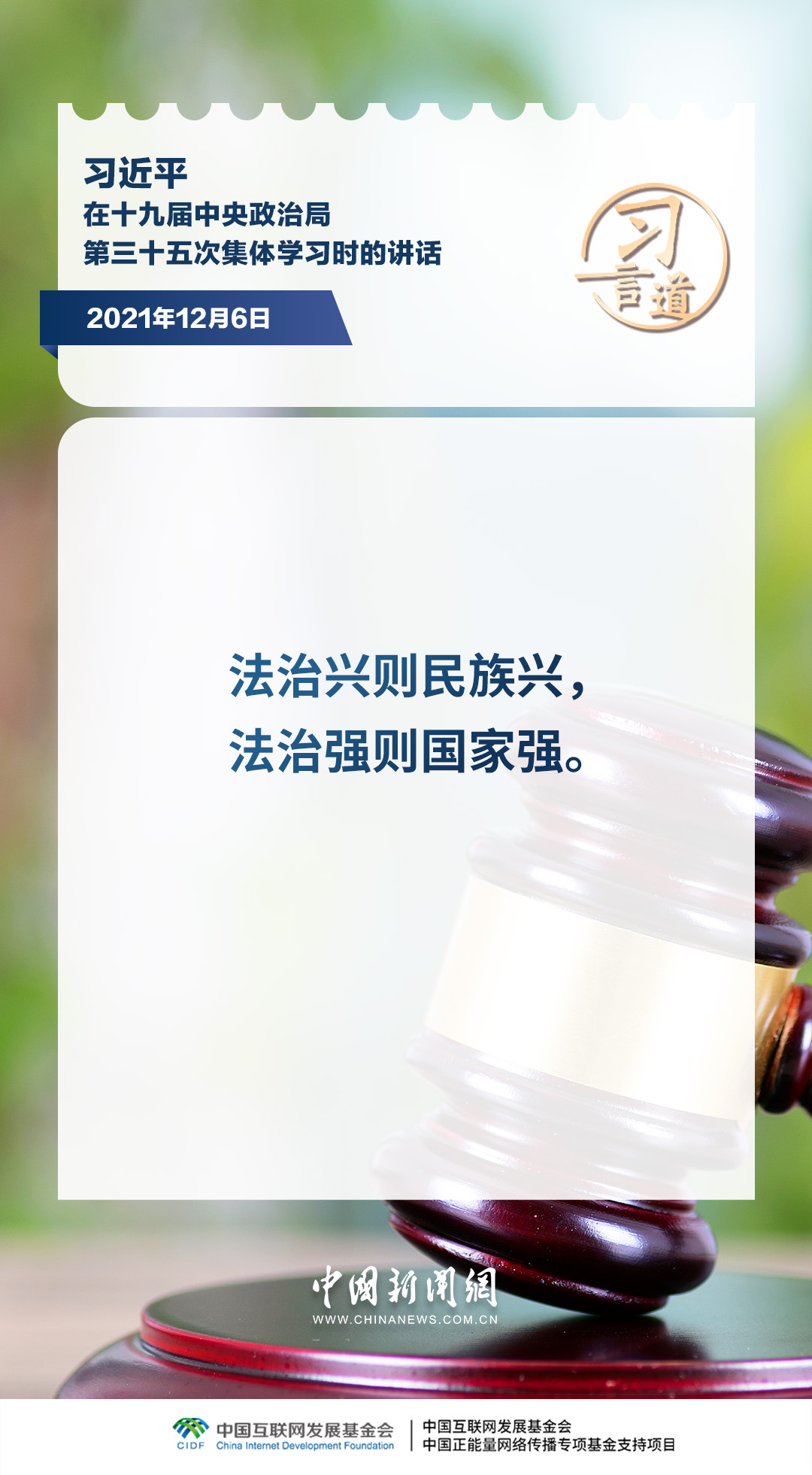
【良法善治】习言道|法治兴则民族兴,法治强则国家强
Zhong Guo Xin Wen Wang· 2025-12-04 01:41
Group 1 - The core viewpoint emphasizes that the rule of law is a crucial support for the national governance system and governance capacity [6][7] - Comprehensive governance by law is identified as a long-term and significant historical task, representing a profound social transformation [9] - The necessity to develop a legal system that aligns with China's national conditions and realities is highlighted, rejecting the adoption of foreign models [16] Group 2 - The importance of law enforcement departments fulfilling their responsibilities and promoting a new phase in the construction of a rule-of-law China is stressed [18] - The need for various departments and fields to strictly adhere to legal procedures is underscored to create a collaborative effort in advancing the rule of law [18]

尊崇法治 厉行法治——写在第十二个国家宪法日
Ren Min Ri Bao· 2025-12-03 23:07
Group 1 - The importance of rule of law as a key guarantee for Chinese-style modernization is emphasized, with December 4 marking the twelfth National Constitution Day and various activities promoting Xi Jinping's rule of law thought [1] - The construction of a legal system in China is evolving, with the compilation of the Civil Code, amendments to the Legislative Law, and the establishment of laws such as the Private Economy Promotion Law and the Personal Information Protection Law [1][2] - The implementation and supervision of the rule of law are highlighted through initiatives aimed at creating a law-based business environment and reforming law enforcement and judicial responsibility systems [1][3] Group 2 - The 20th Central Committee's Fourth Plenary Session outlines a grand blueprint for the next five years, emphasizing the construction of a socialist rule of law state as a major goal [2] - The necessity of utilizing legal thinking and methods to address challenges and enhance governance in the context of modernization is stressed [2][3] - The establishment of a unified national market is supported by the introduction of the Fair Competition Review Regulations to eliminate local protectionism and market segmentation [3] Group 3 - The 40th anniversary of national legal education is marked by the implementation of the Law on Legal Publicity and Education, signifying a new era of institutionalized and standardized legal education [3] - The promotion of legal awareness and compliance among the populace is identified as a foundational task for the rule of law in the country [3][4] - The call for a collective effort to create a new chapter in the construction of a rule of law in China is made, emphasizing the need for law to become a common belief in society [4]
尊崇法治 厉行法治
Ren Min Ri Bao· 2025-12-03 22:29
Core Viewpoint - The rule of law is a crucial guarantee for Chinese-style modernization, with ongoing efforts to promote legal awareness and implementation across society [1][2][4] Group 1: Legal System Construction - The construction of the legal system in China has evolved with the compilation of the Civil Code, amendments to the Legislative Law, and the establishment of laws such as the Private Economy Promotion Law and the Personal Information Protection Law, reflecting a modernized legal framework [1] - The legal system is continuously improving, with a focus on enhancing the socialist legal system with Chinese characteristics [1] Group 2: Law Implementation and Supervision - There is a strong emphasis on creating a law-based business environment, addressing prominent issues in enterprise-related law enforcement, and reforming the responsibility system for law enforcement and judicial practices [1][2] - The implementation of the rule of law is seen as essential for achieving social fairness and justice, with all departments required to strictly adhere to legal processes [3] Group 3: National Development Goals - The 20th Central Committee has outlined a grand blueprint for the next five years, emphasizing the construction of a socialist rule of law state as a key goal for economic and social development [2] - The rule of law is positioned as a foundational element for achieving long-term national development objectives and ensuring stability [2] Group 4: Public Legal Education - The year marks the 40th anniversary of nationwide legal education, with the formal implementation of the Law on Legal Publicity and Education, indicating a shift towards institutionalized and standardized legal education [3] - The integration of legal education into daily life and grassroots governance is essential for fostering a culture of lawfulness among the populace [3]
在建设更高水平社会主义法治国家中实干笃行、担当作为(权威访谈·学习贯彻党的二十届四中全会精神)
Ren Min Ri Bao· 2025-11-26 22:21
Core Viewpoint - The 20th Central Committee's Fourth Plenary Session has approved the "Suggestions on Formulating the 15th Five-Year Plan for National Economic and Social Development," emphasizing the strategic deployment for building a higher level of socialist rule of law in China [1] Group 1: Importance of Rule of Law - Comprehensive rule of law is fundamental and protective for the development of the party and the state, as highlighted in the new deployments and requirements from the 20th Central Committee [2] - The "Suggestions" include the goal of achieving a higher level of socialist rule of law during the 15th Five-Year Plan period, aligning with previous party goals and emphasizing the importance of rule of law in the overall strategic layout [2][3] Group 2: Key Principles and Tasks - The "Suggestions" introduce the principle of combining an effective market with an active government, stressing the need for a legal economy and a market-oriented, law-based international business environment [3] - The document outlines key tasks for rule of law construction, including promoting scientific legislation, strict law enforcement, fair justice, and public compliance with the law, integrating these into all areas of economic and social development [3][6] Group 3: Implementation and Development - The central government's focus on the rule of law is reinforced by the recent Central Comprehensive Rule of Law Work Conference, which aims to summarize and deploy comprehensive rule of law efforts for the current and future periods [4][5] - The emphasis on enhancing the legal system and ensuring that rule of law supports economic and social development reflects a commitment to modernizing governance and improving the legal framework [6][7] Group 4: Enhancing Public Welfare and Stability - Efforts will be made to improve laws related to social insurance, healthcare, education, and public safety, addressing urgent public concerns and enhancing the public's sense of legal rights [8] - The strategy includes maintaining safety and stability through comprehensive mechanisms for conflict resolution and community correction, ensuring effective law enforcement and public safety [8][9] Group 5: Promoting High-Level Openness - The plan emphasizes strengthening the foreign-related legal system and capabilities, aligning with international trade rules, and enhancing the quality of foreign legal services [9]
筑牢法治之基,汇聚法治力量
Ren Min Ri Bao· 2025-11-18 22:51
Core Points - The Central Conference on Comprehensive Law-based Governance was held in Beijing, where significant achievements in building a law-based China since the 18th National Congress were acknowledged, and important deployments for advancing comprehensive law-based governance were made [1] - Emphasis was placed on the integration of the Party's leadership, people's sovereignty, and rule of law, with a focus on building a more complete socialist legal system and a higher level of socialist rule of law [1] Group 1 - The publication of the first volume of "Xi Jinping's Legal Thought" serves as an authoritative textbook for the Party and the nation, reinforcing the commitment to the rule of law in the context of recent breakthroughs in law-based governance [2] - The importance of coordinating law with reform, development, and stability was highlighted, with a focus on promoting social fairness and justice [2] - The implementation of the Private Economy Promotion Law has provided legal support for private enterprises, enhancing their confidence in the business environment [2] Group 2 - Xi Jinping emphasized that achieving high-quality economic development requires leading with the rule of law, citing the successful implementation of environmental protection laws as a means to restore ecological balance [3] - The 20th Central Committee's proposals include elevating the construction of a socialist rule of law state as a key goal for the 14th Five-Year Plan, aiming to create a market-oriented, law-based, and international business environment [3] - The focus on using legal thinking and methods to drive economic and social development is essential for building a stable and transparent institutional framework [3] Group 3 - The commitment to Xi Jinping's legal thought and the unique path of socialist rule of law is seen as crucial for achieving stable and sustainable modernization in China [4]