
社会化治理

Search documents
预计1亿人次下单顺风车!春运出行新风尚
Nan Fang Du Shi Bao· 2026-02-13 05:21
Core Insights - The spring transportation season in 2026 has fully commenced, with ride-sharing services like "顺风车" (Shunfengche) gaining popularity due to their flexibility and personal touch, expected to handle over 1 billion rides during the peak season, marking a year-on-year growth of over 40% [1] - The ride-sharing industry is projected to reach a transaction scale of over 100 billion RMB within three years, driven by a compound annual growth rate of 40%, significantly outpacing the overall growth of ride-hailing services [1][4] - The development of the ride-sharing sector has evolved since its inception around 2012, transitioning from a subsidy-driven model to a more standardized pricing mechanism, with a focus on safety and user experience [1][4] Industry Growth and Trends - The total cross-regional passenger flow during the Spring Festival is expected to reach 9.5 billion trips, with self-driving trips accounting for approximately 80% [1] - The ride-sharing platform "哈啰顺风车" (Hello Shunfengche) has served over 340 million users and facilitated 3.6 billion ride requests since its launch [2] - The shift in transaction structure from urban to intercity travel has been significant, with 60-70% of transactions now occurring between cities, reflecting changing consumer preferences [4] User Experience and Innovations - The ride-sharing service addresses key user pain points, such as the need for door-to-door travel, cost-effectiveness, and accommodating specific needs like traveling with pets [5][6] - The introduction of the "车主PK模式" (Driver PK Model) has improved order matching efficiency, reducing the use of external software for order grabbing by two-thirds and increasing the order completion rate by approximately 6% [7] - Continuous innovations, including specialized services like "优享油车" (Premium Oil Car) and "宠物友好" (Pet-Friendly), aim to enhance user satisfaction and ensure fair compensation for drivers [7][8] Future Directions - The company is exploring a "social governance" model, aiming to involve drivers, passengers, academia, and government in the rule-making process to create a harmonious ride-sharing environment [8]

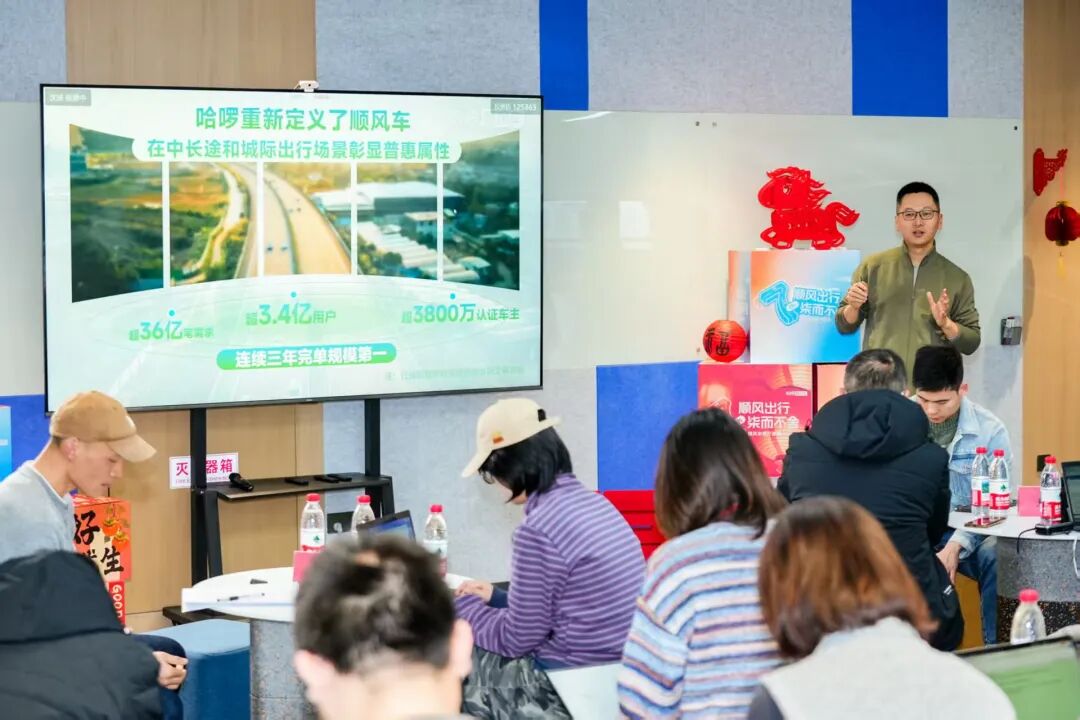
“隐形冠军”的七年坚守与进化:哈啰顺风车夜话车主乘客,作答 “从拼效率到建生态”
Bei Jing Shang Bao· 2026-02-12 11:48
Core Insights - The article highlights the growth and evolution of Hello's ride-sharing service, which has achieved a compound annual growth rate (CAGR) of 40%, significantly outpacing the overall ride-hailing market [3][4] - Hello's ride-sharing platform has facilitated a total of 3.6 billion rides, serving over 340 million users and 38 million certified drivers [3][4] Group 1: Company Growth and User Engagement - Hello's ride-sharing service has become a leading platform in China, with a focus on "shared rides" and "mutual assistance" [3] - The company emphasizes the importance of building trust and meeting unfulfilled travel demands as key drivers for future growth [3][4] Group 2: Product Innovation and Service Improvement - Hello has introduced various service innovations, including the "PK model" to enhance order allocation to high-quality drivers, and new product categories like "exclusive rides" and "pet-friendly rides" [5][6] - The company aims to ensure fair compensation for drivers while providing affordable and reliable services for passengers [5] Group 3: Social Governance and Industry Collaboration - Hello is moving towards a "social governance" model, seeking to involve drivers, passengers, academia, and government in decision-making processes [6][7] - The company has also opened its capabilities to the industry, helping partners like Alipay and Tencent achieve significant growth in their ride-sharing services [6][7] Group 4: Market Outlook and Seasonal Trends - The ride-sharing market in China is projected to reach 100 billion yuan by 2028, driven by evolving consumer demands and preferences [7] - During the upcoming Spring Festival, Hello anticipates that 200 million people will use ride-sharing services, with a 40% year-on-year increase in ride requests [9]
科创企业治理要以人力资本为主导
Di Yi Cai Jing· 2025-12-02 12:13
Core Viewpoint - The essence of governance in technology innovation enterprises is a systematic response to the extreme dynamism of human capital [1][4] Group 1: Governance Philosophy - The governance issue of technology innovation enterprises is fundamentally a cognitive framework problem, where traditional governance theories based on monetary capital are being overturned in the knowledge economy [2] - The ultimate mission of governance should be re-centered on "innovation," which is a direct result of institutional design rather than a byproduct of management processes [2][3] - A culture that supports "freedom and uselessness" is essential for fostering innovation, allowing researchers to explore based on intrinsic interests [2] Group 2: Human Capital-Centric Governance Logic - A fundamental shift in governance logic is required, recognizing that the core competitiveness of technology innovation enterprises lies in their human capital [4] - The governance system must acknowledge the extreme dynamism of human capital, which varies significantly over time and context [4][5] - Effective governance should respect and guide individuals' pursuit of self-interest, aligning personal and organizational goals through institutional design [3][5] Group 3: Socialized Governance System Architecture - The ideal governance model for technology innovation enterprises is a socialized governance structure characterized by the separation of rights to profits, control, and management [6][7] - A mature governance system should support strategic flexibility through a "general partner system," allowing key human capital to explore multiple promising directions [7] Group 4: Mechanisms for Innovation - The governance system must systematically address three fundamental questions regarding innovation: where opportunities come from, how profits are distributed, and how risks are shared [8] - A dynamic incentive compatibility mechanism is essential, linking contribution evaluation, value distribution, and power allocation in a responsive system [8] - Effective supervision must meet three rigid conditions: authority, information advantage, and incentive compatibility [8] Group 5: External Ecosystem Support - The growth of technology innovation enterprises requires more than just funding and technology; effective internal governance is closely linked to the external institutional environment [9] - Enterprises should actively seek to build open innovation networks with universities, research institutions, and industrial capital [9]