私募信贷市场危机

Search documents
美国“万亿私募信贷大故事”正在崩塌
3 6 Ke· 2025-12-22 12:25
Core Insights - The U.S. private credit market, once seen as a safe haven for individual investors, is facing a dual shock of deteriorating fundamentals and collapsing confidence, leading to asset revaluation and exposing the industry's bubble [1] - Blue Owl Capital's withdrawal from financing Oracle's $10 billion AI data center project highlights a fundamental shift in the credit market's attitude towards aggressive capital expenditures by tech giants, resulting in pressure on Oracle's stock and the broader tech sector [1][3] - The crisis in the private credit industry, which exceeds $2 trillion, is reflected in the struggles of Business Development Companies (BDCs) that cater to individual investors, facing stock price declines, rising bad debts, and redemption pressures [1][5] Private Credit Market Dynamics - Jamie Dimon, CEO of JPMorgan, warned of systemic risks in the $1.7 trillion private credit market, indicating that the current issues may be just the beginning [2] - Apollo Global Management is taking defensive measures, including cash accumulation, reducing leverage, and selling high-risk debt assets in preparation for potential market turmoil [2] Blue Owl Capital's Withdrawal - Blue Owl Capital's decision to withdraw from the Oracle project has triggered market anxiety, revealing the fragility of funding chains for AI infrastructure projects [3][4] - The withdrawal was driven by stricter loan terms and concerns over Oracle's rising debt levels, indicating a significant shift in market sentiment [3][4] BDC Sector Challenges - BDCs, which have seen their assets grow significantly, are now facing severe challenges, with many experiencing double-digit stock price declines despite the S&P 500's 16% rise this year [5][6] - The BDC sector's reliance on high-interest loans to lower-rated mid-sized companies is now punishing investors who exit at the wrong time, as income expectations are affected by rising interest rates and deteriorating credit quality [6] Bad Debt and Financial Health - KKR's BDC, FS KKR Capital, has seen its stock price drop by approximately 33% this year, with bad loans increasing from 3.5% to about 5% [7] - BlackRock's BDC reported that 7% of its loans are in default, highlighting the growing concerns over credit quality within the sector [8] Liquidity and Redemption Issues - The liquidity crisis and valuation disputes are accelerating market declines, as evidenced by Blue Owl's failed attempt to merge its private BDC with publicly traded counterparts [9] - The disconnect between private asset pricing and public market valuations is leading to panic-driven redemptions, creating significant uncertainty for retail investors attracted by high dividends [9]
违约、坏账、赎回潮“此起彼伏”,美国的“万亿私募信贷大故事”正在崩塌
Hua Er Jie Jian Wen· 2025-12-22 00:24
Core Insights - The U.S. private credit market, once seen as a safe haven for individual investors, is facing a dual shock of deteriorating fundamentals and collapsing confidence, leading to asset revaluation and the bursting of a bubble in the industry [1][2] - Blue Owl Capital's withdrawal from financing Oracle's $10 billion AI data center project highlights a fundamental shift in the credit market's attitude towards aggressive capital expenditures by tech giants, resulting in pressure on Oracle's stock and the broader tech sector [1][3] Group 1: Market Dynamics - The private credit industry, valued at over $2 trillion, is under significant stress as rising default rates and high-interest environments put pressure on borrowers, leading to stock price declines and increased bad debts for major asset management firms like KKR and BlackRock [1][4] - The Business Development Companies (BDCs) that cater to individual investors are experiencing severe stock price drops, with some down by double digits despite the S&P 500 rising approximately 16% this year [4][6] Group 2: Financial Health of BDCs - FS KKR Capital's stock has fallen about 33% this year, with its non-performing loan rate increasing from 3.5% in January to approximately 5% by September, indicating deteriorating credit quality [6] - BlackRock's BDC reported that 7% of its loans were in default, highlighting the growing concerns over credit quality within the sector [6] Group 3: Liquidity and Valuation Issues - Blue Owl's attempt to merge its private BDC with publicly traded BDCs failed due to significant valuation discrepancies, with public BDCs trading below their net asset value (NAV) [7] - The lack of liquidity in private assets during market downturns complicates pricing, leading to panic-driven redemptions from investors attracted by high dividends, thus increasing uncertainty regarding principal safety [7]


一场“小型次贷危机”?美国“暴雷”企业First Brands债权人称“23亿美元凭空消失”
Hua Er Jie Jian Wen· 2025-10-09 07:31
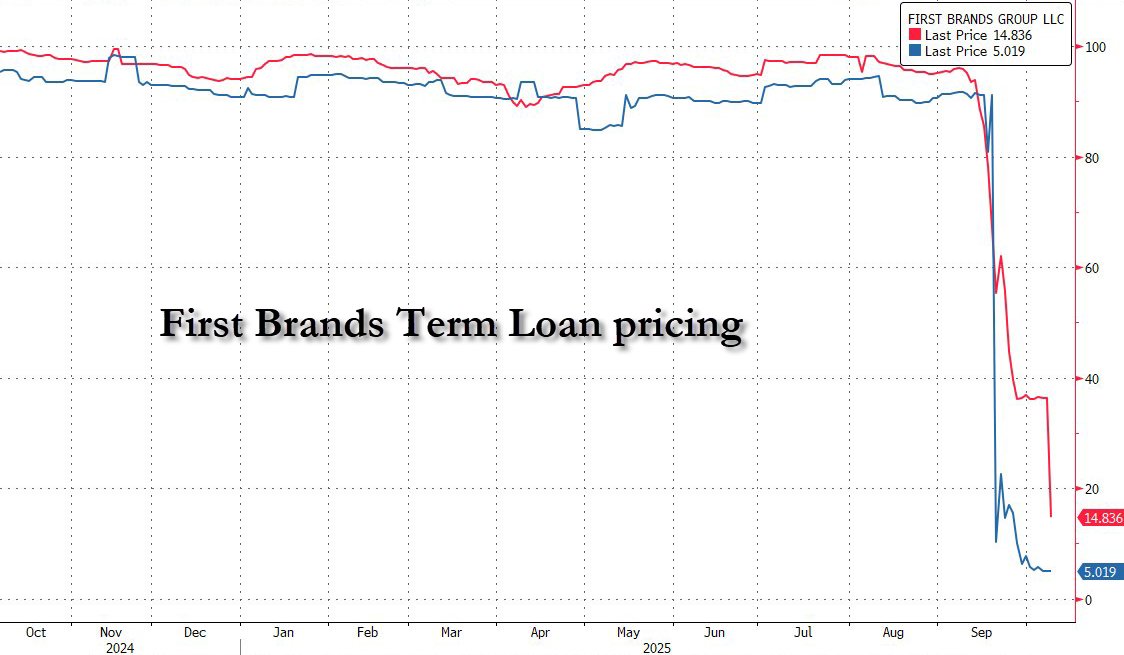
Core Insights - First Brands, an automotive parts supplier, has filed for bankruptcy, raising concerns on Wall Street about potential systemic risks in the credit market due to the disappearance of up to $2.3 billion in assets [1][3][5] - The company left behind $5.8 billion in leveraged loan debt and total liabilities may approach $12 billion, with loan prices plummeting to one-third of their value shortly before the bankruptcy [1][6] Group 1: Bankruptcy Details - First Brands filed for Chapter 11 bankruptcy protection on September 28, leaving behind $5.8 billion in leveraged loan debt [5] - The company’s advisors admitted in court that they could not trace $1.9 billion in assets that were supposed to serve as collateral for creditors, with only $12 million remaining in bank accounts [1][4] Group 2: Creditor Concerns - Raistone, one of the largest creditors, claims that $2.3 billion in assets are "untraceable" and is demanding an independent investigator to examine the circumstances surrounding the bankruptcy [3][4] - Raistone is also linked to $631 million in investments exposed to First Brands' invoices and claims to be owed at least $172 million [3] Group 3: Market Reactions - Morgan Stanley characterized the bankruptcy as an "isolated incident," maintaining a constructive outlook on the overall credit market [6] - Conversely, investor Jim Chanos warned that this could be the "first thunder" of a crisis in the private credit market, drawing parallels to the Enron scandal [6] - Despite the turmoil, the broader credit market remains calm, but Bank of America strategists suggest defensive measures due to widening spreads between high-yield and investment-grade bonds [6]