
私募自购

Search documents
私募自购行动频现 中小型机构成主力
Xin Lang Cai Jing· 2026-01-23 15:50
Core Insights - The surge in private equity self-purchases reflects confidence in investment capabilities and strategic judgment regarding current market undervaluation [1][3] - The trend is particularly prominent among medium-sized private equity firms, which are more agile in decision-making and responsive to market changes [2] Group 1: Private Equity Self-Purchase Trends - Private equity firms have been actively engaging in self-purchases, with at least six firms announcing a total of over 30 million yuan in self-purchases since the beginning of 2026 [1] - Notable examples include Yuanyang Runquan's chairman investing 10 million yuan and Yuanfang Private Equity Fund's commitment of at least 4 million yuan [1] - The self-purchase trend is seen as a positive signal for market sentiment and a potential indicator of market bottoming [5] Group 2: Characteristics of Participating Firms - The participating private equity firms primarily focus on stock strategies, particularly in technology and advanced manufacturing sectors [2] - These firms typically have moderate management scales and flexible incentive mechanisms, aligning the interests of core investment personnel with those of investors [2] - Historical performance shows that some products have achieved positive returns during market fluctuations over the past three years [2] Group 3: Market Conditions and Policy Support - Despite a net outflow of 41.8 billion yuan from the stock ETF market, specific sectors like non-ferrous metals and semiconductor equipment have seen significant inflows, indicating ongoing structural opportunities [3] - Current market valuations are considered reasonable, with the CSI 300 index's price-to-earnings ratio around 12 times, which is at the 40th percentile historically [3] - Supportive policies from the government, including a 500 billion yuan special guarantee plan, are enhancing market transparency and predictability [3] Group 4: Investment Considerations for Investors - Investors are advised to analyze self-purchase behaviors critically, considering factors such as the proportion of self-purchase amounts relative to personal assets and the lock-in periods of purchased products [4] - The credibility of self-purchases can be assessed by examining the historical self-purchase records of the institutions and their investment strategies [4] - Caution is advised as some firms may use self-purchases as marketing tactics rather than genuine commitments to long-term investment [4]
又有私募自购!
Zhong Guo Ji Jin Bao· 2026-01-19 09:30
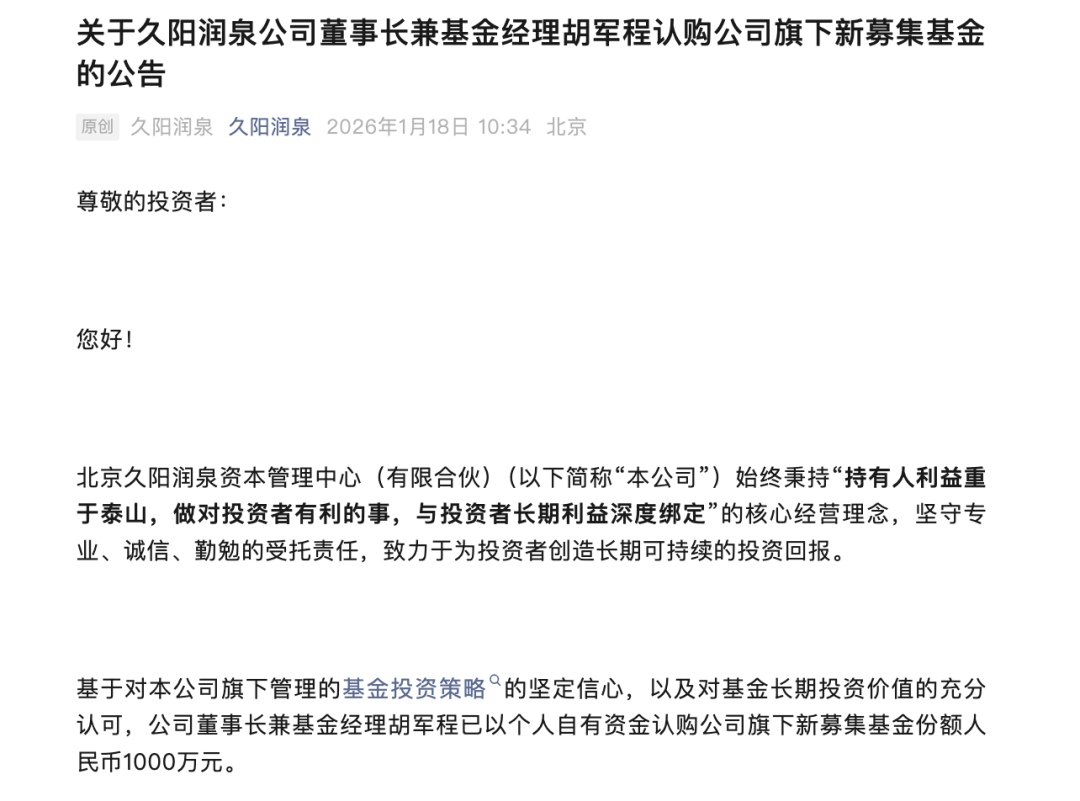
Core Viewpoint - Multiple private equity firms in China have actively engaged in self-purchase actions, indicating confidence in the market and their own products [1][3]. Group 1: Self-Purchase Actions - Jiu Yang Run Quan Capital announced that its chairman and fund manager, Hu Jun Cheng, personally subscribed to new fund shares worth RMB 10 million [1]. - Yuan Fang Fund announced a self-purchase of no less than RMB 4 million for its Yuan Fang Han Ze Growth No. 1 private equity securities investment fund [1][3]. - Hu Jun Cheng expressed that personal investment in the fund demonstrates confidence in the market, despite concerns about potential market corrections [3]. Group 2: Market Confidence and Trends - The private equity confidence index for A-shares recorded 124.94 in January 2026, a slight increase of 0.48% from December 2025, indicating improved confidence among private equity managers [5]. - The average position of subjective long-biased private equity funds remained at 78% as of December 2025, with 93.8% of funds maintaining positions above 50%, reflecting stable market sentiment [5]. - Analysts suggest that the current market liquidity is relatively abundant, and the combination of policy support and improved fundamentals presents numerous investment opportunities [6]. Group 3: Investment Focus Areas - Resource and technology sectors are highlighted as key investment areas for many private equity firms, with a focus on scarce resources and high-quality companies in technology and brand expansion [7]. - Investment strategies include maintaining high positions in cyclical industries, benefiting from rapid AI development, and focusing on monopolistic industries with high dividend rates [7].

私募开启自购表达坚定信心
Zheng Quan Ri Bao· 2026-01-18 17:09
Core Viewpoint - Private equity firms are actively engaging in self-purchase actions at the beginning of 2026, indicating confidence in the market despite concerns about potential downturns [1][2]. Group 1: Company Actions - Jiu Yang Run Quan Capital Management announced that its chairman and fund manager, Hu Jun Cheng, personally subscribed to new fund shares worth RMB 10 million [1]. - The firm has a history of self-purchases, with employees subscribing a total of RMB 12.396 million in the past year and management subscribing RMB 22.51 million in February 2022 [1]. - Another private equity firm, Yuan Fang Private Fund Management, also announced a self-purchase of at least RMB 4 million for its fund [2]. Group 2: Industry Insights - Self-purchase actions by private equity firms serve as a confidence bridge for investors and demonstrate the responsibility of fund managers [3]. - The increase in self-purchase activities reflects a trend towards more regulated and transparent practices in the private equity industry, which can attract long-term capital and stabilize the market [3]. - As of November 2025, the total scale of private equity funds reached RMB 22.09 trillion, with private securities investment funds exceeding RMB 7 trillion [3]. Group 3: Market Outlook - Hu Jun Cheng expressed a rational optimism about the long-term development of the capital market, supported by improved market ecology, funding structure, policy guidance, and economic growth quality [4]. - Key factors contributing to this outlook include strengthened regulations, the influx of long-term capital, and a transformation in economic structure that enhances investment [4].