移动计算

Search documents
台积电的最大客户,变了
芯世相· 2026-01-29 06:38
Core Viewpoint - The semiconductor industry is undergoing a historic transition as Nvidia has officially surpassed Apple to become TSMC's largest customer, driven by the surging demand for AI computing capabilities, indicating a fundamental restructuring of the global chip market [3][4]. Group 1: Nvidia's Rise and Market Dynamics - Nvidia's dominance as TSMC's top customer reflects a steep growth curve in AI-centric chip production, with Nvidia occupying more advanced process capacity than any other client [3][4]. - Nvidia's H100 and H200 data center GPUs, manufactured using TSMC's 4nm and 5nm processes, are priced over $30,000 each, significantly higher than smartphone processors, altering the semiconductor value chain's incentive structure [5][6]. - Over the past 18 months, Nvidia's wafer orders have grown exponentially, leading TSMC to expand its advanced packaging capacity to meet Nvidia's CoWoS requirements, which are critical for modern AI accelerators [6]. Group 2: Apple's Semiconductor Strategy - Apple's replacement by Nvidia does not indicate weakness but rather reflects a maturation of its product lineup and a more restrained hardware update strategy [7]. - Apple completed its transition to self-developed chips for its Mac product line in 2022, leading to a temporary spike in chip demand, which has since normalized [7]. - Despite a relative decline in its share of TSMC's revenue, Apple remains a key customer and is expected to continue using advanced processes for its upcoming A19 and M5 chips [7][8]. Group 3: TSMC's Capacity Allocation Challenges - TSMC faces increasing complexity in balancing the demands of major clients like Nvidia and Apple while also servicing other companies such as AMD and Qualcomm [9][10]. - TSMC's capital expenditure for 2024 exceeds $40 billion, aimed at expanding capacity in Taiwan, Arizona, Japan, and potentially Europe [10]. - The shift towards AI chip demand is influencing TSMC's technology development focus, necessitating a fundamental change in process optimization strategies to cater to high-performance computing [10]. Group 4: Competitive Landscape and Market Implications - Nvidia's strengthened relationship with TSMC occurs amid other foundries struggling to catch up in advanced processes, giving TSMC significant bargaining power [11]. - Geopolitical uncertainties complicate long-term capacity planning for Nvidia and TSMC, as prioritizing high-margin AI chip production may extend lead times and increase costs for other clients [11]. - Major tech companies like Amazon, Google, and Microsoft are accelerating their custom chip initiatives to reduce reliance on Nvidia and secure manufacturing resources amid tightening capacity [11]. Group 5: Future Trends in Semiconductor Manufacturing - The relationship between Nvidia, Apple, and TSMC is expected to continue evolving, with TSMC planning to enter mass production of 2nm processes by 2025 [12][13]. - The long-term trajectory of AI chip demand remains uncertain, with potential shifts in relative positions between Nvidia and Apple depending on market conditions and product innovations [12]. - TSMC's global expansion adds new dimensions to the relationship, as the willingness of Nvidia and Apple to shift core production to higher-cost, lower-risk U.S. facilities remains uncertain [13].



行业聚焦:全球二合一笔记本市场头部企业份额调研(附Top10 厂商名单)
QYResearch· 2025-09-23 04:08
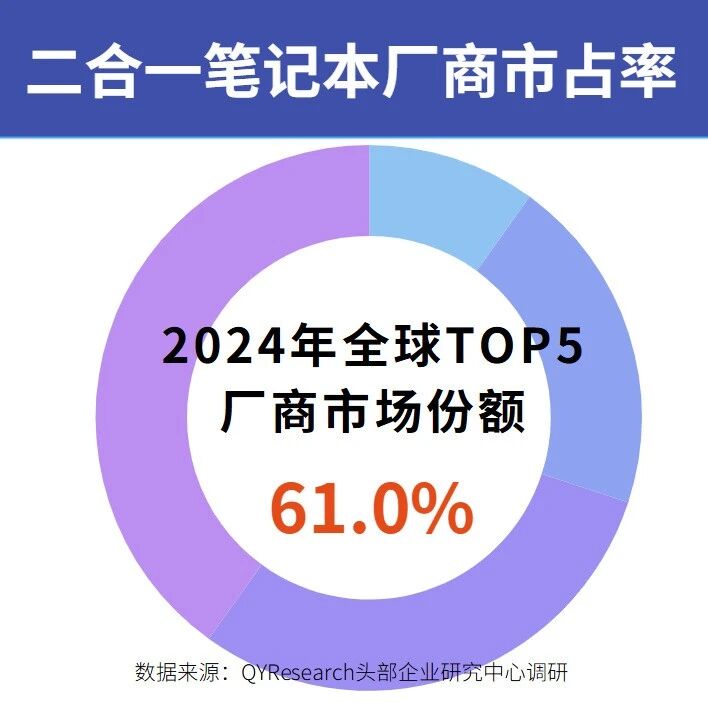
Core Viewpoint - The global 2-in-1 PC market is projected to reach a size of $54.434 billion by 2031, with a compound annual growth rate (CAGR) of 5.9% over the next few years [1]. Market Overview - The global market for 2-in-1 notebooks is dominated by major manufacturers such as Apple, HP, Microsoft, Lenovo, and Asus, which collectively hold approximately 61.0% of the market share as of 2024 [6]. - The primary product segment is 12-14 inches, accounting for about 60% of the market share [7]. Application Segmentation - Windows is the largest downstream market for 2-in-1 notebooks, representing around 67% of the demand [9]. Key Drivers - **Portability and Versatility**: 2-in-1 notebooks enhance portability and meet diverse needs for mobile computing, making them ideal for commuting, mobile office work, and classroom use [12]. - **Flexible Interaction**: These devices support seamless switching between laptop and tablet modes, accommodating touch and stylus input, which enhances user experience across various applications [15]. - **Compatibility and Accessory Convenience**: The compact design allows easy adaptation to various carrying methods, reducing user burden and enhancing the mobile experience [16]. Major Obstacles - **Rising Costs**: Increasing raw material prices, labor costs, and logistics expenses are squeezing profit margins, leading manufacturers to optimize production and supply chains [17]. - **Geopolitical and Supply Chain Uncertainty**: The complexities of U.S.-China relations are prompting companies to relocate assembly processes, creating challenges in efficiency and compliance [18]. - **Quality-Price Correlation**: The strong relationship between product quality and pricing limits performance improvements in mid- to low-end products [19]. - **Macroeconomic Fluctuations**: The demand for 2-in-1 notebooks is closely tied to GDP growth rates, with economic slowdowns potentially dampening consumer purchasing intentions [20]. Industry Development Trends - The 2-in-1 notebook market is diversifying, focusing on environmental compliance, price competition, and product lightweighting [21]. - Stricter regulations on harmful substance emissions are driving manufacturers to enhance green supply chain management [21]. - Intense market competition is exerting downward pressure on average product prices, prompting companies to innovate and differentiate their offerings [21]. - Lightweight materials are gaining traction, with ongoing research aimed at developing thinner, lighter, and more portable devices [21].