空天具身智能

Search documents
面向「空天具身智能」,北航团队提出星座规划新基准丨NeurIPS'25
具身智能之心· 2025-12-15 01:04
Core Viewpoint - The article discusses the challenges and advancements in satellite constellation task planning, emphasizing the integration of AI technologies to enhance efficiency and effectiveness in managing complex satellite operations [2][4][6]. Group 1: Satellite Constellation Overview - Satellite constellations consist of multiple satellites working together, providing extensive global coverage and rapid response capabilities, essential for industries like remote sensing, communication, navigation, and weather forecasting [4]. - The increasing scale of satellite constellations presents significant planning challenges, necessitating advanced solutions to manage the coordination of numerous satellites executing various tasks [6][8]. Group 2: Challenges in Task Planning - The complexity of task planning increases with the number of satellites and tasks, as seen in the example of the SkySat constellation, which requires handling over 100 tasks daily with 13 satellites, escalating to 21 satellites [8]. - Time constraints are critical, as satellites orbit quickly, often providing less than 5 minutes of observable time for any ground area, making precise planning essential to avoid mission failures [9]. - Emergency response tasks, such as those for the "Nüwa Constellation," often achieve less than 60% completion rates due to the limitations of current methods under high time-sensitive demands [10]. - Various physical constraints, including field of view, battery consumption, and attitude adjustment times, complicate the scheduling process exponentially [11]. Group 3: AI Solutions and Innovations - The research team from Beihang University developed the AEOS-Bench, a large-scale benchmark for satellite scheduling, integrating the Transformer model's capabilities with aerospace engineering requirements [4][13]. - AEOS-Bench features over 16,000 satellite task scenarios, ensuring physical accuracy and comprehensive evaluation metrics, including task completion rates and energy consumption [14][13]. - The AEOS-Former model, trained on the AEOS-Bench dataset, incorporates embedded constraints to effectively match satellites with tasks, demonstrating superior performance compared to baseline models in various metrics [18][19]. Group 4: Performance Evaluation - AEOS-Former consistently outperformed baseline models across all test data partitions, showcasing improvements in task completion rates and energy efficiency [19][20]. - The relationship between task completion rates and resource consumption indicates a trade-off, where increased satellite numbers enhance observational capabilities but also lead to diminishing returns in resource efficiency [20]. Group 5: Future Implications - The integration of AI into satellite constellations is poised to expand human capabilities in space exploration and utilization, marking a significant advancement in autonomous decision-making and collaboration in aerospace [22][23].

面向「空天具身智能」,北航团队提出星座规划新基准丨NeurIPS'25
量子位· 2025-12-13 04:34
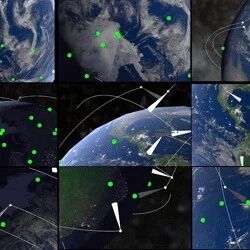
△ 卫星星座任务规划效果展示 卫星星座是由多颗卫星组成的协同网络,具备远超单星的全球覆盖、快速响应和高频观测能力。从美国的巨型卫星通信星座到我国的"千帆"星 座, 卫星星座已从科幻概念走向产业核心,成为数字经济时代的基础设施。 这些运行在距地数百公里的卫星星座,正默默支撑着遥感、通信、导航、气象预测等关键行业。但每一个稳定运行的星座背后,都藏着一个高 维、动态、强约束的规划难题。 如何在短短几分钟的观测窗口内,调度数十颗卫星形成协同观测网络,执行上百项任务,同时响应地震救 援、海上搜救、森林火灾等突发需求? 人工智能技术正在成为破解这一难题的关键钥匙。北航刘偲教授团队提出 首个大规模真实星座调度基 准AEOS-Bench ,更创新性地将Transformer模型的泛化能力与航天工程的专业需求深度融合,训练 内嵌时间约束的调度模型AEOS- Former 。这一组合为未来的"AI星座规划"奠定了新的技术基准。 AEOS-Bench&AEOS-Former团队 投稿 量子位 | 公众号 QbitAI 将卫星星座送入轨道我们都知道很难,但高效规划调度在轨卫星星座执行任务也不简单。 随着部署的星座规模越来越大,通过人 ...