立功

Search documents
三堂会审丨准确区分违反工作纪律和滥用职权罪
Zhong Yang Ji Wei Guo Jia Jian Wei Wang Zhan· 2026-01-21 00:23
Core Viewpoint - The case of Jin, a former deputy director of the B District Management Committee in A City, highlights the issues of work discipline violations and abuse of power, particularly in the context of significant financial risks and the mismanagement of state assets [3][10][12]. Summary by Sections Basic Case Facts - Jin joined the Communist Party of China in September 2004 and held positions including deputy director of the B District Management Committee [4]. - From 2015 to 2020, Jin illegally accepted bribes totaling 1.23 million yuan [5]. - In 2021, Jin made unauthorized payments of over 5.26 million yuan to Company C for equipment that was never delivered, despite knowing the associated financial risks [5][9]. Investigation and Legal Proceedings - On June 19, 2024, the A City Discipline Inspection Commission initiated an investigation into Jin's serious violations [6]. - Jin was expelled from the Party and removed from public office on September 9, 2024, and subsequently charged with bribery and abuse of power [7]. - On October 24, 2024, the D District People's Procuratorate filed a public prosecution against Jin [8]. Legal Analysis and Opinions - There are differing opinions on whether Jin's actions constitute a violation of work discipline or abuse of power. The second opinion, which is favored, argues that his actions meet the criteria for abuse of power under criminal law [10][11]. - Jin's actions resulted in significant losses to state assets, which is a key factor in determining the severity of his offenses [12][13]. Financial Loss Assessment - Between 2018 and 2021, the B District Management Committee made two payments totaling over 9.86 million yuan to Company C, with 5.26 million yuan being paid without proper authorization [14]. - The total loss incurred due to Jin's actions is recognized as exceeding 5.26 million yuan, with some funds recovered post-investigation [16][17]. Sentencing Considerations - Jin's case includes elements of both self-reporting and cooperation with authorities, which may influence sentencing. His actions during the investigation, including confessing to previously undisclosed bribery, are considered mitigating factors [18][19].

三堂会审丨借用房屋还是受贿
Zhong Yang Ji Wei Guo Jia Jian Wei Wang Zhan· 2025-06-25 00:34
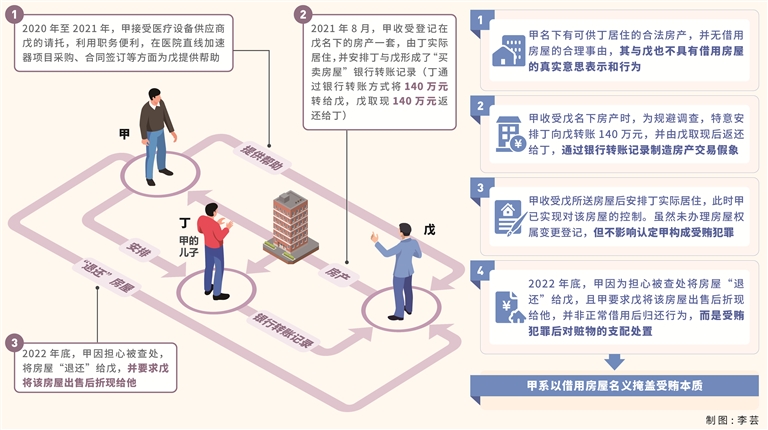
Core Viewpoint - The case involves a former hospital executive, referred to as "甲," who engaged in corrupt practices, including accepting bribes and misusing his position to benefit others, leading to significant legal consequences [4][5][10]. Summary by Sections Basic Case Facts - "甲" held multiple senior positions at a public hospital and violated organizational discipline by accepting a bribe of 10,000 yuan from a subordinate, "乙," in exchange for helping "乙's" daughter secure a job, which he ultimately failed to do [4][5]. - Over the years, "甲" received over 4.75 million yuan in bribes while leveraging his authority in procurement and project contracts [5][10]. Investigation Process - The investigation began on May 10, 2024, leading to "甲" being placed under detention on May 13, 2024, and subsequently expelled from the Party and public office in August and October 2024, respectively [7][8]. - On September 18, 2024, the case was formally prosecuted, resulting in a conviction for bribery with a sentence of eleven years in prison and a fine of 1.5 million yuan [9][20]. Legal Analysis - The actions of "甲" were classified as a violation of organizational discipline and bribery, as he accepted money and facilitated a promotion for "乙" based on the bribe received [11][12]. - The court determined that "甲's" acceptance of a property from a supplier, "戊," constituted bribery, despite the property not being formally registered in his name [13][15]. - The court rejected arguments that "甲's" return of the property indicated a cessation of criminal activity, affirming that the bribery was complete upon acceptance and use of the property [14][16]. Sentencing Considerations - "甲" argued for a lighter sentence based on claims of self-reporting and cooperation, but the court found these claims unsubstantiated, as the investigation had already uncovered his actions prior to any self-reporting [20][21]. - The court concluded that "甲's" actions constituted a particularly large amount of bribery, justifying the eleven-year sentence and fine [21].