自首

Search documents
三堂会审丨准确区分违反工作纪律和滥用职权罪
Zhong Yang Ji Wei Guo Jia Jian Wei Wang Zhan· 2026-01-21 00:23
Core Viewpoint - The case of Jin, a former deputy director of the B District Management Committee in A City, highlights the issues of work discipline violations and abuse of power, particularly in the context of significant financial risks and the mismanagement of state assets [3][10][12]. Summary by Sections Basic Case Facts - Jin joined the Communist Party of China in September 2004 and held positions including deputy director of the B District Management Committee [4]. - From 2015 to 2020, Jin illegally accepted bribes totaling 1.23 million yuan [5]. - In 2021, Jin made unauthorized payments of over 5.26 million yuan to Company C for equipment that was never delivered, despite knowing the associated financial risks [5][9]. Investigation and Legal Proceedings - On June 19, 2024, the A City Discipline Inspection Commission initiated an investigation into Jin's serious violations [6]. - Jin was expelled from the Party and removed from public office on September 9, 2024, and subsequently charged with bribery and abuse of power [7]. - On October 24, 2024, the D District People's Procuratorate filed a public prosecution against Jin [8]. Legal Analysis and Opinions - There are differing opinions on whether Jin's actions constitute a violation of work discipline or abuse of power. The second opinion, which is favored, argues that his actions meet the criteria for abuse of power under criminal law [10][11]. - Jin's actions resulted in significant losses to state assets, which is a key factor in determining the severity of his offenses [12][13]. Financial Loss Assessment - Between 2018 and 2021, the B District Management Committee made two payments totaling over 9.86 million yuan to Company C, with 5.26 million yuan being paid without proper authorization [14]. - The total loss incurred due to Jin's actions is recognized as exceeding 5.26 million yuan, with some funds recovered post-investigation [16][17]. Sentencing Considerations - Jin's case includes elements of both self-reporting and cooperation with authorities, which may influence sentencing. His actions during the investigation, including confessing to previously undisclosed bribery, are considered mitigating factors [18][19].

关于“景德镇一家三口被撞身亡案”,法院发布判后答疑
Xin Lang Cai Jing· 2026-01-09 09:24
Core Viewpoint - The case involves the defendant, Liao Mouyu, who was found guilty of endangering public safety through dangerous driving, resulting in the death of three individuals. The court determined that Liao's actions constituted indirect intent rather than negligence, leading to a sentence of death with a two-year reprieve [2][3][5]. Group 1: Criminal Behavior and Intent - Liao Mouyu's behavior of driving at a speed of 128.96 km/h in a zone with a speed limit of 40 km/h during a peak holiday period posed a severe threat to public safety, resulting in three fatalities [5]. - The distinction between direct and indirect intent was highlighted, with Liao lacking a motive to intentionally harm the victims, thus categorizing his mindset as indirect intent [3][4]. - The court noted that Liao's subsequent actions, such as attempting to brake and steer away from the victims, did not alter the initial assessment of his mindset during the dangerous driving [2][4]. Group 2: Legal Proceedings and Sentencing - Liao Mouyu was recognized for having self-reported his actions by calling emergency services and remaining at the scene, which constituted a confession under legal definitions [4]. - The court's decision to impose a death sentence with a two-year suspension was based on the severity of the crime, the indirect intent, and the presence of mitigating factors such as the confession [5]. - The ruling emphasized that while Liao's actions were extremely dangerous, his mindset and cooperation with authorities warranted a sentence that was not immediately executed [5].

江西景德镇一家三口被撞身亡案一审宣判,法院答疑
Yang Shi Wang· 2026-01-09 02:34
Core Viewpoint - The court has sentenced Liao Mouyu to death with a two-year reprieve for endangering public safety through reckless driving, resulting in three fatalities. The judgment emphasizes Liao's indirect intent and the severe consequences of his actions during a peak traffic period [5][6]. Group 1: Case Background - Liao Mouyu was aware of the vehicle's acceleration capabilities and the speed limits on the main road in Jingdezhen, where he drove recklessly during a holiday peak time, indicating a disregard for public safety [2][3]. - The incident occurred on a busy urban main road, where Liao's actions posed a significant and unpredictable danger to the public, ultimately leading to three deaths [3][4]. Group 2: Legal Findings - The court determined that Liao's mindset constituted indirect intent rather than negligence, as he continued to accelerate despite knowing the risks involved [3][4]. - Liao's actions were not motivated by a desire to harm the victims, as he had no prior relationship with them and was in a distressed state due to a personal dispute [4][5]. Group 3: Sentencing Rationale - The court's decision to impose a death sentence with a two-year suspension was based on the severity of Liao's actions, which included exceeding the speed limit of 40 km/h by reaching 128.96 km/h [5][6]. - Liao's cooperation with authorities post-incident, including calling for help and remaining at the scene, was recognized as a mitigating factor contributing to the self-surrender classification [5][6].

为何判死缓?一审判决书详解成都27岁女子家门口遇害案
Xin Lang Cai Jing· 2025-12-24 00:16
Core Viewpoint - The Chengdu Intermediate People's Court sentenced Liang Mengmeng to death with a two-year reprieve for the murder of Wang Ziya, citing significant mental health issues as a key factor in the ruling [1][16]. Group 1: Court Ruling and Justification - The court determined that Liang Mengmeng exhibited clear signs of mental illness prior to the crime, which affected her ability to recognize and control her actions, classifying her as a person with limited criminal responsibility [1][8]. - The court rejected Liang's defense claims of self-defense, stating that her actions posed a significant danger to others and constituted a violation of Wang Ziya's right to peace [2][12]. - The court found that Liang's behavior, including carrying a knife and disturbing neighbors, indicated a high level of social harm and personal danger [2][8]. Group 2: Background and Incident Details - Wang Ziya was described as a bright and healthy individual, living with her mother, who expressed concerns about Liang's unusual behavior prior to the incident [3][4]. - The incident occurred when Liang was found outside Wang's residence, leading to a confrontation that escalated into violence [5][6]. - Witness accounts indicated that both parties engaged in a physical struggle, with Liang ultimately using a knife, resulting in Wang's death [6][7]. Group 3: Mental Health Assessment - Liang Mengmeng's mental health history was a focal point, with evidence suggesting she had been experiencing significant psychological issues for several years, including symptoms consistent with schizophrenia [8][13]. - Testimonies from family and neighbors corroborated Liang's erratic behavior, including episodes of paranoia and aggression [9][10]. - The court accepted the forensic psychiatric evaluation that diagnosed Liang with schizophrenia, affirming her partial criminal responsibility at the time of the offense [13][14]. Group 4: Legal Proceedings and Reactions - The court's decision to classify Liang's actions as intentional murder, despite her mental health issues, has sparked discussions about the adequacy of legal definitions regarding self-defense and criminal responsibility [12][15]. - Liang's family expressed their disagreement with the verdict, indicating plans to appeal the decision [16].
“成都女子家门口遇害案”一审判处被告人死刑 缓期二年执行
21世纪经济报道· 2025-12-20 08:16
Core Viewpoint - The Chengdu Intermediate People's Court sentenced Liang Mouying to death with a two-year reprieve for intentional homicide, emphasizing the severity of the crime and the need for legal punishment despite the defendant's partial criminal responsibility due to mental illness [1][8]. Summary by Sections Case Background - Liang Mouying frequently disturbed other residents in the community, leading to previous police interventions. On June 9, 2024, after disturbing Wang Mouya, a confrontation ensued, resulting in Liang fatally stabbing Wang [2][5]. Court Findings - The court established that Liang's actions constituted a violation of Wang's right to residential peace. The altercation escalated to violence, with Liang using a knife, leading to Wang's death. The court ruled that Liang's actions amounted to intentional homicide and did not qualify as self-defense [5][6]. Mental Health Considerations - Evidence indicated that Liang suffered from schizophrenia, which affected his criminal responsibility. The court acknowledged this condition, leading to a lighter sentence despite the severity of the crime [6][7]. Sentencing Rationale - The court applied the legal framework for sentencing, determining that Liang's actions warranted a death sentence with a two-year reprieve due to his mental health status at the time of the crime. This decision reflects the balance between the nature of the crime and the defendant's mental condition [8].

关于被告人梁某滢故意杀人案的说明
Xin Lang Cai Jing· 2025-12-20 07:47
Group 1 - The defendant Liang Mouying's actions are classified as intentional homicide due to multiple disturbances to other residents and the fatal stabbing of Wang Mouya during a confrontation [1][5] - The court rejected the defense's claim of self-defense, stating that Liang's actions were not a legitimate response to unlawful aggression [1][5] Group 2 - Liang Mouying did not qualify for self-surrender as he did not voluntarily confess to his crime and was unable to escape from the scene [2][6][7] - The court found that Liang exhibited signs of mental illness prior to the crime, supported by testimonies and records from various sources [3][8] Group 3 - The court determined that Liang Mouying was a person with limited criminal responsibility due to his mental condition at the time of the crime, which influenced the sentencing [4][9] - Liang was sentenced to death with a two-year reprieve, reflecting the severity of the crime while considering his mental health status [4][9]

三堂会审丨借款收息还是非法经营同类营业
Zhong Yang Ji Wei Guo Jia Jian Wei Wang Zhan· 2025-07-02 01:06
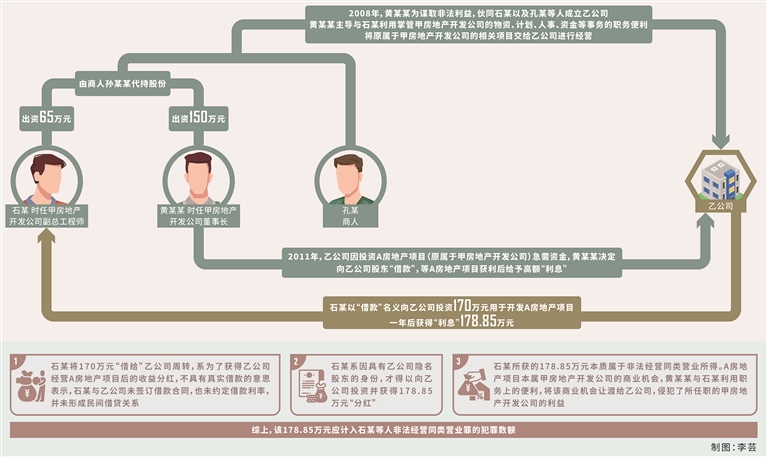
Core Viewpoint - The case involves the investigation and prosecution of Shi for bribery and illegal business operations, highlighting the misuse of public office for personal gain and the legal implications of such actions [5][8][23]. Group 1: Case Background - Shi held multiple positions in a state-owned real estate development company, utilizing his role to facilitate business for others while receiving bribes totaling over 2.44 million yuan [5][23]. - A specific incident involved Shi receiving a property worth 793,000 yuan as a bribe, which was later sold by his son for 2.7 million yuan, raising questions about the proper assessment of the bribe amount [9][11]. Group 2: Legal Proceedings - The investigation began in January 2022, leading to Shi's detention and subsequent charges of bribery and illegal business operations [7][8]. - In March 2023, the court sentenced Shi to six years in prison and imposed fines totaling 550,000 yuan for his crimes, which included both bribery and illegal business activities [8][24]. Group 3: Legal Interpretations - The court determined that the bribe amount should be based on the market value of the property at the time of receipt, rather than the sale price, establishing a precedent for similar cases [11][12]. - The actions of Shi and his co-conspirators were classified as illegal business operations, as they exploited their positions to divert projects from the state-owned company to a private entity, resulting in significant illegal profits [12][13][20]. Group 4: Sentencing Considerations - The court considered mitigating factors such as Shi's confession and cooperation with the investigation, which influenced the final sentencing decision [22][24]. - The ruling emphasized the importance of accountability for public officials and the legal consequences of corruption within state-owned enterprises [23][24].
三堂会审丨借用房屋还是受贿
Zhong Yang Ji Wei Guo Jia Jian Wei Wang Zhan· 2025-06-25 00:34
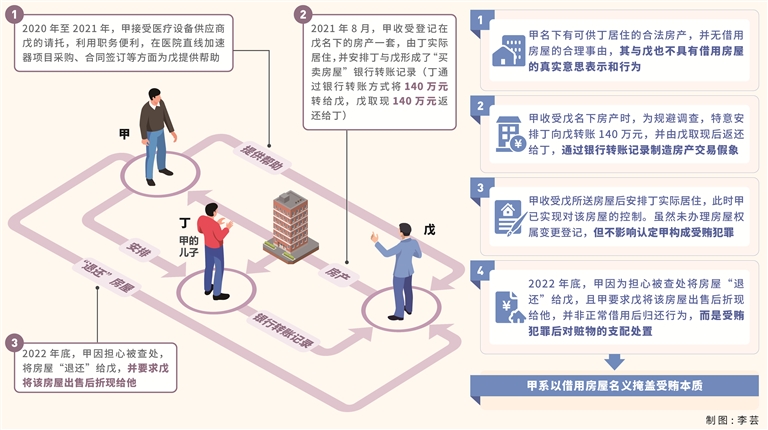
Core Viewpoint - The case involves a former hospital executive, referred to as "甲," who engaged in corrupt practices, including accepting bribes and misusing his position to benefit others, leading to significant legal consequences [4][5][10]. Summary by Sections Basic Case Facts - "甲" held multiple senior positions at a public hospital and violated organizational discipline by accepting a bribe of 10,000 yuan from a subordinate, "乙," in exchange for helping "乙's" daughter secure a job, which he ultimately failed to do [4][5]. - Over the years, "甲" received over 4.75 million yuan in bribes while leveraging his authority in procurement and project contracts [5][10]. Investigation Process - The investigation began on May 10, 2024, leading to "甲" being placed under detention on May 13, 2024, and subsequently expelled from the Party and public office in August and October 2024, respectively [7][8]. - On September 18, 2024, the case was formally prosecuted, resulting in a conviction for bribery with a sentence of eleven years in prison and a fine of 1.5 million yuan [9][20]. Legal Analysis - The actions of "甲" were classified as a violation of organizational discipline and bribery, as he accepted money and facilitated a promotion for "乙" based on the bribe received [11][12]. - The court determined that "甲's" acceptance of a property from a supplier, "戊," constituted bribery, despite the property not being formally registered in his name [13][15]. - The court rejected arguments that "甲's" return of the property indicated a cessation of criminal activity, affirming that the bribery was complete upon acceptance and use of the property [14][16]. Sentencing Considerations - "甲" argued for a lighter sentence based on claims of self-reporting and cooperation, but the court found these claims unsubstantiated, as the investigation had already uncovered his actions prior to any self-reporting [20][21]. - The court concluded that "甲's" actions constituted a particularly large amount of bribery, justifying the eleven-year sentence and fine [21].
三堂会审丨贪污伴随的滥用职权行为是否应单独评价
Zhong Yang Ji Wei Guo Jia Jian Wei Wang Zhan· 2025-06-18 00:16
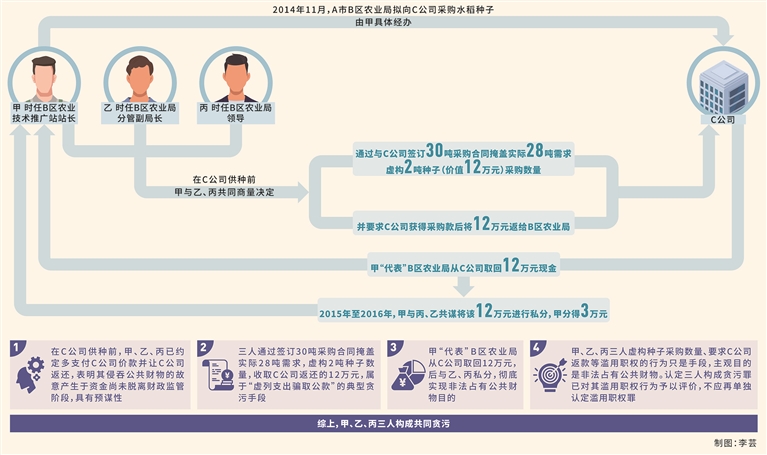
Core Points - The case involves three individuals (A, B, C) conspiring to falsely inflate seed procurement quantities, resulting in an overpayment of 120,000 yuan to Company C, which they later divided among themselves [5][9][10] - A, while serving as the head of the Agricultural Technology Promotion Station, engaged in corrupt practices, including embezzlement and bribery, totaling 2.08 million yuan in bribes and 460,000 yuan in collusion with another employee [6][12][14] - The investigation led to A being expelled from the party and public office, with subsequent criminal charges filed for embezzlement, bribery, and collusion [7][18][20] Summary by Sections Basic Case Facts - A was responsible for a seed procurement contract, where he, along with B and C, conspired to create a false procurement quantity, leading to an illegal return of 120,000 yuan [4][5] - A's actions included receiving bribes from multiple suppliers, totaling 2.08 million yuan over a decade [6][12] Investigation Process - The investigation began on September 25, 2023, with A being placed under detention, followed by disciplinary actions and criminal charges [7][19] - A was convicted on April 30, 2025, receiving a combined sentence of seven years in prison and a fine of 550,000 yuan [7][18] Legal Interpretations - The actions of A, B, and C were classified as joint embezzlement rather than bribery, as they involved the illegal appropriation of public funds [8][9] - The court determined that A and another employee, D, engaged in joint bribery, with A being the principal actor and D playing a secondary role [15][16]