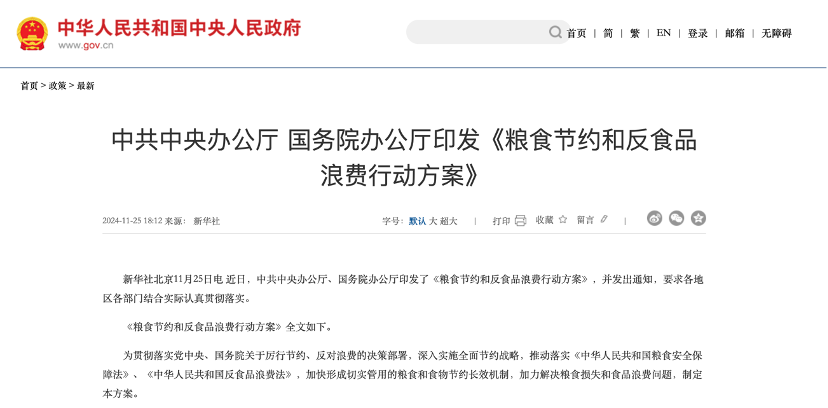
粮食节约和反食品浪费

Search documents
锻造粮食安全强韧性
Jing Ji Ri Bao· 2026-02-02 22:13
Core Viewpoint - The article emphasizes the importance of ensuring food security in China, highlighting the need for a resilient production system, flexible storage and regulation, and a strong international supply chain to maintain control over food security and stabilize the food supply [1]. Group 1: Food Production Stability - Food production must remain a top priority, with a focus on maintaining stable planting areas and increasing yield per unit area through advanced agricultural practices and technology [2]. - The government should implement policies that support farmers, ensuring they have financial incentives to grow crops and stabilize grain planting areas [2][3]. Group 2: Structural Adjustment and Quality Improvement - There is a need to adjust and optimize planting structures to meet consumer demand for high-quality and specialty crops, addressing the imbalance between surplus common varieties and a lack of premium products [3]. - Developing order-based agriculture can help farmers transition to growing high-quality grains by providing comprehensive support throughout the production process [3]. Group 3: Disaster Resilience and Infrastructure - Enhancing agricultural disaster prevention and mitigation capabilities is crucial, with a focus on improving irrigation infrastructure and monitoring systems to ensure stable production despite extreme weather [4]. - A comprehensive approach to disaster management should be established, integrating various agricultural support systems to ensure resilience and sustainability [4]. Group 4: Price Stability and Market Regulation - Maintaining reasonable grain prices is essential for both farmers and consumers, requiring a balance between market forces and government intervention to stabilize prices [5][6]. - Improving grain storage and reserve capabilities is vital for ensuring food security and market stability, with a focus on modernizing storage facilities and optimizing reserve structures [6]. Group 5: Emergency Response and Supply Chain - A robust emergency response system is necessary to address sudden disruptions in food supply, requiring efficient logistics and resource allocation to vulnerable areas [7]. - Digital technologies should be leveraged to enhance monitoring and response capabilities within the food supply chain [7]. Group 6: High-Quality Development of the Food Industry - The food industry must continue to evolve towards high-quality development, addressing existing challenges such as short supply chains and limited value addition [8][9]. - Strengthening the connection between farmers and the food industry can enhance income for farmers and promote regional economic development [9]. Group 7: Technological Innovation - Technology is a key driver for improving the quality and efficiency of the food industry, necessitating investment in new technologies and practices to enhance production capabilities [10]. - Establishing technology service teams in major grain-producing areas can help address industry needs and facilitate the application of innovative solutions [10]. Group 8: Food Safety and Quality Management - Continuous improvement in food quality management is essential, with increased monitoring and regulation of key production areas and processes to ensure safety [11]. - Implementing a traceability system for food products can enhance consumer confidence and ensure accountability throughout the supply chain [11]. Group 9: Waste Reduction and Resource Efficiency - Efforts to reduce food waste and promote resource efficiency are critical for measuring the quality of food industry development [12]. - Establishing post-harvest service centers and improving storage conditions can help address issues like grain loss and enhance overall efficiency [12]. Group 10: Trade Coordination and Import Management - Coordinating domestic production with trade is vital for maintaining food security, requiring careful management of import volumes to avoid market disruptions [13][14]. - Diversifying import sources and enhancing domestic supply chain capabilities can mitigate risks associated with international trade [14]. Group 11: Legal Measures Against Smuggling - Strengthening legal frameworks and enforcement against food smuggling is necessary to protect domestic markets and ensure food safety [15]. - International cooperation is essential to combat cross-border smuggling and enhance global food security governance [15].
“体重350多斤,胃袋就有150多斤”,吃播“大胃王”良子的困惑
Xin Jing Bao· 2025-08-25 00:45
Core Viewpoint - The article discusses the phenomenon of "eating broadcasts" and highlights the case of a popular host, Liangzi, who has gained fame through extreme eating challenges, leading to significant health issues and a complex relationship with his audience [3][15][21]. Group 1: Liangzi's Journey - Liangzi, originally known as Li Zhanli, transitioned from a singing host to an eating broadcaster after discovering that viewers preferred watching him eat rather than his other content [7][12]. - He has gained a massive following of approximately 3.5 million across various platforms, with his eating challenges often resulting in extreme food consumption, such as 16 packs of instant noodles or 120 dumplings in one sitting [3][15][21]. - His weight has fluctuated dramatically, reaching a peak of over 380 pounds, which has led to various health complications and a struggle with self-image [12][21]. Group 2: Health Implications - Liangzi's extreme eating habits have resulted in severe health risks, including potential sleep apnea, diabetes, and joint issues, as he carries a weight equivalent to that of three average individuals [21][22]. - His physical condition has deteriorated to the point where he experiences difficulty in basic movements and has lost several teeth due to poor dietary choices [16][21]. - Despite recognizing the health risks, Liangzi has expressed a conflicted desire to continue his eating broadcasts for the sake of his audience, indicating a complex relationship between his health and his online persona [15][17]. Group 3: Audience Dynamics - The audience's fascination with Liangzi stems from a mix of curiosity and entertainment, with many viewers drawn to his extreme eating as a form of escapism [15][22]. - There is a growing trend among eating broadcasters to push the limits of consumption, often leading to bizarre and extreme food challenges that attract significant viewership [22][26]. - Despite regulatory efforts to curb excessive eating broadcasts, the demand for such content remains high, as platforms continue to recommend engaging and unusual eating videos to users [22][26].