
精准救助

Search documents
为涉诉困难群众驱散阴霾照亮前路
Xin Lang Cai Jing· 2026-01-12 21:04
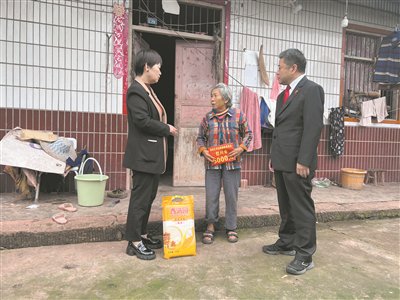
Core Viewpoint - The establishment of the "Tongnan District Judicial Assistance Love Fund" aims to provide support for vulnerable groups involved in legal disputes, ensuring they receive necessary assistance and hope in difficult times [3]. Group 1: Fund Establishment and Structure - The "Tongnan District Judicial Assistance Love Fund" was established in April 2025 by the Minjie Tongnan District Branch, the Tongnan District People's Court, and the Tongnan District Charity Association [3]. - The fund operates on a three-part system: court screening, Minjie customization, and charity execution, to accurately identify and assist those in need [3]. Group 2: Case Studies - Qin Xiangxiu, an elderly woman left without support after a fall, received assistance through the fund after her children refused to care for her, highlighting the fund's role in providing a safety net [4]. - Mi Sucai, who suffered a work-related injury, faced challenges in receiving compensation from his employer, but the fund facilitated legal guidance and financial support to alleviate his family's burden [5][6]. Group 3: Impact and Future Plans - Since its inception, the fund has conducted over ten special actions, demonstrating the effectiveness of the "Together in Tongnan, Love in Hand" initiative in providing both legal protection and social care [6]. - The Minjie Tongnan District Branch plans to continue collaborating with the court and charity association to enhance the assistance mechanism, broaden resource channels, and improve the quality of support for more vulnerable groups [6].

加强分层分类社会救助 北京拟建立刚性支出困难家庭救助制度
Yang Guang Wang· 2026-01-09 02:10
Core Viewpoint - Beijing is implementing a dynamic monitoring system for low-income populations, categorizing them into four groups to enhance social assistance measures and ensure a safety net for livelihoods [1][2]. Group 1: Policy Implementation - The new policy categorizes low-income individuals into four groups: extremely poor individuals, members of minimum living guarantee families, members of minimum living guarantee marginal families, and families facing rigid expenditure difficulties [1]. - The policy aims to provide targeted social assistance, including medical, educational, housing, employment, disaster relief, and heating support for eligible groups [1][2]. Group 2: Precision in Social Assistance - Experts emphasize the importance of a precise social assistance system that recognizes the diverse challenges faced by different families, such as illness or unexpected events leading to financial difficulties [2][3]. - The categorization allows for tailored assistance strategies, ensuring that aid is more effectively directed to those in need [2][3]. Group 3: Data-Driven Approaches - The implementation of a data-driven system in Zhejiang Province allows for real-time monitoring of low-income families' income and expenditure, enhancing the efficiency of assistance [5][6]. - The system can automatically identify families with increased medical expenses, facilitating quicker responses and assistance [5][6]. Group 4: Challenges and Future Directions - There is a recognition of the need to balance data sharing for assistance with the protection of family privacy, ensuring that data usage is strictly for social assistance purposes [6][7]. - Future efforts will focus on improving the capabilities of grassroots workers to ensure that assistance reaches all eligible individuals, particularly those who may struggle with digital processes [7].
救助提质增效 温暖可感可及
Guang Xi Ri Bao· 2025-11-23 02:50
Core Points - The article highlights the innovative social assistance reform in Nanning, Guangxi, allowing residents to apply for minimum living security benefits at their place of residence rather than their registered household location [1][2] - The reform aims to address the challenges faced by migrant workers and other vulnerable groups who experience difficulties accessing social support due to household registration barriers [1][2] - Since the implementation of this policy, over 1.35 million people have benefited from minimum living security in non-household locations, with a total of approximately 63.6 million yuan distributed [2] Group 1 - The policy allows individuals like Liu Xiaoping, who moved from Henan to Nanning, to receive monthly assistance of 690 yuan, easing their financial burden [1] - The reform was initiated in 2021 and expanded in 2023 to include non-Guangxi residents living in Nanning, effectively breaking down household registration barriers [1][2] - The dynamic monitoring system for low-income populations has been established, covering 3.67 million individuals, ensuring that assistance reaches those in need [3][4] Group 2 - The overall goal of Guangxi's social assistance work is to provide comprehensive and precise support to ensure that no one falls below the basic living standards [4] - Since the start of the 14th Five-Year Plan, Guangxi has allocated 54.45 billion yuan for various social assistance programs, helping approximately 3 million individuals annually [4] - The combination of residence-based applications and data-driven monitoring represents a significant advancement in social welfare practices in Guangxi, aiming to protect the livelihoods of vulnerable populations [4]
2025年上半年枣庄市市中区发放社会救助资金3012.7万元
Qi Lu Wan Bao Wang· 2025-06-26 07:17
Core Points - The news conference held in Zaozhuang City focused on enhancing social assistance quality and ensuring basic livelihood security for vulnerable groups [1][2] - The district has established a social assistance brand called "Liunuan Wanjia," which has been recognized as a provincial model for social assistance [2] - A total of 3,012.7 million yuan has been allocated for social assistance, benefiting 7,063 individuals under urban and rural subsistence allowances and 863 individuals under special hardship assistance [1][2] Social Assistance Standards - The urban and rural subsistence allowance standards are set at 941 yuan and 824 yuan respectively, while the basic living standards for special hardship individuals are 1,255 yuan and 1,072 yuan [1][2] - The district has implemented a dynamic monitoring information platform for low-income populations, facilitating data sharing among ten departments to ensure timely assistance [2] Special Groups Support - For vulnerable children, 620 children received subsidies totaling 323.27 million yuan, and 589 children were identified for care services [3] - The district has established a system for purchasing home care services for elderly individuals in need, benefiting 721 individuals and 160 economically disadvantaged elderly [3] Support for Orphans and Unaccompanied Children - The district has recorded 36 social orphans, 277 unaccompanied children, and 307 key vulnerable children, with monthly living allowances set at 1,882 yuan and 1,332 yuan respectively [4] - A total of 323.27 million yuan has been allocated for basic living allowances for these children, along with additional support for education and health [4] Educational Assistance for Orphans - The educational assistance policy provides 10,000 yuan per academic year for orphans and unaccompanied children pursuing higher education [5] - Eligible applicants must submit specific documentation to their local government after being accepted into educational institutions [5]