系统性风险对冲

Search documents
美联储也没想到!强劲GDP撞上高通胀,黄金不跌反涨?
Sou Hu Cai Jing· 2026-01-23 07:39
Group 1 - The core point of the article is that despite the significant upward revision of the US GDP to 4.4%, gold prices have shown resilience and are moving towards the $5000 mark, indicating a shift from a "data-driven" to a "credit-driven" market logic for gold [1][3] - The revision of the US GDP was primarily driven by strong exports and reduced inventory drag, rather than a broad-based surge in end demand, suggesting that while the economy shows resilience, it does not create the "overheating" pressure needed for aggressive Fed tightening [3] - The persistent core PCE inflation at 2.9% complicates monetary policy, leading markets to abandon fiat currency in favor of gold, which is perceived as a "hard asset" [3] Group 2 - The current gold market is trading on "future certainty" rather than "current data," with uncertainty itself becoming a strong support for gold prices [5] - Geopolitical risks and concerns over the independence of the Federal Reserve have led global capital to view gold as a "ultimate anchor," resulting in a rare "run on gold" as central banks and private investors increase their holdings [5] - The unusual market behavior indicates a trend of "superconductivity" for safe-haven assets, with gold evolving into a necessary asset for hedging systemic risks [7] Group 3 - While gold prices are targeting $5000, investors should avoid blindly following the trend, as significant technical pullbacks often accompany historical price milestones [8] - A focus on phased entry and position management is more crucial than predicting price points, with quantitative stop-loss measures recommended to handle sudden volatility [8] - The upward revision of US GDP does not alter the core contradictions in the macro environment, and as long as global debt credibility and geopolitical dynamics remain unchanged, the long-term value of gold as an investment will persist [8]

ATFX:不是简单避险,这一次,黄金正在对全球秩序重新定价
Sou Hu Cai Jing· 2026-01-05 14:21
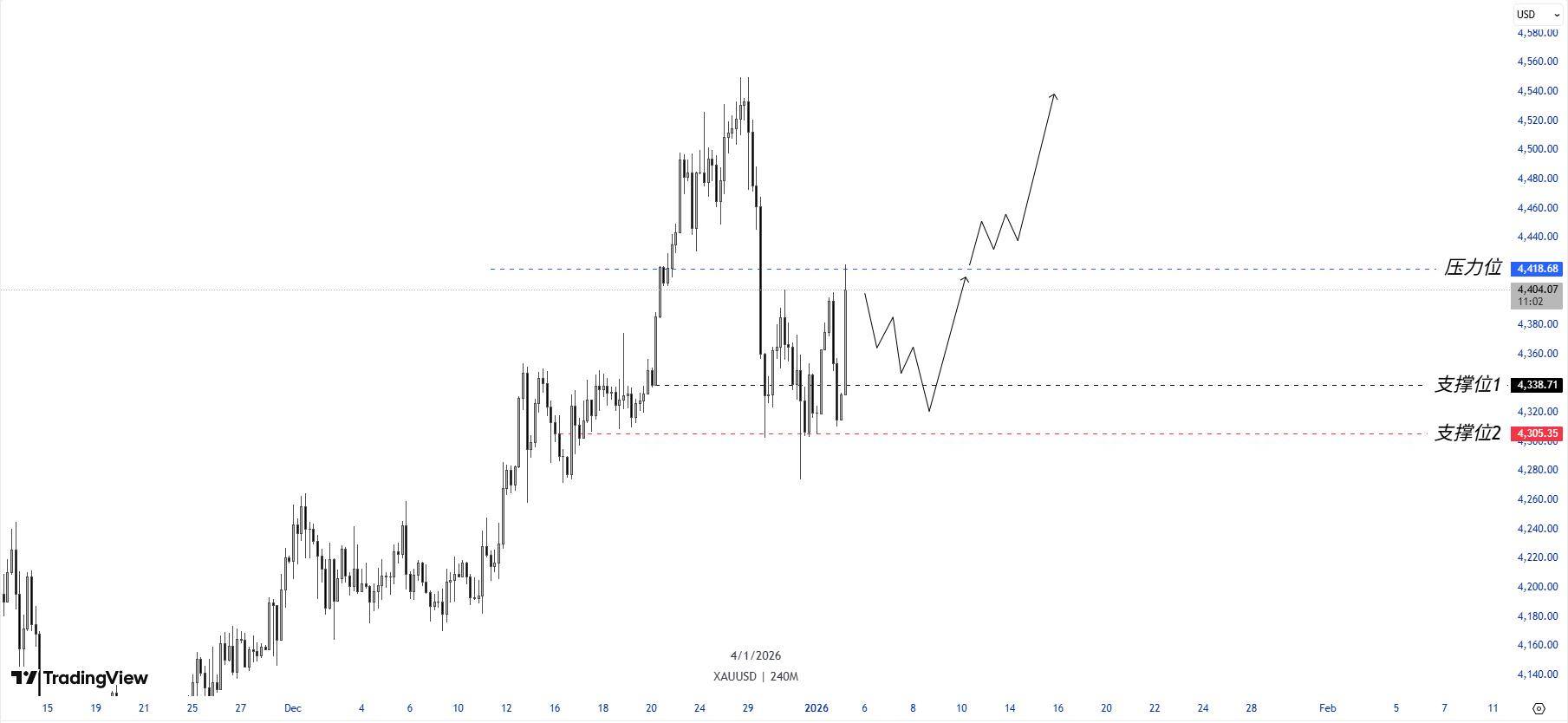
Core Viewpoint - The gold market has been significantly impacted by a sudden geopolitical event, specifically the U.S. military action against Venezuela, which has heightened risk aversion and reinforced gold's status as a preferred defensive asset globally [1]. Group 1: Geopolitical Impact - The U.S. military action against Venezuela has disrupted the market's perception of geopolitical risks, leading to a rapid increase in gold prices, which reached over $4,370, with a daily increase of nearly 1% [1]. - This event signifies a notable escalation in great power competition, prompting a reassessment of the uncertainty premium in the global political order [1]. - The ongoing geopolitical tensions, including the Russia-Ukraine conflict and the situation in the Middle East, suggest that the Venezuelan incident is part of a broader trend of prolonged geopolitical risks [1]. Group 2: Market Dynamics - The recent rise in gold prices occurred despite a strengthening U.S. dollar, indicating that funds are not entirely abandoning dollar-denominated assets during this risk-off phase [1]. - Gold prices are currently experiencing a consolidation phase around $4,330, with strong support at $4,300 and resistance at $4,418, reflecting a strong market structure rather than a trend reversal [3]. - The market is navigating two competing narratives: a short-term dollar strength driven by capital inflows and technical recovery, and a medium-term expectation of a shift towards looser monetary policy by the Federal Reserve [3]. Group 3: Future Outlook - Central bank gold purchases, de-dollarization trends, and reassessments of sovereign asset safety continue to support gold prices from both supply and structural perspectives [6]. - The market's acceptance of higher gold prices, with discussions around $5,000 and beyond, indicates a shift in the pricing center for gold [6]. - Upcoming U.S. economic data, such as the ISM manufacturing PMI, will provide new insights into dollar and interest rate expectations, while the aftermath of the Venezuelan incident may continue to influence market sentiment [6].
ATFX:不是简单避险这一次 黄金正在对全球秩序重新定价
Xin Lang Cai Jing· 2026-01-05 10:38
Core Viewpoint - The gold market has been significantly impacted by a sudden geopolitical event, specifically the U.S. military action against Venezuela, leading to a surge in gold prices and a renewed focus on gold as a defensive asset amid rising geopolitical risks [1][4]. Geopolitical Impact - The U.S. military action against Venezuela has disrupted the market's perception of manageable geopolitical risks, causing a spike in safe-haven demand for gold [1]. - This event is seen as a clear escalation in great power competition, prompting a reassessment of the uncertainty premium in global political order [1][4]. Market Dynamics - Gold prices opened strongly, reaching above $4,370 with a daily increase of nearly 1%, despite the U.S. dollar index also rebounding to a high, indicating that investors are not entirely abandoning dollar assets during this flight to safety [1][4]. - The ongoing geopolitical tensions, including the Russia-Ukraine conflict and Middle East instability, reinforce the expectation of prolonged geopolitical risks, positioning gold as a strategic hedge against systemic risks [1][4]. Technical Analysis - After a previous high, gold prices experienced a quick pullback, stabilizing around $4,330, with $4,300 providing effective support and $4,418 acting as a key resistance level [4][10]. - The market is currently navigating two opposing trends: a short-term strengthening of the dollar due to capital inflows and technical recovery, and a medium-term expectation of a shift towards looser monetary policy from the Federal Reserve [4][10]. Future Outlook - The market anticipates multiple rate cuts by the Federal Reserve in 2026, which is expected to provide solid support for gold prices in the medium term [4][10]. - Discussions around gold prices reaching $5,000 or higher reflect a shift in the market's pricing center for gold, indicating increased acceptance of higher price levels among both institutional and retail investors [7][12]. - Upcoming U.S. economic data, such as the ISM manufacturing PMI, will provide new insights into dollar and interest rate expectations, while the aftermath of the Venezuela incident may continue to influence market sentiment [12].
股指期货杠杆与现货组合的对冲应用:从 β 风险剥离到超额收益捕获
Sou Hu Cai Jing· 2025-08-02 17:05
Group 1 - The core formula for hedging with leverage is "Number of contracts needed for hedging = Spot market value ÷ (Futures contract value × β coefficient)" [1] - Systematic risk hedging example: Holding a 5 million yuan portfolio of CSI 300 stocks (β=1) requires selling approximately 4 futures contracts to hedge against a 10% index drop, needing only 480,000 yuan margin with 10x leverage [1] - In June 2025, a consumer portfolio increased its hedging position from 5 to 6 contracts, successfully offsetting excess losses during a 3% market decline [1] Group 2 - Basis arbitrage with leverage: When futures are over 1% (far-month contract price higher than spot), shorting futures while buying spot can amplify arbitrage profits using 5x leverage [2] - In July 2025, an institution used 1 million yuan margin to control 5 million yuan in contracts, achieving a profit of 60,000 yuan (6% return) after one month as the basis converged [2] - Risk management is crucial; if basis volatility increases (e.g., widening to 3%), leverage should be reduced to below 3x to avoid significant losses [2]

黄金历史新高,还有的炒吗?
Sou Hu Cai Jing· 2025-04-26 09:06
Core Viewpoint - The recent surge in gold prices has sparked significant interest in gold investment, with spot gold prices reaching over $3,440 per ounce and approaching $3,500 per ounce, marking a year-to-date increase of over 29% [2] Group 1: Gold Price Trends - On April 11, domestic gold jewelry prices surpassed 1,000 yuan per gram, with major brands like Chow Tai Fook and Luk Fook Jewelry reaching 1,082 yuan per gram by April 22 [2] - Historical data shows that gold prices have increased dramatically from $20 per ounce in 1850 to $3,500 per ounce in 2025, representing a 175-fold increase [8] - During Trump's first term, gold prices consistently rose, with notable increases from $1,150 to $2,075 per ounce, reflecting a shift from commodity-driven to currency-driven attributes [10] Group 2: Investment Channels - Various channels for purchasing gold include physical gold (bars and jewelry), account gold (paper gold through banks), gold ETFs and funds, and high-risk gold futures/options [4][5] - Buying gold jewelry is often not a profitable short-term investment due to high recovery costs and potential purity issues, with recovery rates typically at 85%-95% of market price [6] Group 3: Future Outlook - If "Trumpism" continues, characterized by tariff policies and fiscal expansion, the "crisis premium" of gold is expected to further increase [11] - The current market conditions suggest that investing in gold remains a viable option, despite inherent risks [12]