
纤维器件

Search documents
新型“纤维芯片”问世
Xin Lang Cai Jing· 2026-02-01 20:19
Core Viewpoint - Fudan University's team has developed a groundbreaking "fiber chip" that integrates large-scale circuits within elastic polymer fibers, offering comparable information processing capabilities to traditional commercial chips while providing unique advantages such as flexibility and adaptability to complex deformations [1][2]. Group 1: Technological Breakthrough - The team has introduced the concept of "fiber devices" and has created over 30 new types of fiber devices with functionalities including power generation, energy storage, lighting, display, and biosensing, with some achieving preliminary industrial applications [1]. - The design of the "fiber chip" utilizes a multi-layer stacking architecture, moving beyond the traditional approach of only utilizing the fiber surface, and has developed a method compatible with existing chip manufacturing processes [2]. Group 2: Performance and Capabilities - The "fiber chip" achieves an integration density of 100,000 electronic components per centimeter, enabling efficient interconnection of transistors for digital and analog circuit operations [2]. - The architecture and manufacturing method of the "fiber chip" are versatile, allowing for the integration of organic electrochemical transistors capable of performing neural computation tasks [2]. Group 3: Application Potential - In the field of brain-machine interfaces, the fiber system is expected to provide new tools for brain science and the diagnosis and treatment of neurological diseases [3]. - The "fiber chip" enables the creation of soft, breathable electronic fabric systems that do not require external processors, enhancing the development of flexible electronic textiles [3]. - In virtual reality, smart tactile gloves based on the "fiber chip" can significantly improve user interaction experiences in scenarios such as remote surgery and virtual object interaction [3].
“头发丝里实现大规模集成电路”
Di Yi Cai Jing Zi Xun· 2026-01-22 03:08
Core Insights - A Chinese research team has developed a groundbreaking technology called "fiber chip," which constructs high-density integrated circuits within a fiber thinner than a human hair, marking a significant advancement beyond traditional silicon-based chips [2][3]. Group 1: Technological Breakthrough - The "fiber chip" has comparable information processing capabilities to some commercial chips and offers unique advantages such as high flexibility, adaptability to complex shapes, and the potential for applications in brain-machine interfaces, electronic textiles, and virtual reality [2][4]. - The research team has previously introduced the concept of "fiber devices" and created over 30 types of fiber devices, with some technologies transferred to leading domestic companies, establishing production lines for light-emitting fibers and fiber lithium-ion batteries [2][3]. Group 2: Integration and Manufacturing - The team utilized a spiral multi-layer circuit design, significantly enhancing space utilization, allowing for the integration of approximately 10,000 transistors in a 1mm long fiber, which can reach the integration level of classic computer CPUs in a 1-meter long fiber [3][4]. - The manufacturing process is compatible with existing mature photolithography techniques, laying the groundwork for large-scale production, with surface roughness reduced to below 1 nanometer to meet commercial photolithography standards [3][4]. Group 3: Future Applications - The "fiber chip" is not intended to replace traditional silicon chips but to open new application pathways, with exceptional flexibility allowing it to withstand extreme conditions while maintaining performance [4]. - The design concept of "one fiber as a micro-electronic system" enables the integration of power supply, sensing, display, and signal processing functions within a single fiber, paving the way for innovative commercial applications such as smart clothing and advanced telemedicine tools [4][5].

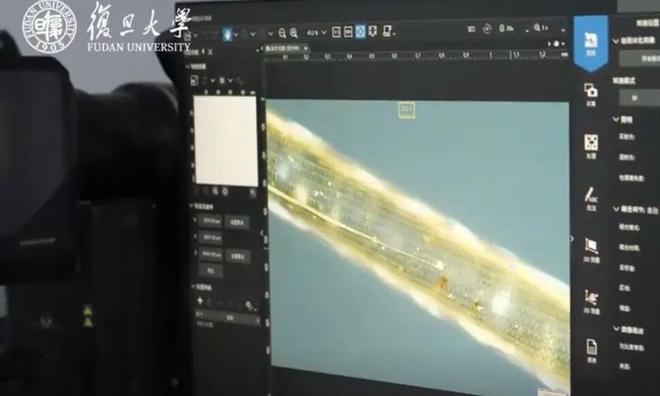
“头发丝里实现大规模集成电路”
第一财经· 2026-01-22 02:53
Core Viewpoint - A Chinese research team has developed a groundbreaking technology called "fiber chips," which integrates high-density circuits into fibers thinner than a human hair, potentially revolutionizing industries such as brain-machine interfaces, electronic textiles, and virtual reality [3]. Group 1: Research Breakthrough - The research was conducted by the Polymer Molecular Engineering National Key Laboratory and Fudan University's Fiber Electronic Materials and Devices Research Institute, achieving a significant milestone in chip technology [3]. - The "fiber chip" has comparable information processing capabilities to traditional commercial chips while offering unique advantages such as flexibility and adaptability to complex shapes [3][4]. Group 2: Technical Details - The team has created over 30 types of fiber devices and has published results in "Nature" seven times, with some technologies transferred to leading domestic companies [3]. - A 1mm long fiber can integrate approximately 10,000 transistors, and a 1m long fiber can reach integration levels comparable to classic computer CPUs, achieving a transistor density of 100,000 per centimeter [5]. Group 3: Manufacturing Compatibility - The fabrication process of the fiber chip is compatible with existing mature lithography techniques, laying the groundwork for large-scale manufacturing [5]. - The surface roughness of the fibers has been reduced to below 1 nanometer, meeting commercial lithography standards and challenging the notion that chips can only be made on silicon substrates [5]. Group 4: Future Applications - The design concept of "one fiber as a micro-electronic system" allows for the integration of power supply, sensing, display, and signal processing functions within a single fiber, enabling the creation of soft, breathable electronic textiles [6]. - Potential applications include smart clothing that can display dynamic pixels and intelligent tactile gloves for remote medical surgeries, enhancing human-machine interaction [6]. Group 5: Industry Impact - The development of fiber chips is expected to transform the rules for implantable medical devices by integrating circuits and signal transmission into fiber materials, significantly reducing their size [6].
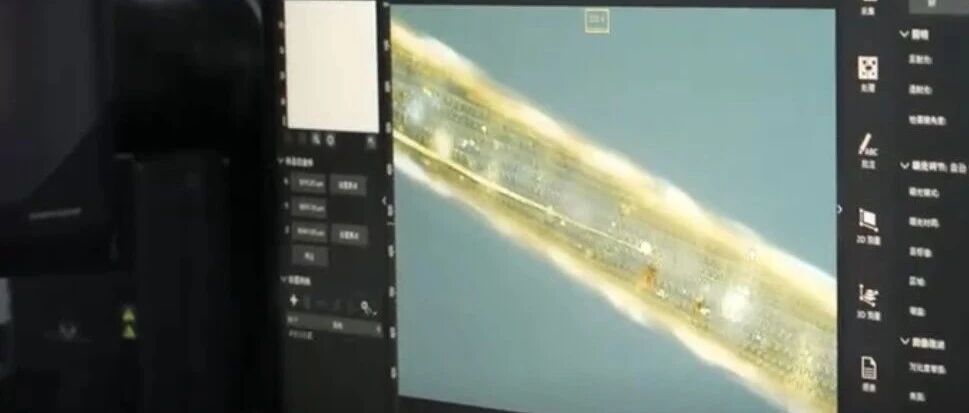
纤维芯片:把大规模集成电路装进“头发丝”
Xin Lang Cai Jing· 2026-01-22 00:44
Core Viewpoint - The research team led by Professor Peng Huisheng from Fudan University has developed a novel "fiber chip" that integrates large-scale circuits into elastic polymer fibers, offering unique advantages for emerging industries such as brain-machine interfaces, electronic textiles, and virtual reality [1][2]. Group 1: Research and Development - The fiber chip represents a significant breakthrough in the field of fiber devices, which has garnered international attention since the team first introduced the concept [2]. - The team has created over 30 types of new fiber devices with functionalities such as power generation, energy storage, and bio-sensing since 2008, with some technologies already in preliminary application [2]. - The integration of different functional fiber devices into a fiber electronic system is essential for large-scale application, similar to the evolution of smartphones and computers [2]. Group 2: Technical Achievements - The fiber chip's electronic components can achieve a density of 100,000 transistors per centimeter, enabling both digital and analog circuit operations [3]. - The fiber chip maintains performance stability even after extensive stress tests, including over a hundred washes and exposure to high temperatures [3]. - The design and fabrication methods of the fiber chip are compatible with existing photolithography processes, potentially easing future industrialization [7]. Group 3: Applications and Future Prospects - In the field of brain-machine interfaces, the fiber chip can integrate sensing, signal processing, and stimulation output functions into a single fiber, providing new tools for neuroscience and neurological disease treatment [7]. - The fiber chip enables the creation of fully flexible electronic textiles without the need for external processors, allowing for dynamic pixel displays within the fabric [7]. - The fiber chip can enhance virtual reality applications by providing flexible and breathable smart tactile gloves that accurately simulate different mechanical sensations [8]. - The research team aims to continue improving device integration density and information processing capabilities while establishing a proprietary intellectual property system for collaboration with industry [8].