
约定限售方式

Search documents
最低仅获配39股!摩尔线程网下初配结果出炉
Sou Hu Cai Jing· 2025-11-26 04:42
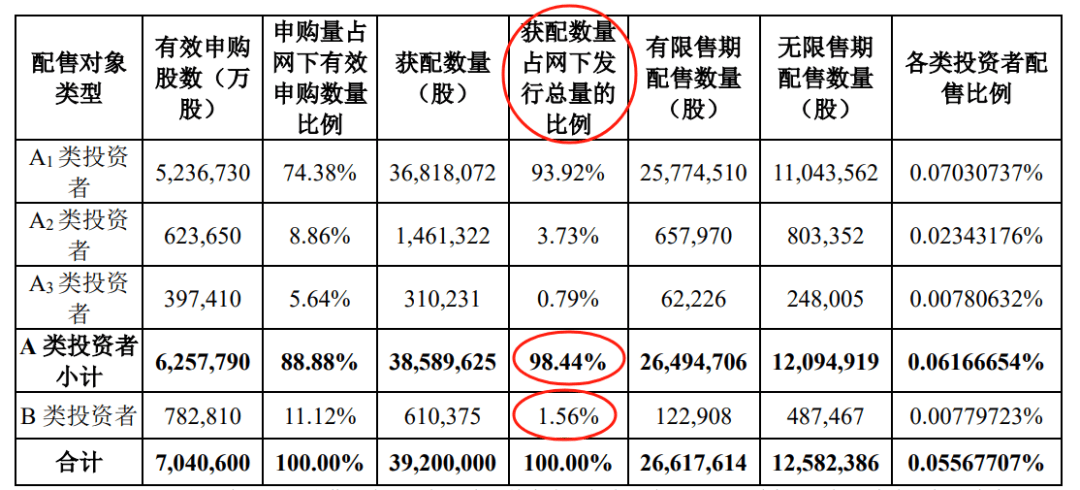
Core Viewpoint - The allocation results of offline subscription for Moer Thread indicate a significant shift in the distribution of shares, with A-class investors receiving 98.44% of the allocation and B-class investors only 1.56%, reflecting changes in the issuance and underwriting system for the Sci-Tech Innovation Board [1][3][9] Group 1: Allocation Results - A-class investors, which include public funds, social security funds, pension funds, and qualified foreign investors, received 98.44% of the shares allocated, while B-class investors received only 1.56% [1][3] - The specific allocation numbers show that some B-class investors received as few as 39 shares, highlighting the disparity in allocation [1] - Previous new stocks on the Sci-Tech Innovation Board also exhibited similar trends, with B-class investors typically receiving less than 5% of the allocation [4][5] Group 2: Subscription Rules - The reduction in B-class investor allocation is attributed to adjustments in the offline subscription rules, which now implement a new subscription method called "agreed lock-up" [7] - Under the agreed lock-up method, different lock-up periods and ratios are set for various investor classes, with A-class investors having the option to choose higher lock-up tiers [7][8] - For instance, the lock-up tiers for Moer Thread were set at three levels, with the first tier requiring a 9-month lock-up and a 70% lock-up ratio, while B-class investors could only subscribe at the lowest tier [7] Group 3: Impact on Investment Returns - The disparity in allocation ratios has led to a significant decrease in the share of B-class investors, which may affect their potential returns from new stock subscriptions [9] - Research indicates that the average return contribution from new stocks for A-class investors is significantly higher than for B-class investors, with A1-class investors potentially seeing returns of 0.116% compared to 0.014% for B-class investors [12] - The adjustments in the subscription rules aim to favor long-term investors, thereby increasing the allocation for those with a commitment to holding shares [11]

最低仅获配39股!摩尔线程打新出炉 B类投资者几乎被“忽视”
Zheng Quan Shi Bao Wang· 2025-11-25 23:59
Core Viewpoint - The offline subscription for new shares in the Sci-Tech Innovation Board is experiencing a significant shift, with A-class investors receiving a dominant share of allocations compared to B-class investors due to new subscription rules [1][5][6]. Group 1: Allocation Results - A-class investors received 98.44% of the allocation, while B-class investors only received 1.56% in the recent subscription by Moer Thread [2][3]. - The allocation for B-class investors was notably low, with some receiving as few as 39 shares [1]. - Previous new shares in the Sci-Tech Innovation Board also showed a similar trend, with B-class allocations generally below 5% [3][4]. Group 2: Subscription Rules - The new subscription rules implemented for the Sci-Tech Innovation Board involve a "contractual lock-up" method, which sets different lock-up periods and ratios for A-class and B-class investors [5][6]. - A-class investors can choose from multiple lock-up tiers, while B-class investors are restricted to the lowest tier [5]. - The allocation ratios are designed to favor A-class investors significantly, with A1-class investors' allocation being at least nine times that of B-class investors [6]. Group 3: Impact on Investment Returns - The new rules are expected to impact the potential returns for B-class investors, as the disparity in allocation ratios may reduce their profitability from new share subscriptions [6][7]. - Research indicates that under the new allocation method, A1-class investors could see a return contribution of approximately 0.116% per new share, while B-class investors might only see a return contribution of 0.014% [8].
最低仅获配39股!摩尔线程打新出炉,B类投资者几乎被“忽视”
券商中国· 2025-11-25 23:22
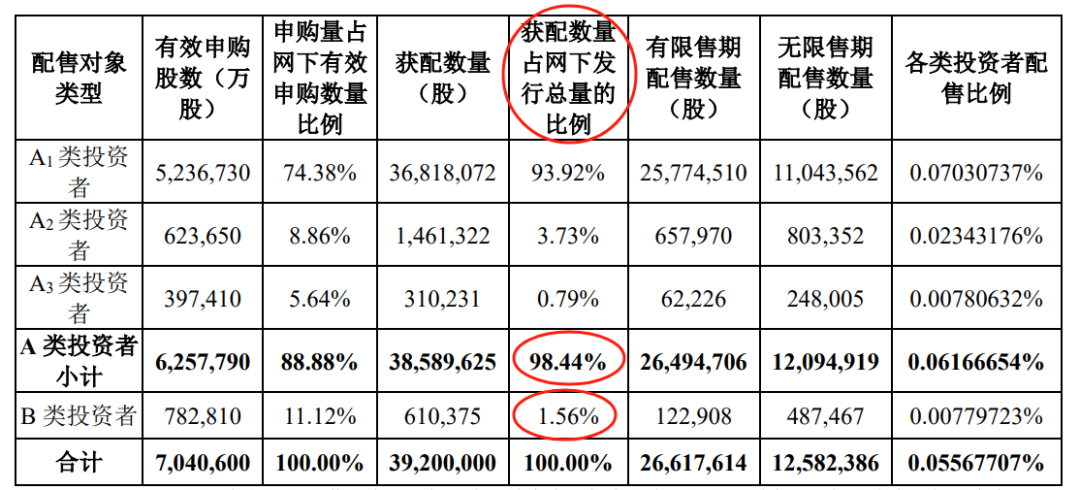
Core Viewpoint - The offline subscription for new shares in the Sci-Tech Innovation Board is experiencing a significant shift, with A-class investors receiving a dominant allocation compared to B-class investors due to new subscription rules [1][5][9]. Group 1: Allocation Results - A-class investors received 98.44% of the allocation, while B-class investors only received 1.56% in the recent subscription by Moer Thread [2][3]. - The allocation for A-class investors in other recent Sci-Tech Innovation Board subscriptions also showed a similar trend, with A-class allocations ranging from 94.66% to 97.48% [3][4]. Group 2: Subscription Rules - The reduction in B-class investor allocations is attributed to the adjustment of offline subscription rules, which now implement a "contractual lock-up" method [5][6]. - The new rules allow A-class investors to choose from different lock-up periods and ratios, significantly favoring them over B-class investors [6][9]. Group 3: Impact on Investors - The disparity in allocation ratios has raised concerns about the potential impact on the returns for B-class investors, such as private equity firms [8]. - Research indicates that under the new subscription rules, the average return contribution for A-class investors is significantly higher than that for B-class investors, with A1 class potentially contributing 0.116% compared to B-class's 0.014% [9].

首例出炉!A股打新巨变:获配比例差距扩大至10倍
券商中国· 2025-10-17 03:53
Core Viewpoint - The introduction of a new subscription mechanism for IPOs in the Sci-Tech Innovation Board has significantly changed the allocation of new shares, with A-class investors receiving approximately ten times the allocation of B-class investors, indicating a shift towards a risk-matching mechanism in the subscription process [1][2][5]. Summary by Sections New Share Allocation Discrepancy - The allocation ratio for A1-class investors is 0.081%, while B-class investors receive only 0.0089%, marking a tenfold difference [2][3]. - This disparity was not observed in previous IPOs on the Sci-Tech Innovation Board, where A and B-class investors had similar allocation ratios [2][4]. Changes in Subscription Rules - The new subscription rules allow A-class investors to choose from different lock-up periods and ratios, while B-class investors are limited to the lowest tier [5][7]. - The lock-up periods for the tiers are set at 9 months with a 70% lock-up ratio, 6 months with a 45% ratio, and 6 months with a 10% ratio [5]. Policy Background - The changes are part of a broader initiative by the China Securities Regulatory Commission (CSRC) to enhance the issuance and underwriting system, particularly for unprofitable companies [7]. - The CSRC's "Eight Measures for the Sci-Tech Innovation Board" aims to increase the allocation for investors willing to hold shares longer, thereby promoting stability in the market [7].
